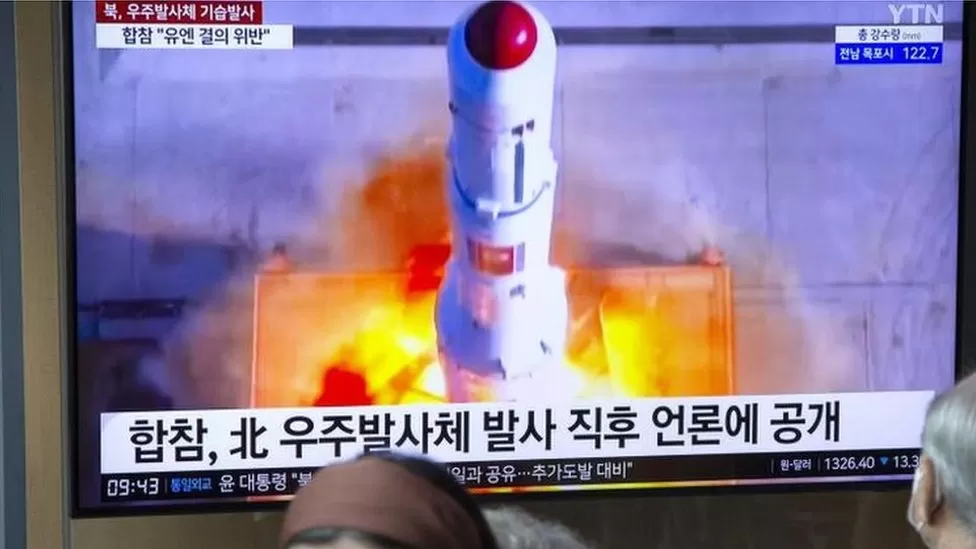
North Korea launches Spy satellite. In a move that has stirred regional tensions, North Korea announced the successful launch of what it claims to be a spy satellite. However, neighboring countries, notably Japan, have expressed skepticism, characterizing the launch as a “suspected ballistic missile.”
The launch took place ahead of the expected schedule, catching Japan off guard. Residents on the southern Japanese island of Okinawa were temporarily advised to seek cover, but the situation de-escalated as the missile reportedly plunged into the Pacific Ocean.
Pyongyang had formally notified Japan of a nine-day window for potential launch, which began on Wednesday and was slated to conclude on November 30 at 23:59 local time (14:59 GMT).
The Japanese Prime Minister’s office promptly labeled it a violation of UN resolutions and pledged to collaborate with South Korea and the United States to dissuade North Korea from pursuing further launches.
Japan Coast Guard received notification from North Korea designating three maritime zones where debris from the satellite-carrying rocket might fall.
These zones include areas to the west of the Korean Peninsula and to the east of the Philippines’ Luzon Island.
South Korea’s response was measured but firm. Kang Ho-pil, Chief Director of Operations at the South Korean Joint Chiefs of Staff, cautioned that Seoul would take “necessary measures” should North Korea proceed with its launch.
The United Nations Security Council has consistently opposed North Korea’s satellite launches, viewing them as a pretext for testing the country’s missile technology.
The latest move would mark North Korea’s third attempt to launch a spy satellite this year, despite international objections.
The strategic significance of spy satellites for North Korean leader Kim Jong Un is evident, as they enable monitoring of potential threats and enhance strategic planning capabilities.
However, the international community remains wary of these advancements due to concerns over North Korea’s missile technology.
Previous attempts by North Korea to launch satellites were met with skepticism, with South Korea retrieving debris and asserting that the satellites had “no military utility.”
Russia had previously hinted at assisting North Korea in satellite development, but the specifics of the arrangement remained unclear.
Adding to the dynamics, South Korea recently announced plans to launch its own spy satellite by the end of November, using a rocket provided by the U.S. company SpaceX.
Seoul aims to deploy a total of five spy satellites by 2025, further intensifying the strategic landscape in the region.
As North Korea launches Spy satellite, the situation underscores the delicate balance in Northeast Asia, with nations closely monitoring and responding to developments that could impact regional security and stability.
