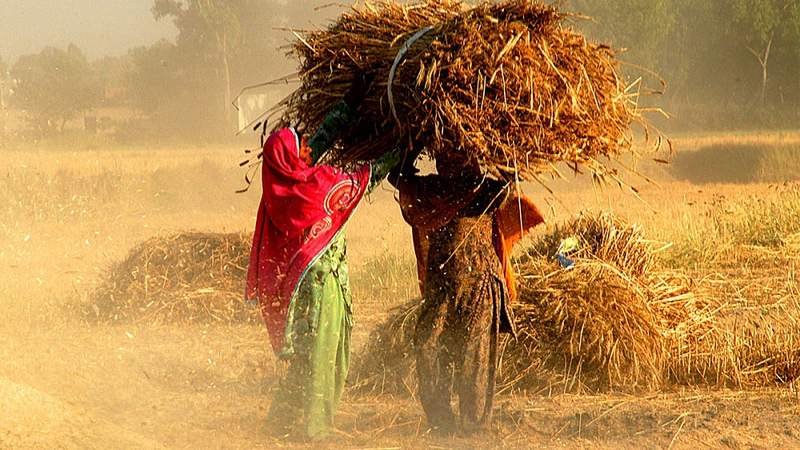
The stature of Pakistan as an agricultural economy has been grossly imperiled, so much so, that the government has to import huge amount of edible items annually to meet the domestic needs – $8bn alone in the financial year 2020-2021. The key drivers behind rising acute food insecurity in 2022 as far as global food supply chain is concerned are: conflicts and wars, pernicious climate change patterns and after-effects of the economic shocks foisted by Covid-19. But, the issues of Pakistan’s food supply side are more nuanced than that of the global level.
It is understandable that Russia-Ukraine conflict has jeopardized the global food security to an extent that many countries in the Global-South, including Pakistan, are facing the extreme brunt of it – without actually being a party to the conflict. To put it into perspective, Russia and Ukraine produce 30% of the global wheat, which means that world’s dependency on these two warring countries in terms of food items is significant. In case of this conflict being prolonged, the prospect of global food security – especially in the developing countries – is very bleak, which could account for increased levels of famine and hunger in the Asian and African countries – two regions having the highest number of undernourished people currently estimated to be around 657 million.
As the incumbent Foreign Minister of Pakistan, Bilawal Bhutto, took a seat in the ministerial meeting on ‘Global Food Security Call to Action’ organized by the United Nations in May, 2022 – which included not only the countries most affected by the food shortages but also the ones possessing the power and authority to bolster the global food security – it pretty much summed up the current precarious state of Pakistan’s food insecurity. In his address, Pakistan’s Foreign Minister stressed that global food supply restrictions should be neutralized, export bans on essential food items be lifted and hard-headed measures should be taken in order to counter hoarding and panic buying of food items in the international market.
In Pakistan, the looming shadow of food crisis not only brings the possibility of food insecurity of its people but also the prospect of increased levels of unemployment in the country, as a major portion of the local population is associated with the food industry for its living – around 65-70% as per the Pakistan’s Economic Survey 2020-2021. It is important to take into account the historical, administrative, political, social and environmental factors that contributed to the dire state of affairs as far as the food security in Pakistan is concerned.
The colonial agrarian settlements (set up by the British) became the ground on which the national food system of Pakistan was built. As the feudalism – inherited from the patronage system promoted by the British in the sub-continent – strengthened in the country in Ayub’s era, a never-ending cycle of exploitation of the peasants in particular and the masses in general, took its guard. Consequently, the monopoly of the feudal lords became one of the most important mechanisms of controlling the food and agricultural prices in the market. The Wheat Floor Crisis of 2019-2020 was a perfect manifestation of how the monopoly of market players – to seek personalized benefits – can wreak havoc on the common public. The worst part is, now, the government has to procure grain from the international market as to neutralize the hoarding mafia and market monopolies. The seriousness of Pakistan’s major stakeholders with respect to mainstreaming the issue of food security could be determined from the fact that country’s first-ever National Food Security Policy was introduced in 2018, however, the tenuous state of hunger and malnutrition was inherited by Pakistan at the time of independence and the grave intensity of it remained intact up until the formulation of the food policy.
Inter-provincial disputes vis-à-vis water distribution is another substantial factor that has all but worsened the food security of the people of Pakistan. For watering the crops, each province requires a considerable amount of water. Punjab being an upper-riparian region, is usually been accused by lower-riparian provinces of stealing their apportioned water despite of the existent Water Accord of 1991 among the provinces – which aimed to resolve the issue of water distribution.
As per the World Bank’s Report on Population 2020, Pakistan’s population is growing at the rate of 2% annually – second highest in the region after Afghanistan. When there are so many mouths and so little food available, it becomes a daunting task for the government to ensure food security of its people. To make things unpropitious, Pakistan’s average growth rate of small and large crops stands at 1.5% annually, which does not counterpoise the average annual population growth rate of the country, hence the food insecurity.
Climate change, by far, is the most hideous factor responsible for the vulnerability of Pakistan as to its food security. For the third successive year, Pakistan is being ranked top ten in the list of countries most affected by climate change and its devastating impacts. Ensuingly, agricultural productivity of the main crops i.e. wheat and rice has been on the decline to an alarming level – 14.7% and 20.5% respectively alone in the 2019-2020 season.
The vast impacts of the food crisis in Pakistan could as well become something far beyond the administering capacity of the government, if stern preventive measures are not taken at the earliest. Starting off, it is imperative that Pakistan adopts the likes of innovative agricultural techniques to increase its agricultural productivity. Drip irrigation – though a little expensive – could prove to be revolutionary in the long run, in terms of saving huge quantities of water as opposed to the flood irrigation. It works on the principle of supplying small quantities of water to the plants through pipes which, in turn, saves water and reduce dependence on traditional man-power.
Vertical farming is another agricultural practice that is being tested and used in many technological hubs of the world. In Singapore, where horizontal land is not as abundantly available as in Pakistan, vertical farming is making sure that technology – and not the land –remains the major factor in contributing to their agricultural production. In this technique, crops are grown in vertically stacked layers and incorporates controlled-environment which, resultantly, optimizes plant growth.
In addition to vertical farming, Precision Agriculture is also making its way as a scientific approach to farm management which ensures that crops receive exactly the amount of water and nutrients as required for its optimum health and productivity. The real time data about the condition of various crops is accessed and consequently, farmers are provided with detailed predictive analytics highlighting the indispensable steps needed to be taken with respect to certain crops.
Many would deem such solutions ideal for a country like Pakistan and would go on to propose measures such as controlling the population, increasing plantation drives, countering market monopolies, subsidizing agricultural-based businesses and implementing National Food Security of Pakistan in its true letter and spirit. While the aforementioned course of actions are crucial to initiate Pakistan’s response to the looming food crisis, the stated innovative solutions would make sure that Pakistan utilizes its vast agricultural market to the best of its advantage. Many startups are now operational in Pakistan which are providing their services and expertise to amplify the agricultural productivity of the farmlands. Hence, it is imperative for the government not only to facilitate these newly-operational startups, but also to increase the annual allocated budget for agricultural research – currently, only 0.11% to 0.63% of the agricultural GDP is allocated for it. A coordinated effort is required, on part of the state institutions, to pre-emptively strike the possibility of food crisis in the country, which by all means could become a gruesome reality anytime soon.

One thought on “Looming shadow of food crisis on Pakistan: Causes and solutions”
Keep it up👍