According to health standards, the average daily adult body oil requirement is 5-6 teaspoons. The normal yearly edible oil intake lies between 7-8 kg per person annually. According to the “Journal of Pakistan medical association” research, the per capita intake of edible oil in Pakistan is standing at a staggering 22 kg per year. Compared to Europe, the number lies at only 3 kg per year.
This massive consumption brings overwhelming health issues abundant in the population and burdens the economy. According to reports, Pakistan’s import bill of edible oil has swollen up to 30 pc in the fiscal year 2021-2022 compared to the last year. The most significant factor is the rise in local consumption, standing at 4.5 million tonnes. The import requirement to fulfill the demand and supply gap has surged up to 3.7 million tonnes this year. The country’s edible oil production is 20 percent of the demand making a dependency of 80 percent on the imports.
The major oilseed crops grown in Pakistan can be categorized into traditional, i.e., rapeseed-mustard, linseed, sesame, and groundnut. The non-traditional oilseed crops are sunflower, safflower, and soybean. With changing climatic conditions, and another dilemma for the country’s agriculture, these crops show good adaptability to extreme environmental conditions.
Major dependency on local edible oil production relies on Brassica having rapeseed-mustard in its family. The presence of high erucic acid and glucosinolate contents in mustard has been a health challenge, discouraging its use as an edible oilseed crop for oil extraction. Breeding to lower the chemical composition of these chemicals helped scientists make them fit for edible purposes. The reason for Canola being in demand is its composition having lower erucic acid contents, making it feasible for edible purposes.
Another important oilseed crop, linseed, is considered optimal because it contains unsaturated fatty acids, mainly linolenic acid, which is considered beneficial for reducing the risk of cardiovascular diseases. However, high linolenic acid contents in linseed are prone to autoxidation, making it unfit for human consumption and a doomed oilseed crop. Breeding linseed for reduced high linolenic contents is challenging for plant breeders to make it a healthy oilseed crop, considering its significance among the farmer community.
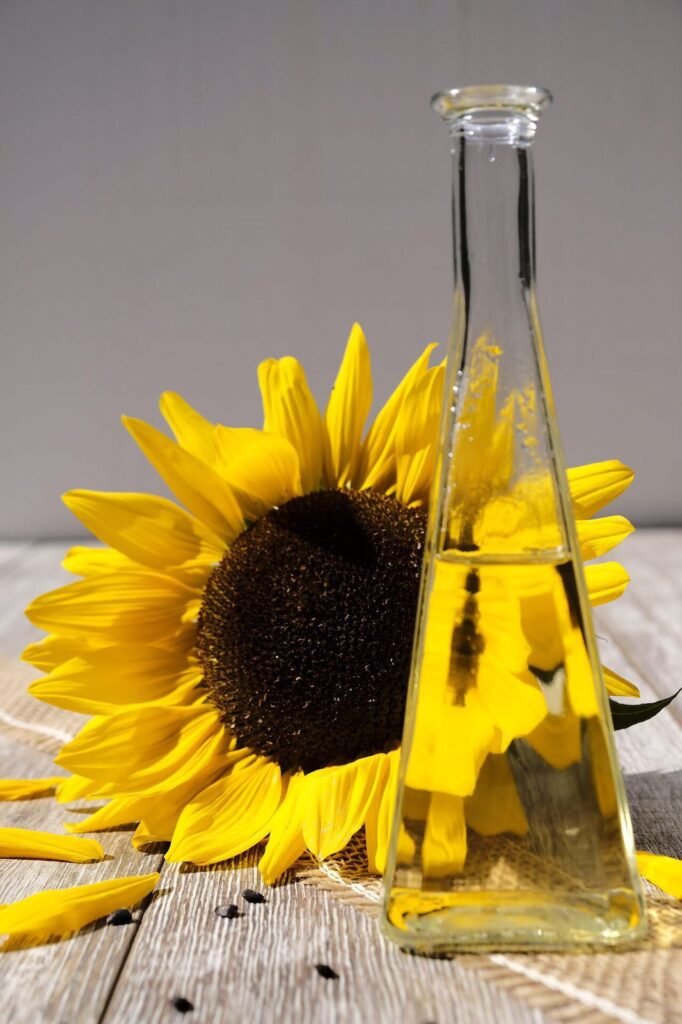
In the case of sunflower, a non-traditional crop for Pakistan, high saturated fatty acids are the determinants of increasing cholesterol levels that do not make it a suitable edible oil for aged groups. Breeding for this demerit pertaining to Pakistan’s dependency on sunflower, i.e., 18 percent in the local production, makes it a crucial cause that needs to be considered.
Shedding light on health concerns, the Vegetable oil that is present at your disposal is not that pure. Unlike virgin oil, which contains no chemical in the oil extraction process and is costly, almost the whole population could not afford it. The other vegetable oils that are common in the market are extracted with the help of chemicals, thus making them unhealthy. The industrial process involves using chemicals, notably ‘hexane,’ to squeeze the oil from oilseeds in the maximum quantity. Things do not end here; the process further involves removing solid wax that might cause oil oxidation; the next steps involve cooling and bleaching with more chemicals to remove further impurities; the last step involves chemical deodorization. In short, the intake of so many chemicals is not compatible with human health.
The obsession of Pakistanis with street foods and local restaurants aggravates the situation. No check and balance on oil quality usage by local street vendors are problematic. Rancidity and oxidation of oil being used again and again for deep frying and cooking purposes contain the formation of harmful compounds like peroxides and aldehydes that causes cell damage leading to atherosclerosis. Free radical formation can damage DNA, a significant cause of cancer. Vegetable oil contains polyunsaturated fats, which when subjected to heat, get oxidized proving detrimental for heart patients, causing the clogging of arteries and leading to heart issues.
A breakthrough in the production of Olives by increasing the area under cultivation would help make Pakistan achieve self-reliance. An estimated yield by 2024 will reach 3 million fruit-bearing plants producing 1,400 tonnes of oil with an estimated value of Rs4.5 billion. The olive forestation also proves beneficial for the environment as it absorbs carbon dioxide. Similar projects with other major oilseed crops are needed to bolster the local industry.
Agricultural research institutions under the umbrella of NARC Islamabad should prioritize research and development to breed high-yielding and better-quality edible oilseed crops. In this way, national production could be ramped up, relying less on imports. Also, prioritizing quality will positively impact health issues integrated and associated with excessive oil usage. Strong policy-making to aware the masses of the issues of excessive oil usage is indispensable. Also, state institutions must ensure a proper inspection of edible oil quality parameters in industries and extraction units. In this way, we can mitigate the impending health challenges, stepping toward a healthy Pakistan.

9 thoughts on “Abysmal status of edible oil: A looming crisis for health and economy”
Really a nice wording for awareness 👍
Nice piece of information
Good job buddy 😊
Thank you
It helped a lots.
A great piece of work..
Great
Still not a millionaire? Fix it now! https://collectif-hameb.fr/Shuch
Being a nutritionist, I endorse every single word uttered.