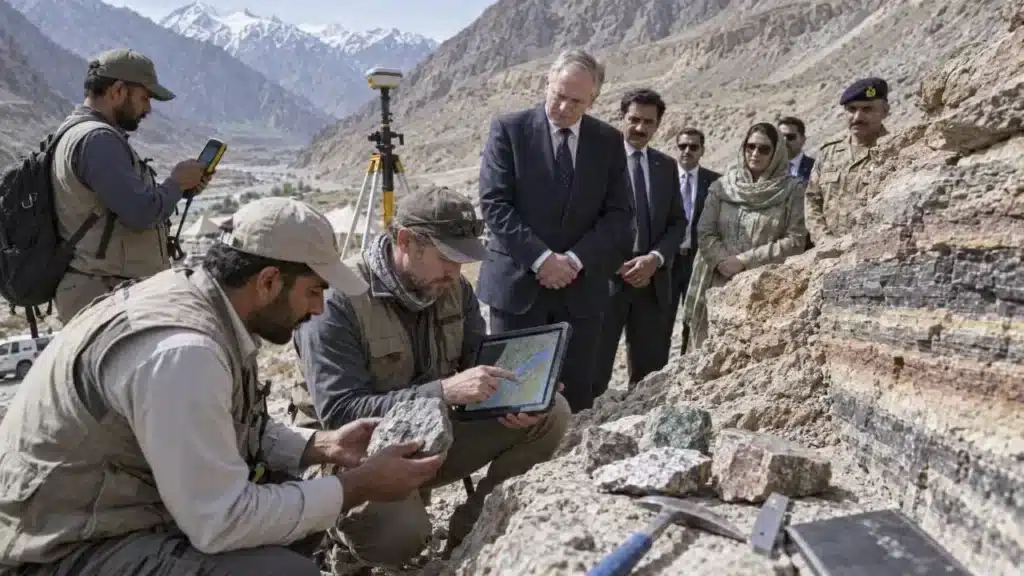
The United Kingdom is helping Pakistan strengthen its geological research and mineral exploration capabilities by training local experts in modern digital surveying techniques, as both countries seek to improve the quality of geological data and support responsible development of the mining sector.
The British Geological Survey (BGS) has provided practical training to staff of the Geological Survey of Pakistan (GSP), covering digital geological surveying, geochemical sampling, airborne geophysics, Geographic Information Systems (GIS) and spectral remote sensing.
The programme was funded through the UK’s Revenue Mobilisation, Investment and Trade (REMIT) programme and introduced Pakistani specialists to internationally recognised methods used in geological mapping, mineral exploration and data collection.
The training is intended to improve Pakistan’s ability to identify mineral resources, assess geological conditions and develop reliable information for future exploration and investment decisions.
The initiative is also linked to a draft cooperation agreement prepared by the BGS and GSP to establish a framework for collaboration in geological mapping, scientific research and data sharing.
British High Commissioner to Pakistan Jane Marriott highlighted the proposed partnership during the Pakistan Minerals Investment Forum in Islamabad, emphasising the importance of reliable geological information in attracting investment and developing the country’s mineral resources.
Pakistan has considerable deposits of minerals, including resources that could support industrial development, exports and international supply chains.
However, mining currently contributes less than 2% of the country’s gross domestic product, indicating the gap between its estimated mineral potential and the sector’s contribution to the economy.
Marriott said Pakistan needed credible geological data, stronger institutions and transparent supply chains to turn its mineral resources into sustainable employment, exports and investment opportunities.
The proposed cooperation is expected to cover several areas, including technical knowledge exchange, professional training, geological mapping, research and improved access to geological information.
Critical minerals and environmental sustainability are also included in the planned areas of collaboration.
Digital surveying and modern geological technologies could help Pakistani researchers build more accurate maps, identify potential mineral deposits and assess exploration opportunities with greater precision.
Better geological information can also help investors evaluate projects while reducing uncertainty during the early stages of mineral development.
The emphasis on environmental sustainability is particularly relevant as Pakistan seeks to attract investment in its mining industry.
Reliable geological assessments and responsible exploration practices are important for limiting environmental risks and ensuring that mineral development benefits local communities.
Although the draft agreement provides a basis for longer-term cooperation, its practical impact will depend on the finalisation of the arrangement, continued technical collaboration and the ability of Pakistani institutions to apply the training in future geological projects.
The partnership represents another step in efforts to strengthen Pakistan’s mineral exploration capabilities and improve the technical foundations needed to attract responsible investment into the country’s mining sector.
