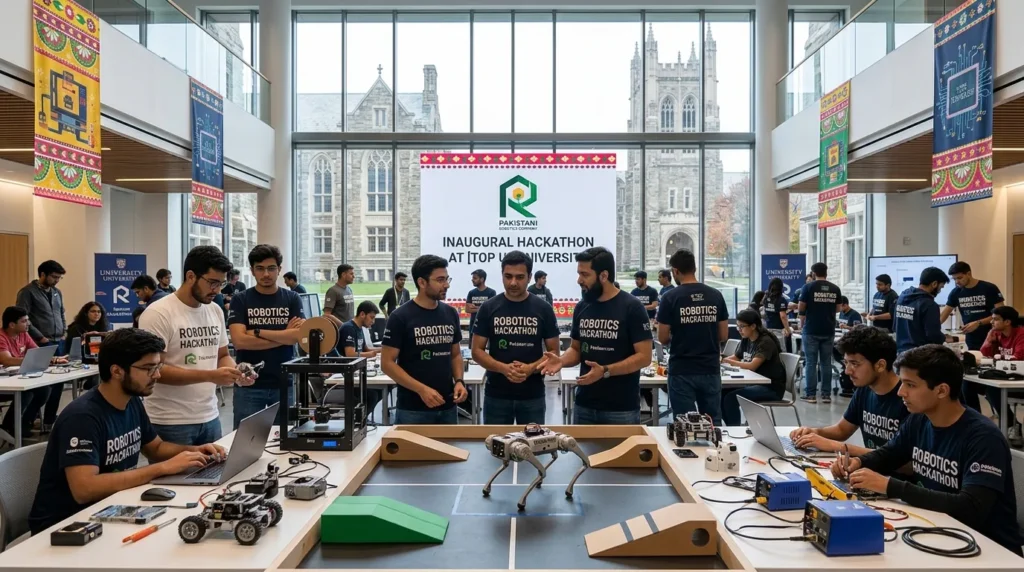
Pakistani robotics data company World Context has held its first robotics hackathon at the University of California, Berkeley, bringing together 13 teams to develop projects using real-world robotics datasets.
The event was organized in collaboration with Blockchain at Berkeley and sponsored by Google Gemini, ElevenLabs, The Hackathon Company, Lovable, Praxis Robotics and UC Berkeley Startup.
Teams Compete Across Three Robotics Tracks
Participants competed in hardware, software and visualization categories, using datasets supplied by World Context to develop their projects.
In the hardware category, Sortbot took the top position with a project aimed at developing robots that can identify and sort different types of objects.
The Reconstructors team won the software track with a project focused on recreating World Context data in the physical world.
The team also developed a simulation that secured first place in the visualization category.
A total of $4,500, equivalent to around Rs. 1.25 million, was distributed among the winners as cash prizes.

Hackathon Highlights Human Demonstration Data
The event focused on the use of human demonstration data in robotics, an approach that captures how people perform physical tasks in real-world environments.
Such datasets can help developers train robotic systems to replicate or learn similar tasks.
World Context collects human demonstration data from workers operating in real-world settings and provides the resulting datasets to robotics companies developing robotic systems.
World Context Eyes More University Partnerships
World Context Founder and CEO Sherdil Ali Khan said the quality of projects produced during the hackathon was among the event’s biggest surprises.
“The talent on display at Berkeley showed how advanced the industry is in the U.S., and that there are tremendous opportunities to learn from and partner with U.S. institutions and companies,” Khan said.
“We can bring these learnings back to Pakistan to improve the state of technology there as well.”
Khan said participants also used the company’s datasets in unexpected ways, highlighting different potential applications for human demonstration data in robotics.
The company plans to organize similar hackathons with universities in the future and explore partnerships with additional academic institutions.
