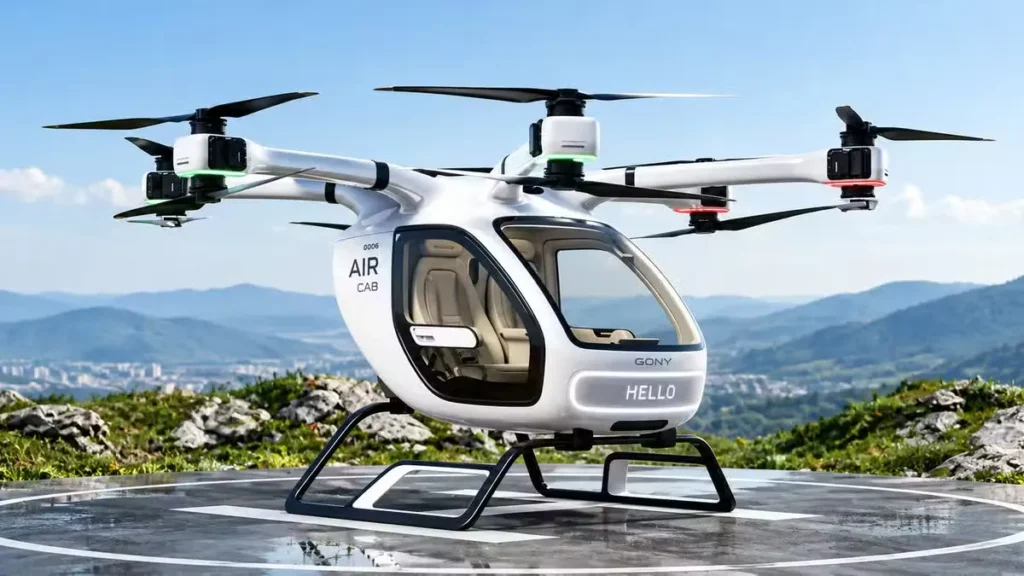
One of the standout technology displays at PAPS 2026 was the GOVY AirCab, a two-seat electric vertical take-off and landing (eVTOL) aircraft developed for short-distance urban travel.
PakWheels also spoke with a GOVY representative at the event about the company’s plans for the technology and its potential role in the wider low-altitude economy.
The term is increasingly used in China for activities such as short-range aviation, air taxis, tourism flights and emergency services operating below conventional airline routes.
GOVY was developed as the low-altitude mobility arm incubated by GAC Group, while GAC Pakistan brought the AirCab to PAPS as a technology showcase.
Designed for Short Urban Journeys
The AirCab is intended primarily for short trips within cities rather than long-distance flights.
According to GOVY, passengers can book a flight with a single click, while the aircraft is capable of autonomous operation. Its sensing system can detect objects from distances of more than 300 metres.
The aircraft also features redundant critical flight systems, designed so that a single-point failure does not bring the aircraft down.
| Specification | GOVY AirCab |
|---|---|
| Type | Two-seat autonomous eVTOL |
| Intended use | Urban short-distance travel, tourism |
| Official range | 20–30 km |
| Official flight speed | 120 km/h |
| Seating | 2 |
| Flight mode | Autonomous |
| Fast charging | 25 minutes |
| 50–100% charging | Around 15 minutes |
| Detection range | More than 300 metres |
The GOVY representative also highlighted the AirCab’s sensor-based safety technology, which assesses the landing area and surrounding environment before the aircraft touches down.
Potential Uses Beyond Tourism
The development of eVTOL aircraft in China is not limited to sightseeing. Companies are exploring their use for urban transportation, tourism, emergency response and medical services.
However, putting such aircraft into wider commercial operation will depend on aviation certification, safety requirements and local regulatory approval.
GOVY has already conducted demonstration flights and moved the AirCab into production-line development. Its airworthiness certification, however, remains in progress.
Battery Technology Remains Important
Battery technology remains one of the biggest considerations for electric aircraft because weight has a much greater impact on flight performance than it does on conventional electric vehicles.
GOVY management has identified solid-state batteries as a potential future technology for flying vehicles. Such batteries could offer higher energy density while potentially reducing weight compared with conventional lithium-ion systems.
Could AirCab Be Used in Pakistan?
The GOVY AirCab could have several potential applications in Pakistan if the necessary infrastructure and regulatory framework are developed.
Short aerial routes over congested cities such as Karachi and Lahore, tourism flights in the northern areas and emergency medical transport are among the possible uses.
But commercial deployment would require significant groundwork. Pakistan would need certified landing and take-off zones, charging infrastructure, low-altitude traffic rules, maintenance standards and a clear approval system for autonomous aircraft.
For now, the GOVY AirCab at PAPS 2026 is best viewed as a glimpse into the future of urban mobility rather than an indication that autonomous air taxis are about to begin commercial operations in Pakistan.
