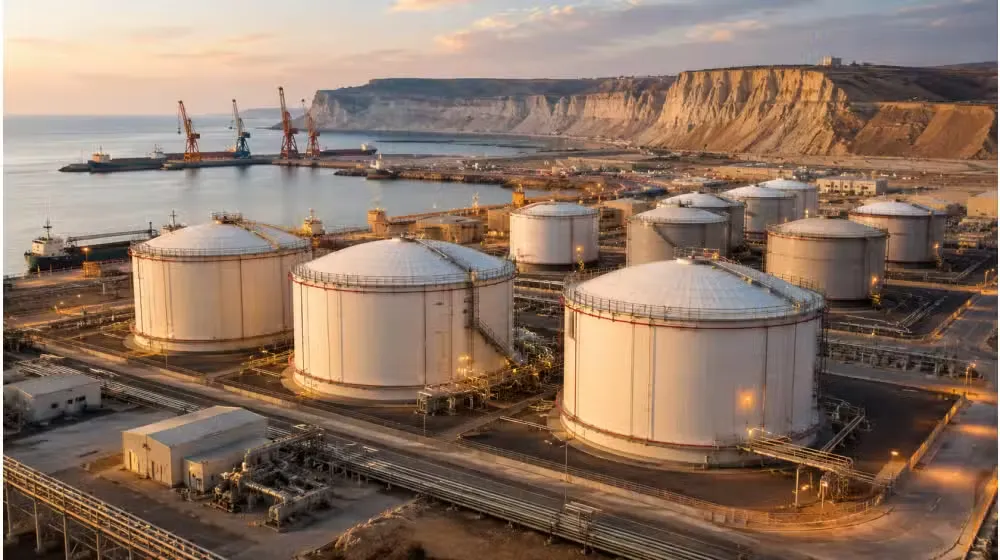
Pakistan is planning an integrated oil city at Hub in Balochistan featuring an offshore Single Point Mooring (SPM), dedicated crude oil and petroleum product pipelines, and large bonded storage facilities as the country seeks to strengthen its petroleum import and logistics infrastructure.
The proposed Hub oil city is intended to increase Pakistan’s capacity to handle large crude oil tankers and petroleum product vessels while reducing pressure on Karachi and Port Qasim, where existing port limitations can restrict the berthing of very large ships.
Feasibility Study Underway
The government has engaged consultancy firm Technique to conduct a basic feasibility study for the proposed oil city.
The study will assess the project’s technical and commercial viability and is expected to be completed within two months. The government will then decide whether to proceed with the next stage of development.
The proposed oil city would be established on government-owned land at Hub that had previously been allocated to Pakistan’s national oil company Parco for a coastal refinery project.
Parco presented the oil city proposal to the petroleum minister during a recent visit to Karachi. Following the presentation, the minister directed the company to undertake the initial feasibility work and further develop the proposal.
Offshore SPM to Handle Large Oil Tankers
A key component of the proposed Hub oil city is an offshore Single Point Mooring facility in deep water.
The SPM would allow large crude oil tankers and vessels carrying finished petroleum products to unload cargo offshore without having to enter shallow-water port facilities.
The offshore facility is planned to connect with the mainland through two dedicated pipelines.
One pipeline would transport imported crude oil to the Karachi Port Trust’s (KPT) Kemari facilities, while the second would transport finished petroleum products to Port Qasim and connect with the existing White Oil Pipeline network.
The proposed infrastructure could provide an alternative route for petroleum imports and help improve the efficiency of Pakistan’s oil supply chain.
Bonded Storage to Support Oil Trading
The Hub oil city is also expected to benefit from the government’s renewed customs bonded storage policy.
Under the proposed system, petroleum companies and international traders would be able to store imported petroleum products in bonded facilities without immediately paying applicable duties and taxes, subject to regulatory requirements.
Bonded petroleum storage is also being considered at several other strategic locations, including Port Qasim, Kemari, Gwadar, Kot Addu, Machike and Faisalabad.
Gulf-based companies have reportedly expressed strong interest in developing petroleum storage facilities at several of these locations.
The expansion of bonded storage could give traders greater flexibility in managing imported petroleum products while supporting Pakistan’s broader efforts to develop its energy logistics infrastructure.
Pakistan Also Studies Strategic Petroleum Reserves
Separately, Pakistan is developing a framework for Strategic Petroleum Reserves to strengthen national energy security and reduce the impact of disruptions in international oil supplies.
Consultancy firm Wood Mackenzie has been tasked with conducting a comprehensive study covering the technical, financial, commercial, legal and institutional requirements for establishing strategic petroleum storage facilities.
The study will examine international and regional strategic reserve models, potential public-private partnership structures and the possible use of existing pipelines, transportation networks and petroleum import infrastructure.
It will also assess short-, medium- and long-term options for increasing Pakistan’s strategic petroleum storage capacity, including potential locations and implementation models.
If approved, the Hub oil city, expanded bonded storage network and strategic petroleum reserves could form part of a broader effort to modernise Pakistan’s petroleum infrastructure and improve the resilience of its oil import and distribution system.
