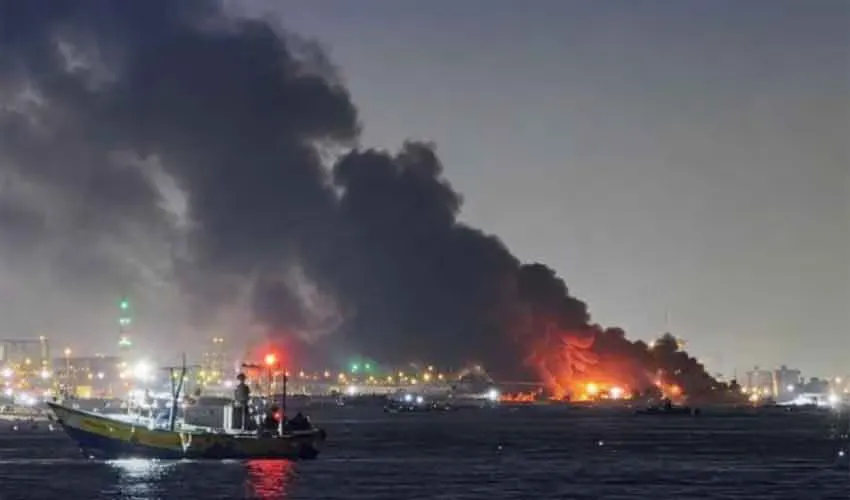
Iran said it launched missile and drone attacks against United States military facilities in Bahrain and Kuwait on Wednesday, claiming the operation was retaliation for fresh US strikes on Iranian military targets near the Strait of Hormuz.
The latest exchange has significantly heightened tensions in the Gulf and placed the already fragile ceasefire framework under renewed pressure, with both Tehran and Washington accusing each other of violating previous commitments.
Iran Says US Crossed a Red Line
Iran’s Khatam al-Anbiya Central Headquarters described the US military operation as a “blatant act of aggression” and warned that Iran would deliver what it called a “crushing response.”
Iranian military officials also reiterated that Tehran considers any foreign interference in the Strait of Hormuz unacceptable, adding that shipping routes through the strategic waterway should operate under conditions determined by Iran.
IRGC Claims Attack on US Military Installations
The Islamic Revolutionary Guard Corps (IRGC) said its naval and aerospace forces carried out a coordinated missile and drone operation targeting US military facilities across Bahrain and Kuwait.
According to Iranian officials, approximately 85 locations were targeted, including:
- US Fifth Fleet headquarters in Bahrain
- Bahrain’s Fifth Naval District
- Bandar Salman
- Ali Al Salem Air Base in Kuwait
- Sheikh Isa Air Base in Bahrain
Iran claimed the attacks were a direct response to what it described as Washington’s breach of the ceasefire agreement.
No independent verification of the claimed targets was immediately available.
Iran Says It Shot Down a US MQ-9 Drone
Iranian media also reported that an American MQ-9 Reaper drone was shot down over southern Iran during the military operation.
Officials claimed the aircraft was intercepted near Bushehr after allegedly attempting to interfere with Iranian operations.
The US military had not publicly confirmed the claim at the time of reporting.
Bahrain and Kuwait Activate Air Defences
Authorities in Bahrain confirmed that air raid sirens sounded across the country and urged residents to move to designated safe locations.
Officials later reported a second round of sirens as air defence systems responded to incoming missiles and drones.
In Kuwait, the state news agency confirmed nationwide sirens, while military authorities said defensive systems were intercepting hostile aerial threats.
Neither Bahrain nor Kuwait reported confirmed casualties or significant damage.
US Says Earlier Strikes Targeted Iranian Military Infrastructure
Earlier on Wednesday, US Central Command announced strikes on Iranian military facilities after accusing Tehran of attacking commercial vessels operating near the Strait of Hormuz.
According to CENTCOM, the operation targeted infrastructure linked to maritime attacks, including:
- Air defence systems
- Coastal radar installations
- Command and control centres
- Surface-to-air missile batteries
- Anti-ship cruise missile sites
- Drone launch facilities
- Missile storage and launch positions
- More than 60 IRGC fast attack boats
US officials said the strikes were intended to protect commercial shipping and freedom of navigation through one of the world’s busiest energy corridors.
Explosions Reported Across Southern Iran
Iranian media reported explosions in several southern locations following the US operation, including:
- Bandar Abbas
- Qeshm Island
- Kharg Island
- Sirik
State media said several civilians were injured after debris struck a commercial pier in Sirik, while no fatalities were immediately reported.
Kharg Island, which handles the majority of Iran’s crude oil exports, also reported explosions, although US officials did not specifically confirm strikes there.
Washington Tightens Pressure on Iran
Alongside the military operation, Washington revoked an oil export licence that had previously allowed Iran to continue limited crude sales.
Iran’s Foreign Ministry condemned both the military strikes and the licence cancellation, calling them violations of the existing diplomatic framework.
Officials warned that Tehran would take whatever measures it considered necessary to defend its national interests.
Dispute Over Commercial Shipping
The United States accused Iran of attacking commercial vessels transiting the Strait of Hormuz, including oil tankers operating near the Gulf.
Iran denied involvement.
Qatar separately alleged that an Iranian drone struck the LNG tanker Al Rekayyat, while maritime sources reported damage to the Saudi-flagged crude tanker Wedyan near Oman.
Iran rejected the accusations but maintained that commercial vessels should coordinate navigation through routes approved by Tehran.
Ceasefire Under Increasing Pressure
The latest military exchange further threatens the ceasefire established last month to create space for negotiations following weeks of conflict.
Indirect talks held in Qatar recently ended without a breakthrough, while both sides continue exchanging accusations over violations.
US President Donald Trump has warned that military operations could resume unless a broader agreement is reached.
Iranian Foreign Minister Abbas Araqchi has insisted that negotiations cannot move forward while military threats continue.
Strategic Importance of the Strait of Hormuz
The renewed confrontation has once again highlighted the importance of the Strait of Hormuz, through which a significant share of global oil exports passes every day.
Any prolonged military escalation around the waterway could disrupt global energy markets, shipping routes, and regional security, making the situation one of the most closely watched geopolitical crises in the world.
About Tamoor Ahmed

Tamoor Ahmad has been covering politics since 2022.
