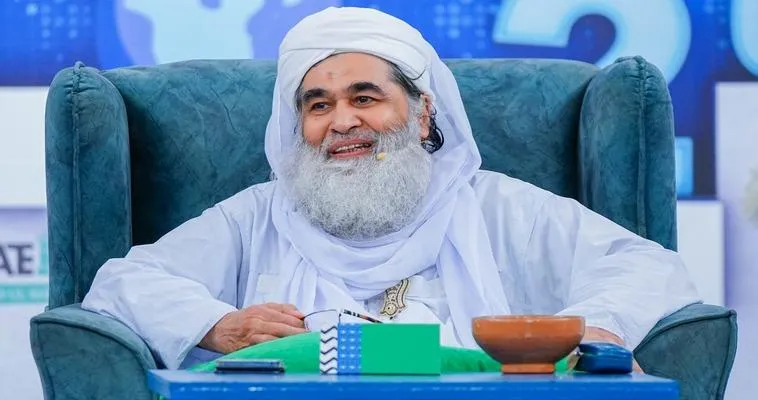
Muhammad Ilyas Attar Qadri was born on 26th Ramadan 1369 AH, corresponding to 1950, in Karachi, Pakistan. His birth in the holy month of Ramadan is viewed by followers as symbolically significant, marking the arrival of a scholar whose influence would later extend far beyond South Asia.
His family roots trace back to Kutiyana in Junagadh, India. After the creation of Pakistan his parents migrated first to Hyderabad Sindh and later settled permanently in Karachi This migration experience shaped his worldview and commitment to religious stability in a rapidly changing society.
Religious Upbringing and Scholarly Discipline
Raised in a household grounded in Islamic discipline Muhammad Ilyas Attar Qadri was deeply influenced by his father Haji Abdur Rahman Qadiri, a devout follower of the Qadiriyyah Sufi order. Known for humility and detachment from materialism, his father instilled in him reverence for Sunnah knowledge and ethical restraint.
From an early age he demonstrated a strong inclination toward religious study, prioritising Islamic sciences over worldly pursuits This foundation later defined his approach to scholarship, which emphasized inner reform alongside outward practice.
Mentorship and Spiritual Authority
A defining phase of his scholarly life was his long association with Mufti Waqar ud Din Qadri Razavi, the Grand Mufti of Pakistan. Under his guidance, Muhammad Ilyas Attar Qadri spent over two decades in structured learning, receiving formal spiritual authorisation and responsibility.
Also read: Saudi women allowed to drive trains between Makkah and Madinah
This mentorship positioned him as a trusted authority within Sunni circles, particularly among followers of the Barelvi tradition His scholarly credibility was reinforced through deep engagement with classical works, including Bahar e Shariat Fatawa e Rizvia and Ihya ul Uloom.
From Scholarship to Mass Outreach
Unlike many scholars who remained limited to academic or local circles Muhammad Ilyas Attar Qadri translated scholarship into public reform His sermons emphasised accountability, self-correction and adherence to Quran and Sunnah in daily life.
His ability to communicate complex spiritual concepts in accessible language enabled his message to reach ordinary Muslims, workers, traders, students and youth His lectures encouraged behavioural reform, including prayer, honesty, modesty and social responsibility.
Establishment of Dawat e Islami
In 1401 AH Muhammad Ilyas Attar Qadri founded Dawat-e-Islami as a non-political grassroots movement focused on reviving Islamic practice through education and preaching.
At a time when media-driven materialism and religious neglect were rising, Dawat-e-Islami positioned itself as a corrective force Its emphasis on voluntary reform rather than coercion allowed it to expand rapidly across Pakistan and internationally.
Global Expansion and Institutional Reach
Today Dawat-e-Islami operates in more than 180 countries managing mosques, madrasas, digital platforms publishing houses and television broadcasting through Madani Channel The movement has facilitated religious education community service and intergenerational transmission of Islamic values.
Importantly its non-political stance has enabled engagement across borders cultures and regulatory environments, making it one of the most widespread Sunni missionary networks of the modern era.
Spiritual Leadership and Public Accountability
Muhammad Ilyas Attar Qadri is known for personal humility and reluctance toward self-promotion. Despite holding spiritual authorization from multiple scholars, he initially refrained from initiating disciples until directed by senior mentors.
His leadership model emphasizes moral accountability personal reform and service rather than institutional power This approach has contributed to the credibility and sustainability of Dawat-e-Islami in diverse societies.
Lasting Impact on Contemporary Islam
The influence of Ameer e Ahle Sunnat extends beyond sermons or organizations He represents a model of modern Islamic leadership grounded in classical scholarship ethical restraint and mass engagement.
As Muslim communities continue to navigate identity challenges, globalisation and moral uncertainty Muhammad Ilyas Attar Qadri’s work stands as a case study in faith-based reform achieved through peaceful preaching education and accountability-driven leadership.
His legacy remains actively visible through millions of followers who continue to reform their lives under the banner of Quran Sunnah and Sunnah-inspired character building.
