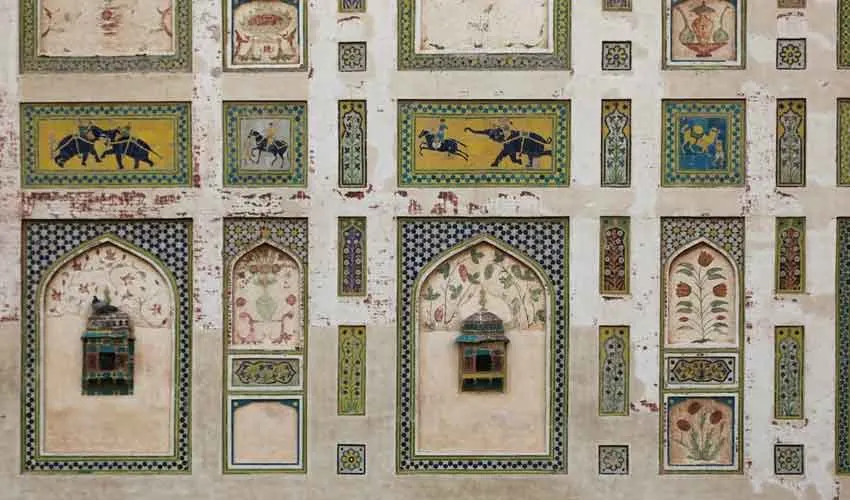
The UNESCO has praised the completion of the Northern section conservation of the Lahore Fort Picture Wall, describing it as a landmark achievement in Pakistan’s cultural heritage preservation and one of the most ambitious restoration efforts ever undertaken in the country.
The Picture Wall, a defining feature of Lahore Fort, spans nearly half a kilometre and carries a 400-year artistic legacy from the reigns of Mughal emperors Jahangir and Shah Jahan.
Built in the 17th century, the wall contains around 2,000 intricately designed recessed panels arranged in three tiers, showcasing floral patterns, fauna, geometric motifs, and narrative scenes inspired by Indo-Persian folklore.
The artistic composition includes depictions of royal processions, hunting scenes, mythical figures, angels, demons, birds, and ornamental designs. These were created using traditional Mughal techniques such as Kashikari glazed tile mosaic, fresco painting, marble and red sandstone jali work, and terracotta relief—making it one of the most complex mural structures in the world.
The conservation project was implemented through collaboration between the Aga Khan Cultural Service Pakistan and the Walled City of Lahore Authority, with funding support from international partners including the United States, Germany, France, and Norway. Institutional oversight was provided by the Government of Punjab through WCLA.
UNESCO representative Fuad Pashayev described the restoration as evidence of what can be achieved when scientific precision, international cooperation, and local expertise work together.
He said the project strengthens the Outstanding Universal Value of the heritage site and sets a benchmark for future conservation work in Pakistan.
The conservation process, initiated in 2015 and formally executed from 2018, followed a highly scientific and phased approach. Experts documented the entire structure using advanced technologies including 3D laser scanning, electronic distance measurement systems, and high-resolution ortho-photography. This marked one of the first large-scale scientific documentation efforts for heritage conservation in Pakistan.
Over time, the Picture Wall had suffered significant deterioration, including moisture damage, structural cracking, missing sections, fungal growth, and surface decay caused by drainage issues and environmental exposure.
Restoration teams focused on preservation rather than redesign, carefully stabilizing original materials and retaining authenticity.
The work included removal of later-added plaster layers, treatment of biological growth, consolidation of tile mosaics, restoration of frescoes, and structural reinforcement. Excavation beneath selected areas also helped reveal original ground levels, adding further historical insight.
A key outcome of the project has been capacity building in Pakistan’s heritage sector. A new generation of conservators, architects, engineers, and artisans—many of them women—received training in internationally recognized conservation methods.
Traditional crafts such as Kashikari and Naqqashi were also revived through apprenticeships and workshops, strengthening long-term preservation capacity.
According to project leadership, the Picture Wall is central to the UNESCO World Heritage status of Lahore Fort, and its restoration demonstrates that world-class conservation standards can be achieved within Pakistan through sustained collaboration and expertise.
Plans are underway for a formal opening ceremony to mark the completion of the project, bringing together local and international stakeholders to celebrate the preservation of one of the most significant Mughal-era artistic landmarks in South Asia.
About Hamna Ghias Sheikh

The writer has been covering politics, lifestyle and finance since 2023.
