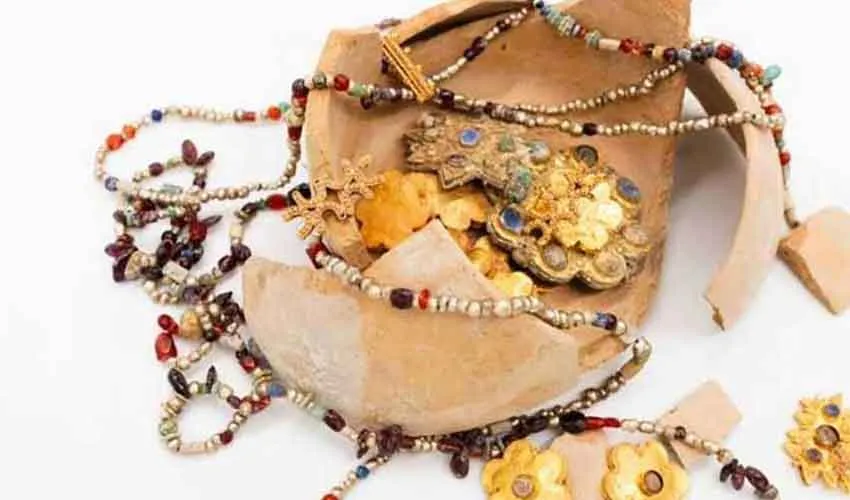
Saudi Arabia has unveiled a rare archaeological discovery after the Saudi Heritage Commission announced the unearthing of nearly 100 pieces of gold jewellery dating back to the Abbasid era, offering new insight into the Kingdom’s early Islamic history and craftsmanship.
The discovery was made in the Qassim region during the commission’s fourth archaeological survey and excavation project at a historic site in Dariyah.
Experts described the find as one of the most complete Abbasid-era jewellery collections recovered in the Kingdom to date, reflecting both artistic sophistication and economic prosperity during that period.
The artefacts form a complete decorative set crafted in intricate floral designs, with precious gemstones embedded within finely shaped gold frames.
Among the most striking items is a large circular ornament featuring vividly coloured stones arranged in a distinctive central pattern, suggesting ceremonial or high-status use.
The collection also includes multicoloured prayer beads accompanied by large yet delicately made gold spacers designed to separate the beads while maintaining symmetry and balance.
Also read: Saudi Arabia Sets Final Umrah Visa Deadlines
Archaeologists noted that the jewellery was produced using advanced techniques for its time. The pieces were shaped through hammering and layered gold-forming methods, while decorative frames were enhanced using pressure engraving and carefully set gemstones. These techniques point to highly skilled artisans and a mature goldworking tradition during the Abbasid era.
Chief Executive Officer of the Saudi Heritage Commission, Dr Jasser Suleiman Al-Harbash, said the discovery highlights the depth and richness of Saudi Arabia’s cultural heritage.
Also read: Saudi Arabia Suspends 1,800 Travel Agencies Over Umrah Service Violations
He added that findings from Dariyah reinforce the Kingdom’s historical significance as a hub for trade routes and cultural exchange that connected different regions over centuries.
Historians believe such discoveries strengthen evidence that central Arabia played an active role in Abbasid-era economic and religious life, rather than existing on the periphery of major Islamic centres.
The Qassim find is expected to contribute valuable material for future research, exhibitions, and heritage preservation efforts as Saudi Arabia continues to document and showcase its archaeological legacy.
About Tamoor Ahmed

Tamoor Ahmad has been covering politics since 2022.
