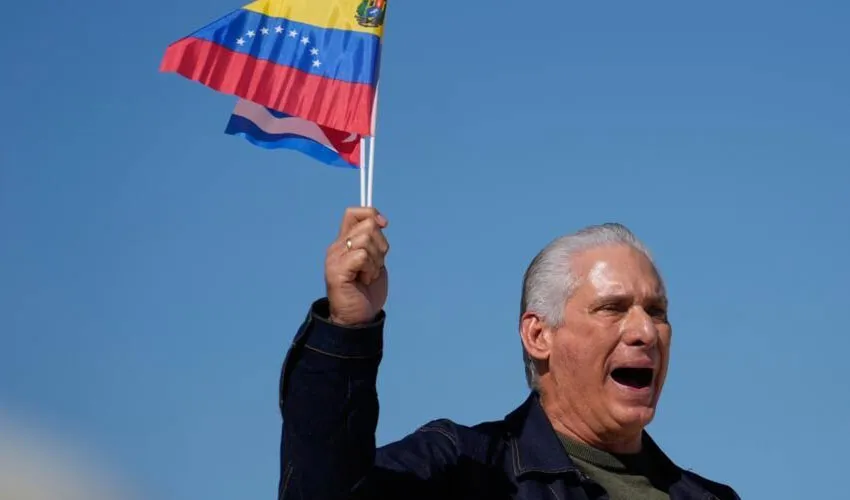
Cuban President Miguel Díaz-Canel has issued a sharp warning to the United States, cautioning that any military action against Cuba would trigger what he described as a “bloodbath” with serious consequences for regional peace.
His remarks come at a time of heightened Cuba US military tensions, fueled by intelligence claims circulating in Washington.
Speaking through a public statement shared on X, Díaz-Canel rejected accusations that Cuba poses a threat to other nations. He stressed that Havana has no aggressive intentions but made clear that the country would respond decisively to any external attack.
According to the Cuban leader, defending national sovereignty is an absolute and legitimate right under international law, not a provocation.
The warning follows a report published by Axios, which cited classified intelligence alleging that Cuba has acquired more than 300 military-grade drones.
The report suggested these systems could potentially reach US-linked locations, including the Guantanamo Bay Naval Base, US naval assets in nearby waters, and even parts of southern Florida.
Also read: Trump Warns Colombia, Mexico and Cuba After Nicolás Maduro Capture
Cuban authorities have firmly denied these claims. Officials in Havana argue that the drone allegations are exaggerated and politically motivated, accusing Washington of manufacturing a narrative that could be used to justify further pressure or even military escalation.
The Cuban government maintains that its defense capabilities are strictly defensive and consistent with international norms.
Strained US–Cuba relations have continued to deteriorate in recent months against a backdrop of expanding US sanctions, economic isolation, and mounting internal pressures within Cuba.
The island has been grappling with severe fuel shortages, rolling blackouts, and supply disruptions that have deepened public hardship and tested the resilience of daily life.
Despite these challenges, public reaction inside Cuba has been mixed. Some citizens have voiced defiance, saying economic difficulties would not weaken national resolve in the face of external threats.
Others have urged restraint, calling on both Havana and Washington to step back from confrontation and pursue dialogue before tensions spiral further.
Also read: What can we learn from near miss of Cuban Missile Crisis?
Cuban Foreign Minister Bruno Rodríguez has reinforced the government’s position, stating that Cuba’s actions fall squarely within its rights under the United Nations Charter.
He emphasized that self-defense should not be mischaracterized as aggression, especially in a region with a long history of intervention and mistrust.
As Cuba-US military tensions continue to rise, regional observers warn that rhetoric alone carries risks. Any miscalculation could destabilize the Caribbean and complicate broader hemispheric relations.
For now, Havana insists it seeks peace, but not at the expense of sovereignty, while Washington faces growing scrutiny over how it frames security threats linked to the island.
About Tamoor Ahmed

Tamoor Ahmad has been covering politics since 2022.
