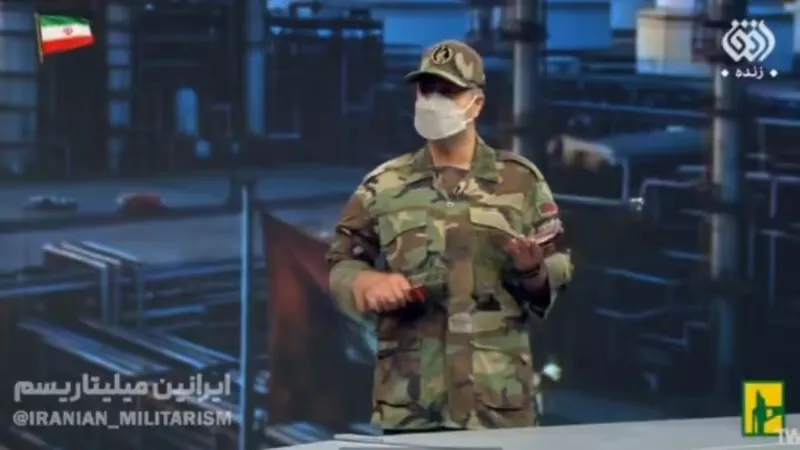
Iranian state television sparked widespread international attention on Friday night after multiple live programmes showed presenters standing inside studios while holding assault rifles, openly discussing their readiness to participate in active combat if required.
The broadcasts, aired simultaneously across different channels, marked a rare and striking departure from conventional state media programming.
Clips from the shows quickly spread across social media platforms, where viewers noted presenters receiving on-air instructions related to basic firearm handling.
Military analysts online identified one of the weapons displayed as an early East German MPi-KMS, a variant linked to the AK-47 family, adding to speculation that the demonstrations were carefully staged rather than symbolic.
The footage triggered intense debate, with many observers interpreting the broadcasts as a signal of wartime mobilisation by Tehran.
The timing has proven critical. Tensions remain high following a Pakistan-brokered ceasefire that analysts describe as fragile, with uncertainty surrounding what happens once the truce expires.
Discussions of a possible United States ground operation have intensified in recent days, amplifying scrutiny of Iran’s domestic messaging.
American political commentator Jackson Hinkle shared the footage on X, claiming Iranian state media was actively demonstrating the use of AK-style rifles in preparation for a potential US ground invasion. His post rapidly gained traction, drawing responses from military observers and geopolitical analysts alike.
Russia’s state-run broadcaster RT also reported on the broadcasts, noting that presenters were given live studio instruction on how to fire the weapons. The report framed the segment as part of a broader narrative portraying national readiness rather than entertainment programming.
The unusual television segments aired against the backdrop of stalled negotiations between the United States and Iran, where talks have reached an impasse over Tehran’s enriched uranium stockpile and Washington’s naval pressure around the Strait of Hormuz.
The strategic waterway remains a focal point, with any disruption carrying significant global economic consequences.
Despite the diplomatic deadlock, Donald Trump has publicly suggested openness to a long-term nuclear suspension framework lasting up to 20 years. Iranian officials, however, continue to demand firm security guarantees and warn that further economic measures would provoke a stronger response.
Analysts say the televised displays should be viewed as part of Iran’s psychological signalling strategy rather than an immediate indicator of mobilisation orders.
Still, the imagery of armed presenters inside professional broadcast studios has blurred the line between media messaging and military posture, reinforcing perceptions that Tehran is preparing its population for a prolonged period of instability.
As ceasefire timelines approach critical deadlines and military options remain under review in Washington, the broadcasts have added another layer of complexity to an already volatile regional equation.
Whether symbolic or strategic, Iran’s decision to air such content reflects a media posture aligned closely with the realities of escalating geopolitical risk rather than routine state television.
About Tamoor Ahmed

Tamoor Ahmad has been covering politics since 2022.
