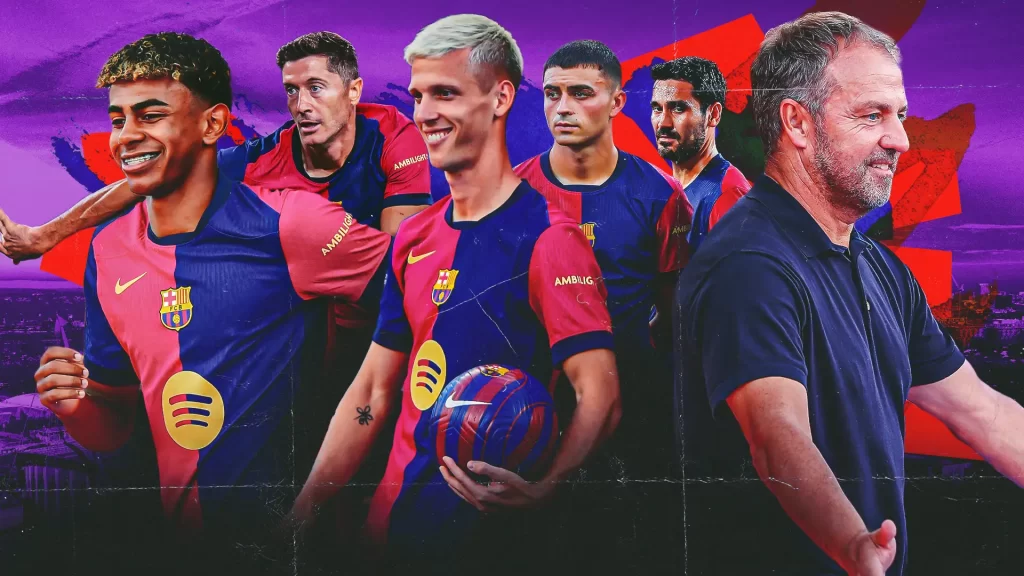
When Barcelona started the season, not many imagined them winning the league comfortably. Even few expected them to win the domestic treble and reach the semi-finals stage of the Champions League. And if we’re being completely honest, no one could be faulted for their skepticism towards Barca’s chances.
In fact, there were more than a few good reasons behind all the pessimism surrounding the Catalan giants, not least because of their disastrous previous campaign. Barcelona had ended the 2023-24 season trophyless, after getting knocked out of the Champions League in the quarter-finals, suffering humiliating exits from both domestic cups, and finishing ten points behind Real Madrid in the league.
What little morale the Blaugrana faithful had left took a final blow, thanks to the unceremonious manner in which the president, Joan Laporta, handled the departure of their manager, and club legend, Xavi Hernández.
Xavi’s replacement was the former Bayern Munich and German National Team manager, Hansi Flick. Flick had arrived with a proven track record of success, and a reputation for playing high-risk attacking football. However, even his appointment managed to generate little excitement among the supporters, who felt the club’s problems were far too deep to be solved by a new manager alone. And to be fair, they weren’t wrong… at least at the time. The team faced several uphill battles before the season had even begun.
With an ageing squad battling constant injuries, and most of the team’s top-earners failing to find form, Barcelona were in desperate need of reinforcements over the summer. However, the financial constraints placed on the team by LaLiga’s strict wage cap regulations severely limited their ability to conduct any meaningful business in the transfer market. According to a report by The Athletic, Barcelona needed to raise at least €130 million by June to be able to register not only any new additions, but some of the existing first-team players as well.
To make matters worse, their archrivals over in Madrid had further bolstered their already worldclass attack that had just helped them win both Champions League and LaLiga, with the arrivals of Kylian Mbappe and Endrick. The contrast couldn’t have been more stark. Where Real Madrid were gearing up for the upcoming season by assembling ‘Galacticos 2.0’, Barcelona were scrambling to register players they already owned, by selling off others.
In fact, their only notable arrival was Dani Olmo, who was signed for €55m, and Barcelona risked losing even him for free after LaLiga initially refused their request to register him. The club had to jump through many hoops to get him registered; including closing a last-minute €100m deal to sell off VIP boxes at their newly renovated stadium, and winning a tough legal battle against LaLiga.
To reduce their wage bill, Barcelona were forced to get rid of numerous players in several key positions during the summer transfer window. The departures of Ilkay Gündogan, João Cancelo, Sergi Roberto, Vitor Roque, João Félix, Oriol Romeu and Marcos Alonso—all important squad players under Xavi last season—left the team with virtually no depth. And with hardly any inbound replacements, Hansi Flick was left with no choice but to promote youth players to the senior squad.
Barcelona’s squad was already stretched thin as it was, but long-term absence of several injured key players such as Gavi, Ronald Araujo, Andreas Christensen and Frenkie de Jong made matters even worse for the manager. Even Marc Bernal, the 17-year-old youth prospect whom Flick had identified as his replacement for De Jong after a promising pre-season, suffered a horrific injury during the third matchweek that forced him to miss the rest of the season. Just a few weeks later, Barcelona’s first-choice goalkeeper, Marc-Andre ter Stegen, also sustained a knee injury that would keep him out of the action until the very end of the campaign. It was only September.
By the start of October, Flick had finally settled on his preferred lineup, and it made for a bizarre sight.
In goal stood Wojciech Szczęsny: a 34-year-old goalkeeper who had only just hung up his boots a month ago, but was persuaded by Barcelona to come out of his retirement after Ter Stegen’s injury.
In defense, Flick’s go-to centre-back pairing was the 17-year-old academy graduate Pau Cubarsi, and alongside him, the Spanish veteran Inigo Martinez, who, interestingly, was twice Cubarsi’s age. Their age gap feels even more surreal when you realize the pair was also responsible for holding Flick’s aggressively high defensive line all season. With no other rotation options available, Héctor Fort and Gerard Martín were promoted from the reserve side to serve as backup full-backs. In midfield, 21-year-old academy prospect Marc Casadó was promoted to fill in for the injured Frenkie de Jong and Marc Bernal. Meanwhile, other youngsters such as Fermín López and Pablo Torre were used as rotation options.
Things looked most desperate in the attack, however. The underwhelming attacking output of the previous campaign made it clear that Barcelona’s frontline needed a radical overhaul. There were calls for underperforming players like Raphinha and Ferran Torres to be sold, with the funds reinvested in fresh talent—the name of Nico Williams was frequently mentioned. None of that came to pass though. And after Vitor Roque was allowed to leave on loan, the only striker left at the club was the 36-year-old Robert Lewandowski, who, despite being amazing, was still very much 36. The only silver lining was the 17-year-old wonderkid, Lamine Yamal, who was instrumental in Spain’s European Championship triumph during the summer.
It was quite clear to everyone that this was supposed to be a season of transition; a feeling further reinforced by the fact that Barcelona would be playing their home games at Estadi de Montjuïc, with their traditional home, Camp Nou, undergoing renovations. No one was under any illusions about winning silverware. At best, fans hoped the team would put up a good fight. But the mood around the club started to shift after a positive start to the season.
By the start of November, Barcelona had won 11 of its first 12 games in the league, and were sitting comfortably on top of the table, six points ahead of Real Madrid. Among those wins was also a 4-0 demolition of Madrid in the first Clasico of the season, which followed a 4-1 win against Bayern Munich in the Champions League. After these two results, even the most pessimistic of Barca fans had started to believe.
Flick’s extreme tactics were largely proving to be effective as a suddenly rejuvenated Barca attack blew apart one defense after another. This was the same attack that had looked utterly toothless barely months ago, but now ranked amongst the highest-scoring offensive units in all of Europe. The midfield was also performing well above expectations considering the absence of some of Barcelona’s key midfielders, and was instrumental in controlling the games. Casado, who normally wouldn’t even have been the second-choice player in his position at the start of the season, had become a fan-favorite after his impressive displays, particularly in big games against Bayern and Real Madrid. The defense, despite some erratic moments, had also largely managed to hold its own. In short, everything seemed to be going in Barcelona’s favor. Well, almost everything…
Barcelona got a really loud wake-up call in the coming months, as they failed to win any of the last three league games in November. Despite winning 5-1 against Mallorca at the start of December, Barca drew two and lost two of their next four games in LaLiga, having managed to win only six points of the available 24 since the start of November. Flick’s high-line defense, which had so far been his biggest weapon against unsuspecting opponents, now looked like a liability. The defense was leaking far too many goals, to the point that it cost them their top spot in the league. By mid-January, Barcelona had sunk to third place, seven points behind league leaders, Real Madrid.
Aside from making a couple of adjustments to his starting lineup, Flick stuck by his system, and was soon rewarded for it. One of those adjustments was bringing Frenkie de Jong, who had been struggling with game time after his injury, back into his starting lineup, replacing Casado. The other was bringing the new signing Wojciech Szczesny in goal to replace Inaki Pena, who was sidelined as a punishment for arriving late in a team meeting.
Szczesny’s first Champions League start for the club in the game against Benfica didn’t go well as he made many mistakes, including one leading to goal. However, that game helped define the rest of Barcelona’s season, as the team launched a sensational comeback to win the game 5-4, after they had been losing it 4-2 until the 78th minute. They never looked back since. Barcelona went on to win nearly all their remaining games in the league, bar a draw against Betis in April and a defeat against Villareal on the penultimate matchday, by which point they had already won the league.
Their comeback against Benfica was one of the nine games this campaign in which they clinched victory from the jaws of defeat, typifying the ‘remontada’ spirit that reflected in their performances all season. In fact, Barcelona won all of its trophies this campaign after coming back from behind. And all of them involved Real Madrid, making the success all the more sweet.
They won both the Supercopa and Copa del Rey finals against Madrid after coming back from a losing position. Then there was the May 11 Clasico, which virtually sealed their league title after they beat Madrid by 5-2, despite going 2-0 down in the first 15 minutes. Barca’s four wins against Los Blancos are the highest number of Clasico wins in a season, and their 16 goals scored against them are the most any team has scored against Real Madrid in a single campaign.
Perhaps the most astonishing aspect of Barca’s season was some of the individual performances. Lamine Yamal, the crown jewel of Barcelona’s famed La Masia academy, reached new heights this season, recording 18 goals and 25 assists across all competitions. It is worth mentioning that he’s yet to turn 18, and is already being compared with the great Lionel Messi. The only player who impressed more than Yamal was Raphinha. The Brazilian winger, after struggling with form during the previous campaign, enjoyed the best season of his career, boasting an eye-watering return of 34 goals and 25 assists in all competitions. Both Raphinha and Yamal are also frontrunners for this year’s Ballon d’Or.
It wasn’t just these two, though. Nearly all members of the squad shone in the roles assigned to them by Flick. Lewandowski, in spite of his age, once again ended the campaign as the team’s top-scorer, netting 42 goals in just 52 appearances. Ferran Torres, the makeshift backup striker, and another player who struggled last season, recorded a staggering 27 goal contributions across all competitions. Pedri and Frenkie de Jong were key to Barca controlling the tempo of the game, and Cubarsi and Inigo Martinez also performed better in defense than their numbers suggest. Even the promoted youngsters like Fermin Lopez, Marc Casado, Hector Fort and Gerard Martin produced some solid displays whenever they were called upon.
All in all, despite the heartbreaking loss against Inter Milan in the Champions League semi-finals (a game they were winning 4-3 until the 93rd minute), the Blaugranas couldn’t have hoped for a more successful campaign. It started off as a season of misfortunes. However, the team’s resilient spirit, Flick’s brave management, and the superb performances of what was otherwise a ragtag group of kids, aged veterans, and previously out-of-form players managed to turn their fortunes around. And so, Barcelona will head into the summer break with their pride restored, and will be returning next season full of renewed confidence and belief—a far cry from where they stood this time last year.
