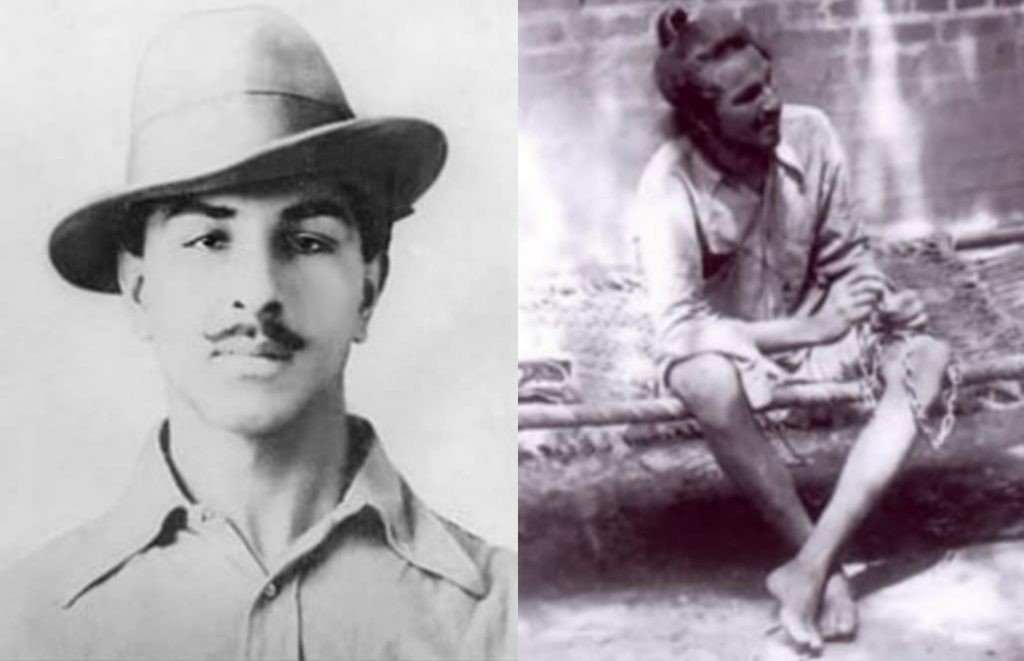
We present you 5 amazing facts about Bhagat Singh. Bhagat Singh was an iconic figure in India’s struggle for independence against British colonial rule during the early 20th century.
Born on September 28, 1907, in the village of Banga in what was then the Lyallpur district (now Faisalabad, Pakistan), Bhagat Singh emerged as a charismatic revolutionary leader at a young age.
He became renowned for his acts of defiance against British authorities, including his involvement in the assassination of British police officer John Saunders in 1928.
Bhagat Singh’s actions were driven by his fervent belief in the need for India’s freedom from British rule and his dedication to the principles of justice and equality.
5 amazing facts about Bhagat Singh
1. Born into a family of progressive freedom fighters
Bhagat Singh was immersed in anti-colonialism from a young age due to the political activities of both his father, Kishan, and his uncle, Ajit, against the British regime.
Kishan faced imprisonment in 1910 for distributing seditious literature, while Ajit was deported to Mandalay in 1907 for his fiery speeches and opposition to the Punjab Colonisation Bill.
Following his release, Ajit traveled to Europe and America, where he became associated with the Ghadar party in San Francisco.
Also read: Bhagat Singh: life, activism and death
Growing up in such an environment meant that Bhagat Singh absorbed nationalist ideals practically from birth, as noted by Hansraj Rahbar in “Bhagat Singh and His Thought” (1990), stating that Bhagat Singh internalized these traditions from infancy.
Yet, in many ways, Bhagat Singh was — as Chris Moffat wrote in India’s Revolutionary Inheritance: The politics and promise of Bhagat Singh (2019) — “a dissenter from a family of dissenters.”
2- Intellectual Pursuits: Beyond the Revolutionary Veil
Contrary to popular portrayal, Bhagat Singh’s intellectual prowess rivaled his revolutionary fervor.
A voracious reader and prolific writer, he penned critiques of colonial rule and contributed extensively to newspapers and journals, showcasing a depth of understanding beyond mere activism.
During the 1920s, Singh was actively involved in writing for Urdu and Punjabi newspapers in Amritsar, contributing to the dissemination of ideas critical of British colonial rule.
His writings weren’t just expressions of dissent; they were well-informed critiques backed by a thorough understanding of political theory and history.
Singh’s preference for the pen over the pistol underscores his belief in the power of ideas to spark change.
He saw writing as a potent tool for awakening consciousness and mobilizing people against oppression.
3- Ideological Standpoint: Atheism and Marxism
Delving into Bhagat Singh’s beliefs unveils a tapestry of atheism and Marxism.
His steadfast rejection of religious orthodoxy and alignment with Marxist principles underscored a nuanced perspective on societal transformation, challenging conventional narratives of his legacy.
In his jail diary entitled “The Jail Notebook”, there are various references of Marxist scholars and quotations from Marxist literature.
4- When Jinnah supported Bhagat Singh
In a surprising turn, figures like Muhammad Ali Jinnah and Jawaharlal Nehru emerged as staunch supporters of Bhagat Singh’s cause.
Their defense in the face of British oppression highlighted the broad appeal of his struggle, transcending ideological boundaries for the sake of justice.
When Bhagat Singh and his comrades went on hunger strike, Jinnah said in his assembly speech, “You know perfectly well that these men are determined to die. It is not a joke. I ask the hon’ble law member to realise that it is not everybody who can go on starving himself to death. … The man who goes on hunger-strike has a soul. He is moved by that soul and he believes in the justice of his cause; he is not an ordinary criminal who is guilty of cold-blooded, sordid, wicked crime.
“Mind you, sir, I do not approve the action of Bhagat Singh, and I say this on the floor of this House. I regret that, rightly or wrongly, youth today in India is stirred up, and you cannot, when you have three hundred and odd millions of people, prevent such crimes being committed, however much you deplore them and however much you may say that they are misguided. It is the system, this damnable system of government, which is resented by the people.”
5- Enduring Legacy
As time passes, Bhagat Singh’s legacy remains a potent force in India’s collective memory.
Commemorations, literature, and cultural representations ensure that his sacrifices are not relegated to the annals of history, but rather serve as a guiding light for future aspirations of freedom and justice.
In exploring the lesser-known aspects of Bhagat Singh‘s life, a more nuanced portrait emerges—one that goes beyond the conventional narrative of heroism and martyrdom.
His intellectual depth, ideological convictions, and unexpected alliances reveal a complexity that enriches our understanding of his enduring legacy in India’s struggle for independence.
