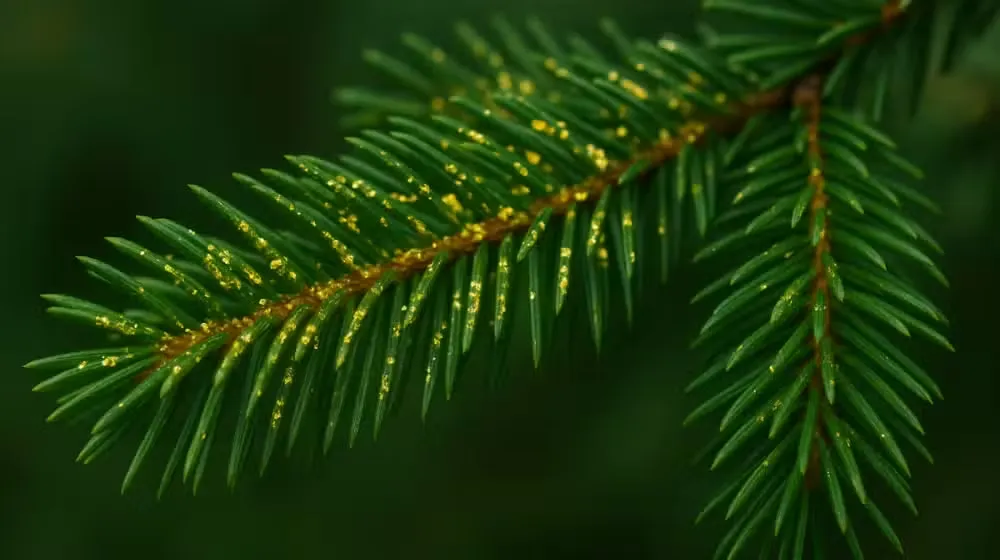
Scientists have found a tree that literally grows gold, or tiny particles of the precious metal form within its leaves.
A groundbreaking study has revealed that bacteria living inside Norway spruce needles can play a key role in turning dissolved gold into solid nanoparticles.
The research was conducted by scientists from the University of Oulu and the Geological Survey of Finland, who analysed 138 needle samples from 23 spruce trees growing near the Kittilä gold mine in Finland.
Gold nanoparticles detected
Remarkably, gold nanoparticles were detected in four of the trees, embedded within bacterial biofilms.
Researchers have long known that metals like gold can be transported through the soil as ions released by mineral deposits, later absorbed by plants through their roots.
Many plants host beneficial microbes that help them survive harsh conditions, including aiding in biomineralisation, the process of forming minerals within plant tissues.
This new research provides evidence that gold may accumulate and solidify inside plant tissues as part of this natural process, potentially serving as a defence mechanism.
“Our study offers the first indications of how gold moves into plant shoots and forms nanoparticles within spruce needles,” said Dr Kaisa Lehosmaa, a postdoctoral researcher at the University of Oulu and lead author of the study.
“In the soil, gold exists in a soluble, liquid form. It is carried by water into the spruce needles, where microbial activity transforms it back into solid, nanosized particles.”
These particles are microscopic, measuring only a millionth of a millimetre, and invisible to the naked eye, making them unsuitable for commercial extraction. However, scientists believe this discovery could be invaluable for geological exploration.
“The bacteria associated with spruce needles appear capable of converting soluble gold into solid nanoparticles,” Dr Lehosmaa explained.
“By identifying similar bacteria in other plants, we could develop more sustainable and biological techniques for detecting gold deposits.”
