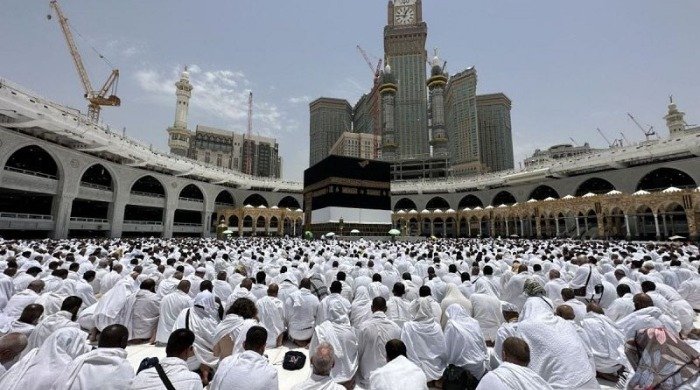
The federal cabinet on Wednesday approved Pakistan’s Hajj Policy 2026, setting clear guidelines on pilgrimage quotas, cost, eligibility, and operational procedures.
The announcement came after a high-level meeting chaired by Prime Minister Shehbaz Sharif and a detailed press conference by Federal Minister for Religious Affairs Sardar Muhammad Yousaf.
Under the newly approved policy, Pakistan’s total Hajj quota for 2026 stands at 179,210 pilgrims, with 119,000 seats allocated to the government scheme and 60,000 to private Hajj operators.
The collection of applications for the government scheme will officially begin on August 4, the minister confirmed.
Hajj cost, payment structure
Sardar Yousaf revealed that the estimated cost of performing Hajj will range between Rs1.15 and Rs1.25 million, depending on the final arrangements.
Pilgrims will be allowed to submit their dues in two instalments, with the first instalment set at Rs500,000.
“Long and short Hajj packages will remain the same as before,” the minister announced.
To enhance transparency and financial monitoring, the government will introduce an effective oversight system, and a third-party monitoring agency has been tasked with reviewing both government and private Hajj schemes.
Highlights of Hajj Policy 2026
- No children under 12 will be allowed to perform Hajj this year.
- The “Road to Makkah” pre-clearance service will continue at Islamabad and Karachi airports.
- Comprehensive training sessions will be organized for pilgrims, covering logistics, clothing, rituals, and emergency procedures.
- A transparent complaint redressal system and emergency response teams will also be established.
- Vaccination approved by Saudi Arabia will be mandatory for all pilgrims.
- Pilgrims’ data will be available on the Ministry of Religious Affairs website for real-time tracking and transparency.
-
In cases of death or serious illness, suitable alternatives will be considered.
Private operators’ reforms, accountability
In response to ongoing concerns, the government has decided to reduce the private sector’s Hajj quota.
The move, according to Minister Yousaf, is aimed at improving the quality of service for pilgrims.
Financial eligibility criteria for private tour operators have also been introduced to ensure timely collection of funds and reliable service delivery.
“Private operators who failed to take pilgrims last year will be required to accommodate them this year without additional costs,” the minister added.
Policy implementation in line with Saudi timeline
The minister emphasized that the Hajj Policy 2026 aligns with the Saudi Arabian Hajj timeline and that all logistical preparations will be completed well in advance.
When questioned about the Senate committee’s report on Hajj operations, Sardar Yousaf responded that the Ministry of Religious Affairs had not been taken onboard and would formally respond, adding that the committee’s recommendations will be considered where appropriate.
Minister Yousaf reiterated the government’s commitment to ensuring a safe, transparent, and spiritually fulfilling Hajj experience for all pilgrims.
He lauded the previous year’s arrangements under the government scheme and expressed confidence in even better execution in 2026.
