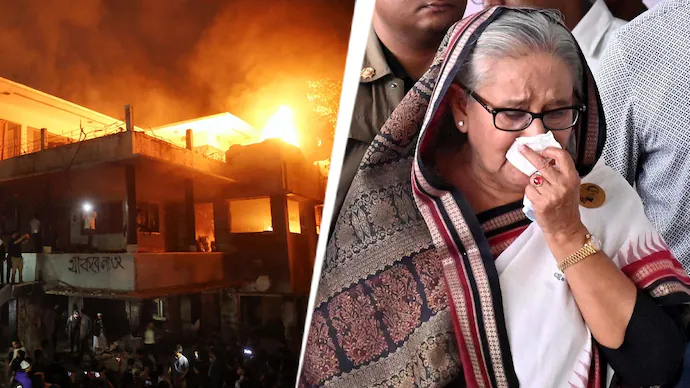
Bangladesh protesters set fire to Sheikh Mujib’s historic home.
In a tragic incident, the political upheaval in Bangladesh reached its zenith on Thursday as protesters, some armed with sticks and tools, attacked the residence of Sheikh Mujibur Rahman, the father of ousted prime minister Sheikh Hasina.
The demolished building held great significance as it was the site where Bangladesh’s independence was declared in 1971.
The building was set ablaze and partially destroyed by a crane and excavation.
“Bulldozer Procession”
The protest was in line with the broader demonstration, dubbed the “Bulldozer Procession,” aimed at disrupting Hasina’s scheduled address to the nation via social media.
Also read: Bangladesh’s high growth under ousted PM Hasina was ‘fake’, Yunus says
Hasina, in exile in India since her ousting in August 2024, had delivered a fiery speech, calling on her supporters to stand against the interim government and blaming them of seizing power unconstitutionally.
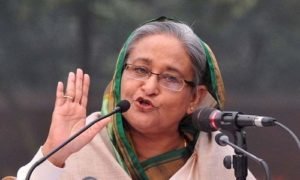
The former Prime Minister’s speech angered the protesters, many of whom are part of the “Students Against Discrimination” movement.
They have raised serious concerns over the interim government and have pledged to dismantle the 1972 Constitution, which they argue represents the legacy of Hasina’s rule.
As thousands gathered around the site of Rahman’s home and the nearby independence monument, emotions ran high.
Witnesses reported scenes of chaos as protesters, many clad in student uniforms, clashed with police officers stationed at the scene.
Around 700 protesters were present at the site, according to local authorities, though the situation quickly escalated into violent destruction.
Importance of Sheikh Mujibur Rahman’s house
Sheikh Mujibur Rahman, often referred to as Bangabandhu (Friend of Bengal), is revered as the architect of Bangladesh’s independence.
The house, which became a national symbol of the country’s liberation, also marks a tragic chapter in the nation’s history.
In 1975, Mujib and most of his family were assassinated within its walls, and Hasina, who survived the attack, later transformed the residence into a museum dedicated to her father’s legacy.
Also read: US rejects involvement in Sheikh Hasina’s ouster
In her speech on Wednesday, Hasina condemned the destruction of the house, asserting that “They can demolish a building, but not the history. History takes its revenge.” The comments reflect her continued defiance, as she faces charges in connection with her government’s crackdown on student-led protests last year, which led to hundreds of casualties.
Political kurfuffle and calls for justice
The political chaos has been occurring since August 2024, when huge, deadly protests forced Hasina to leave Bangladesh and take political asylum in India.
The interim government, led by Muhammad Yunus, has struggled to regain control as demonstrations against Hasina’s party, the Awami League, continue to spread.
While Yunus, a Nobel laureate, works to stabilise the country, he has faced accusations of corruption and failing to address the nation’s economic challenges.
Protesters have called for Hasina’s prosecution for her role in the deadly suppression of student protests, as well as for alleged corruption during her two decades in power.
They are also pushing for accountability over the perceived manipulation of the country’s economy under her rule.
On Wednesday, rallies in Dhaka expanded to target other symbols of Hasina’s government, including the residences and businesses of senior Awami League officials.
Calls have been circulating on social media for the removal of these “pilgrimage sites of fascism.”
Despite ongoing protests, the caretaker government has remained in power.
Yunus, who assumed leadership following Hasina’s ouster, has committed to holding elections in late 2025 or early 2026, but the country remains in a state of uncertainty.
Yunus leadership under criticism
Yunus has faced sharp criticism from Hasina’s supporters and opponents alike, with many blaming him of exacerbating the country’s economic crisis.
The Nobel laureate has alleged that Hasina faked the nation’s economic growth during her tenure and laundered billions of dollars, an accusation that has fuelled tensions further.
As protests continue to grow, Bangladesh stands at a crossroads.
The burning of Sheikh Mujibur Rahman’s home marks a turning point in the country’s political struggle, one that could either lead to a new era of governance or deepen the divide that has plagued the nation for decades.
…
