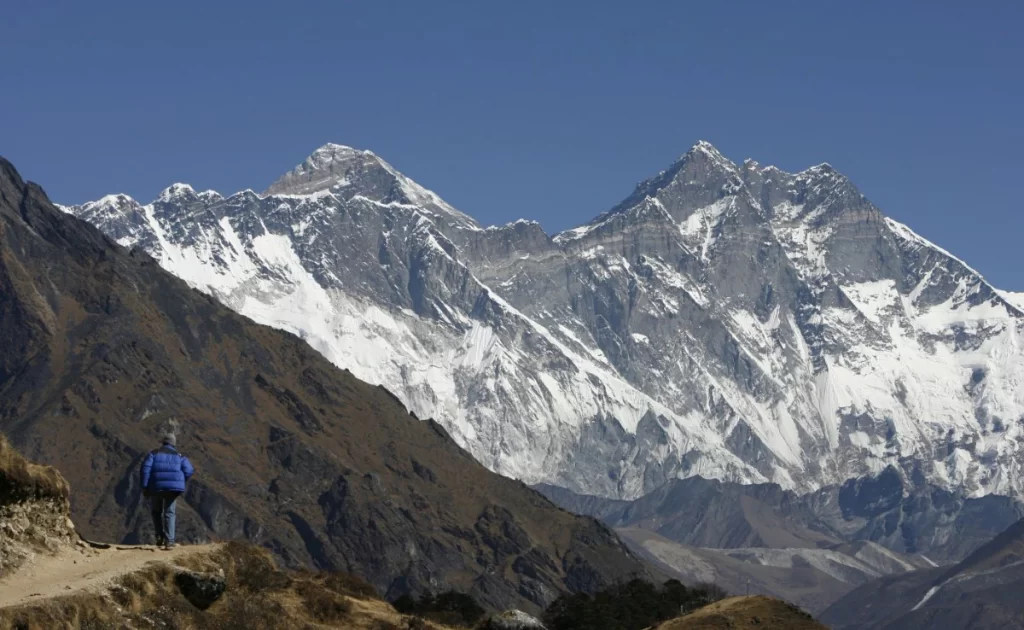
Mountains 3 To 4 times higher than Mount Everest are found inside Earth. The deep Earth has mountains with peaks three to four times taller than Mount Everest.
According to the BBC, a team of researchers from Arizona State University employed seismology facilities in Antarctica to discover these incredible massive mountains near the boundary between the core and mantle, some 2,900 kilometres deep inside our globe.
“The mountain-like structures they revealed are utterly mysterious,” the BBC report read. Scientists explained that these underground mountain ranges – dubbed ultra-low velocity zones or ULVZs – had managed to escape the experts’ gaze all these years until earthquakes and atomic explosions generated enough seismic data to be spotted by them.
As Mountains 3 To 4 times higher than Mount Everest are found inside earth, Scientists believe that these huge mountain ranges are over 24 miles (38 kilometres) in height, while Mount Everest is around 5.5 miles (8.8 kilometres) from the surface.
“Analysing 1000’s of seismic recordings from Antarctica, our high-definition imaging method found thin anomalous zones of material at the CMB [core-mantle boundary] everywhere we probed,” Arizona State University geophysicist Edward Garnero said in a statement.
“The material’s thickness varies from a few kilometres to 10’s kilometres. This suggests we are seeing mountains on the core, in some places up to 5 times taller than Mt. Everest,” he added.
According to the study, researchers also discussed the likely cause of the formation of these mystery mountain summits. They assume that these ancient structures were generated when oceanic crusts sank into the Earth’s interior. They further contend that it might have started with tectonic plates slipping down into the mantle of our planet and sinking to the core-mantle boundary. These then gradually spread out to form a variety of structures, leaving a path of both mountains and blobs in their wake. This would imply that these strange mountains are comprised of ancient oceanic crust, which is a combination of basalt rock and ocean floor sediments.
Now, with this recent discovery, scientists are seeking to argue that these underground mountains may play a critical role in how heat escapes the Earth’s core. “Seismic investigations, such as ours, provide the highest resolution imaging of the interior structure of our planet, and we are finding that this structure is vastly more complicated than once thought,” study co-author and University of Alabama geoscientist Samantha Hansen said in a statement.
“Our research provides important connections between shallow and deep Earth structure and the overall processes driving our planet,” she added.
