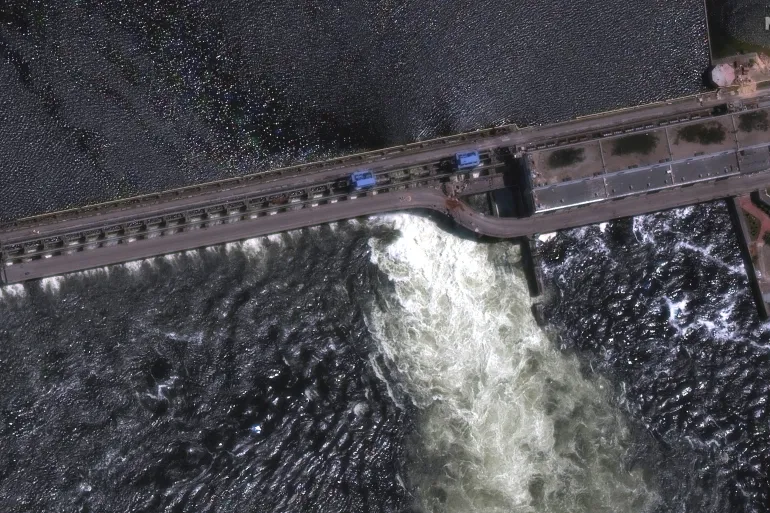
Russian forces blew up Nova Kakhovka dam in Kherson. The military of Ukraine claimed that Russian forces had blown up a sizable dam in the country’s south, but a Moscow-installed official in the city of Nova Kakhovka in the region of Kherson that is under Russian control attributed the dam’s devastation to Ukrainian shelling.
The southern command of the Ukrainian Armed Forces posted on Tuesday that “the Russian occupying forces blew up the Kakhovka [reservoir].”
“The scale of the destruction, the speed and volumes of water, and the likely areas of inundation are being clarified,” the army said.
Ukraine’s military administration for the Kherson region called on people to be ready to evacuate from several villages on the right bank of the Dnipro River as water levels were rising following the destruction of the dam.
“The water level is rising and everyone who is in the danger zone must: Turn off all electrical appliances; take documents and essentials; take care of loved ones and pets; follow the instructions of rescuers and policemen,” the administration said on its Telegram messaging channel.
“About 16,000 people are in the critical zone on the right bank of the Kherson region,” Oleksandr Prokudin, head of the Kherson military administration, said on social media, adding that there was already flooding in eight areas along the Dnipro River.
As Russian forces blew up Nova Kakhovka dam in Kherson, Ukrainian President Volodymyr Zelenskyy has called an emergency meeting of the country’s national security council following the attack at the dam, said Oleksiy Danilov, secretary of the National Security and Defense Council of Ukraine.
Zelenskyy later accused “Russian terrorists” of destroying the dam and said the outrage “confirms for the whole world that they must be expelled from every corner of Ukrainian land”.
“Not a single meter should be left to them, because they use every meter for terror,” Zelenskyy wrote in a tweet.
“The terrorists will not be able to stop Ukraine with water, missiles, or anything else,” he added.
Russian terrorists. The destruction of the Kakhovka hydroelectric power plant dam only confirms for the whole world that they must be expelled from every corner of Ukrainian land. Not a single meter should be left to them, because they use every meter for terror. It’s only… pic.twitter.com/ErBog1gRhH
— Володимир Зеленський (@ZelenskyyUa) June 6, 2023
An unnamed source familiar with the situation told the Russian state news agency TASS that the dam had been destroyed and the area was flooded.
Vladimir Leontiev, the mayor of Nova Kakhovka who was installed by Moscow, was quoted by RIA Novosti as saying that the dam had been struck by shelling that he attributed to Ukraine.
“There were several hits” on the dam, he said, according to the news agency.
Al Jazeera’s Charles Stratford, reporting from Kyiv, said that analysts had long seen the dam as a potential target for both sides in the war.
The dam is important in supplying water and irrigation for Russian-occupied Crimea, while Russia could see the destruction of the dam as a way of making it more difficult for Ukrainian forces to cross the Dnipro river and enter Crimea in a ground offensive, Stratford said.
“We are also hearing from the Ukrainians that they believe … water levels will reach a critical point around five hours from now. We also know there are ongoing evacuations from some of the settlements that are going to be affected,” he said.
According to Ukrainian and Russian forces, the Soviet-era dam in the Kherson region under Russian control could cause a flood that would spread throughout the conflict area.
Unverified social media videos displayed a string of powerful explosions near the Kakhovka dam.
In other videos, water was seen rushing through the dam’s wreckage while onlookers expressed their shock by using foul language at times.
The 3.2 km (mile) long and 30 m (98 foot) tall dam was constructed on the Dnipro River as part of the Kakhovka Hydroelectric Station in 1956.
The dam, according to the Reuters news agency, is home to an 18 cubic kilometre (4.3 cubic mile) reservoir that provides water to the Zaporizhzhia nuclear plant, which is also under Russian control, and to the Crimean peninsula, which Russia annexed in 2014.
The explosion of the dam “could have negative consequences for the Zaporizhzhia nuclear power plant,” according to a Telegram statement from Ukraine’s nuclear operator Energoatom, but the situation is currently “controllable.”
There was “no immediate nuclear safety risk” at the facility, the International Atomic Energy Agency of the UN tweeted, adding that its experts were closely monitoring the situation at the Zaporizhzhia Nuclear Power Plant upstream.
Also read: Watch: Ukraine soldiers dance to “Naatu Naatu” song
The Ukraine War Environmental Consequences Working Group claims that a total dam failure would cause much of the left bank to be washed away and that a significant decrease in reservoir level could potentially prevent the nuclear plant from receiving vital cooling and cause the water supply in northern Crimea to run dry.
