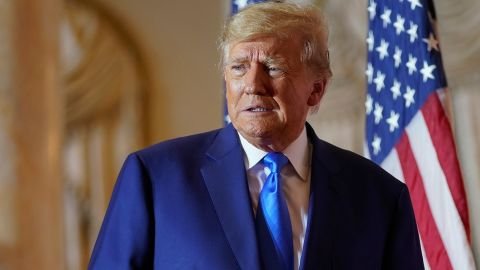
A United States jury has found that Donald Trump sexually assaulted writer E Jean Carroll in the 1990s and then falsely accused her of lying.
Following a seven-day trial, the verdict was announced in a federal courtroom in Manhattan on Tuesday afternoon, just hours after the jury’s deliberations had started.
Carroll claimed that in the middle of the 1990s, the former president—who is running for reelection in 2024—had sexually assaulted her in a department store in New York City. E Jean Carroll further claimed that Trump had defamed her by calling her memoir’s account of her experiences a “con job.”
A total of $5 million in compensatory and punitive damages were awarded by a jury of nine.
Carroll, 79, testified during the civil trial that Trump, 76, raped her in a Bergdorf Goodman department store dressing room in Manhattan in either 1995 or 1996, then harmed her reputation by writing in an October 2022 post on his Truth Social platform that her claims were a “complete con job,” “a hoax” and “a lie.”
President from 2017 to 2021, Trump is the front-runner in opinion polls for the Republican presidential nomination and has shown an uncanny ability to weather controversies that might sink other politicians.
The civil verdict is unlikely to have any effect on Trump’s core supporters, who see his legal troubles as part of an organized campaign by opponents to discredit him, given the polarised political environment in America today.
“The folks that are anti-Trump are going to remain that way, the core pro-Trump voters are not going to change, and the ambivalent ones I just don’t think are going to be moved by this type of thing,” said Charlie Gerow, a Republican strategist in Pennsylvania.
According to him, any adverse effects would probably be minor and would only affect moderate Republicans and suburban women.
Carroll could prove battery if she could prove that Trump assaulted her physically or that he sexually assaulted her, and the jury was tasked with making that determination. Each individual was questioned about whether Trump disparaged Carroll.
Trump won’t face any criminal repercussions because this case was a civil one. Carroll requested an unspecified amount of money in damages.
In an effort to increase their chances that the jury would conclude that Carroll had not made a strong argument, Trump’s legal team decided not to offer a defense.
Trump claimed that Carroll, a former Elle magazine columnist, and registered Democrat, made up the allegations to damage his political standing and boost sales of her 2019 memoir.
Because the case was in civil court, Carroll was required to establish her rape claim by “a preponderance of the evidence” – meaning more likely than not – rather than the higher standard used in criminal cases of “proof beyond a reasonable doubt.” Carroll had to show “clear and convincing evidence” to prove her defamation claim.
The trial featured testimony from two women who said Trump sexually assaulted them decades ago.
Former People magazine reporter Natasha Stoynoff told jurors that Trump cornered her at his Mar-a-Lago club in Florida in 2005 and forcibly kissed her for a “few minutes” until a butler interrupted the alleged assault. Another woman, Jessica Leeds, testified that Trump kissed her, groped her, and put his hand up her skirt on a flight in 1979.
Jurors also heard excerpts from a 2005 “Access Hollywood” video in which Trump says women let him “grab ’em by the pussy.”
“Historically, that’s true, with stars … if you look over the last million years,” Trump said in an October 2022 video deposition played in court. He has repeatedly denied allegations of sexual misconduct.
Also read: Stormy Daniels loses Defamation Case against Trump
