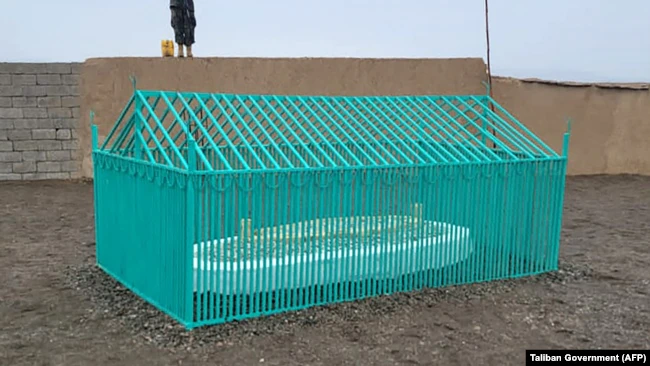
Mullah Omar’s grave revealed nine years after death: Report
The location of Mullah Omar’s last resting place was made public by the Taliban on Sunday after being kept secret for years following his passing and burial.
After a U.S.-led war forced the Taliban out of power in 2001, there were several rumors concerning Omar’s condition and location; the Taliban didn’t acknowledge his death until April 2015, two years after it had occurred.
Senior officials of the organization attended a ceremony at his tomb earlier in the day close to Omarzo, in the Suri area of Zabul province, according to the Taliban’s Zabihullah Mujahid, who spoke to Agence France-Presse on Sunday.
In August of last year, the Taliban took back control of the country after defeating government forces as the U.S.-led military’s 20-year presence in the country came to an end.
In order to protect the tomb from harm and because the country was under occupation, Mujahid explained that it was kept a secret. “Only the close family knew where it was.”
Taliban leaders may be seen gathered around a straightforward white brick mausoleum that was covered in what appeared to be gravel and contained in a green metal cage in photos published by the authorities.
The decision has been taken, thus there are no longer any obstacles for people to visit the grave, according to Mujahid.
Omar, who was about 55 years old when he passed away, started the Taliban in 1993 as a response to the bloody civil conflict that broke out after the Soviet occupation of Afghanistan for ten years.
Under his direction, the Taliban imposed an exceedingly strict form of the Islamic law that forbade women from participating in public life and instituted severe public penalties, such as public hangings and beheadings.
Omar’s event comes a day after local Taliban leaders refuted rumors that resistance hero Ahmad Shah Massoud’s grave in the Panjshir Valley had been destroyed. Mujahid warned that if the accusations were accurate, the act would be “punished.”
Having led the fight against the Soviet occupation, Massoud is revered by ordinary Afghans but despised by the Taliban, who he also battled until his assassination by al-Qaida in 2001.
Since the Taliban seized control of the nation in August of last year, his tomb has been protected by Taliban militants in a magnificent granite and marble mausoleum overlooking the lovely Panjshir Valley.
Locals claimed a recently arrived group of fighters broke the tombstone, and an unconfirmed video of the desecrated burial was uploaded by local media and widely shared on social media.
The national hero’s monument was desecrated by new forces from Helmand and Kandahar when they stormed Panjshir, a local told AFP.
The director of information and culture for the Panjshir province, Nasrullah Malakzada, disputed that the tomb had been harmed and released a video that allegedly showed it to be such.
But it was clear from the movie that not all of the building was shown, particularly the section that was damaged in the original video.
Journalist requests to visit or take pictures of the mausoleum were rejected by Malakzada.
According to Mujahid, no one has the right to disparage the deceased.
He continued, “Previously, we had penalized people who had carried out such activities. This will also be looked into, and appropriate action will be done.”
