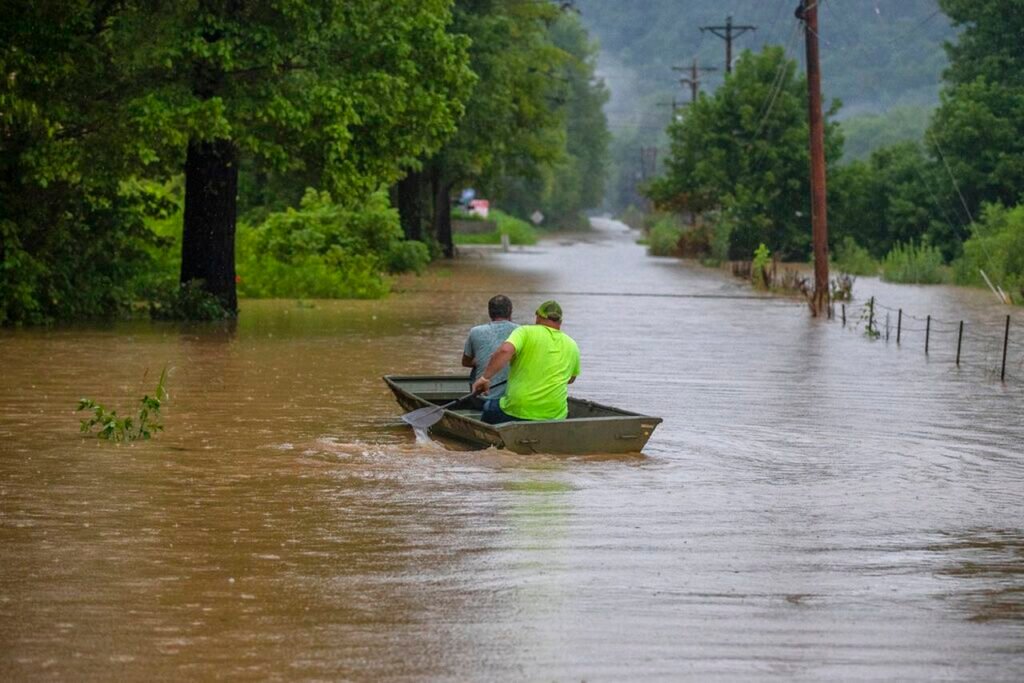
The administration issued a high alert after India released water into the Ravi River.
A flash flood of 175,000 cusecs is rushing forward at breakneck speed, and a high flood is expected in the Ravi.
According to the most recent information, India released 171,797 cusecs of water from the Ujh Barrage on Monday at 1530 PST. Considering the releases from the Ujh Barrage, inflows in the River Ravi at Jassar are expected to increase between 70,000 and 100,000 cusecs, reaching the medium to high flood level between 0000 and 1200 PST on August 16, 2022.
The Punjab irrigation department and local administration, as well as residents living in riverbank settlements, have been notified of the potential for flooding.
On Tuesday, an emergency meeting was held under the chairmanship of the Punjab Chief Secretary to review the province’s rain/flood situation.
The meeting was informed that if a flood occurred in the area, up to 600,000 people would be affected.
The rail track between Narowal and Sialkot washed away
Meanwhile, the Narowal-Sialkot rail line has been washed away as a result of the floodwaters that flooded Qila Ahmadabad.
The water flow in nullah Dek was 40,000 cusecs last night, whereas the nullah’s water capacity is 25,000 cusecs. The overflowing nullah inundated the surrounding areas, destroying the rail track near Qila Ahmadabad.
Today, there will be no train service between Narowal and Sialkot.
Flash floods in Pasrur have wreaked havoc on the surrounding villages.
People in 50 villages have been left stranded because rescue efforts have yet to begin.
Situation with flooding
Due to recent rains, the water level in the Chenab River near Wazirabad has risen once more. The water discharge at Marala Headworks in the Chenab River was 178,500 cusecs last night, while the water flow near Wazirabad was 195,950 cusecs. The inflow of water into the Chenab River at the Qadirabad headworks was 79,962 cusecs, while the outflow was 60,962 cusecs. A flood warning had been issued for Wazirabad’s surrounding areas.
Meanwhile, flood torrents from the Taunsa area in Kot Addu have wreaked havoc, and people have begun to relocate their belongings.
Floodwaters from the Suleman Mountains wreaked havoc in Taunsa, Dera Ghazi Khan’s Kot Chutta, neighboring tribal areas, and Rajanpur. Many houses collapsed, many people drowned, animals died, vehicles were swept away, and many roads leading to tribal areas were cut off.
On Monday, as many as 19 people were drowned in flash floods in Mosa Khel, Balochistan, and Dera Ghazi Khan, Punjab, with rescuers pulling nine dead bodies from the water.
Seven people were killed in the hill torrent from Koh-e-Suleman in Tuman Qaisarani in Dera Ghazi Khan, Punjab. Five bodies were discovered. However, one person was saved while another was still missing.
A woman died as a result of land sliding in the area.
Due to hill torrents from the Suleman Range Mountains, Dear Ghazi Khan has been cut off from the rest of the country.
The nullahs and streams in Kohlu, Barkhan, Dera Bugti, Jhal Magsi, and Jafarabad in Balochistan have overflowed, threatening to flood. The Nari and Tili rivers are experiencing moderate flooding.
According to official figures, 194 people have died in Balochistan.
Problems with the Met Office Warning of urban flooding
Meanwhile, the Metrological Department warned on Tuesday that heavy rains on the 15th and 16th of August could cause urban flooding in Rawalpindi/Islamabad, Peshawar, Nowshera, Mardan, Faisalabad, Lahore, and Gujranwala.
On the 15th and 16th of August, flash flooding is expected in the local nullahs of Islamabad/Rawalpindi, Shakargarh, Sialkot, Narowal, Abbottabad, Mansehra, Dir, Karak, Lakki Marwat, Bannu, and Kashmir.
From the 15th to the 18th of August, heavy rains may cause urban flooding in Karachi, Thatta, Badin, Hyderabad, Dadu, Jamshoro, Sukkur, Larkana, Shaheed Benazirabad, and Mirpurkhas.
During the forecast period of August 15th to 18th, flash flooding is expected in Qilla Saifullah, Loralai, Barkhan, Kohlu, Mosa Khel, Sherani, Sibbi, Bolan, Kalat, Khuzdar, Lasbella, Awaran, Turbat, Panjgur, Pasni, Jiwani, Ormara, Gwadar, and hill torrents may hit Dera Ghazi Khan.
During the forecast period, rain may cause landslides in Kashmir, hilly areas of Khyber Pakhtunkhwa, Galiyat, Murree, Chillas, Diamir, Gilgit, Hunza, Astore, Ghizer, and Skardu.
Monsoon currents from the Bay of Bengal are penetrating the country’s central and upper regions. Strong monsoon currents are expected to reach the southern parts of the country beginning Tuesday.
