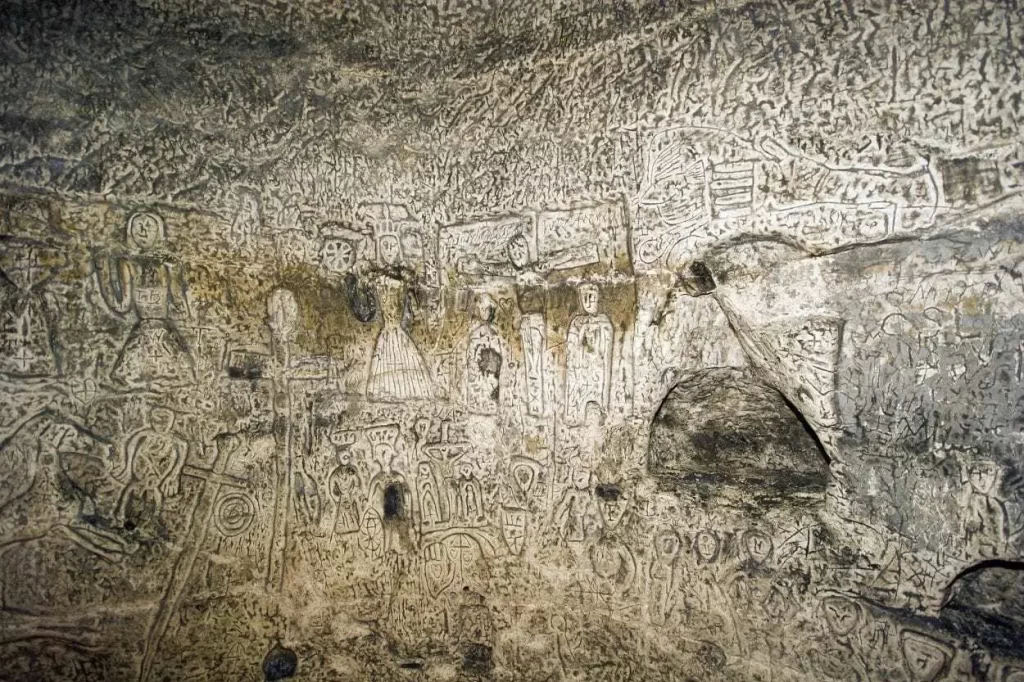
Royston Cave was discovered in 1742, cut into the chalk bedrock beneath crossroads in the centre of town. Shaped like a beehive, 16ft wide and 26ft tall, its walls are covered in crude carvings dated to the mid 1300s of Christian saints, animals and pagan earth goddess Sheela-na-gig.
Holes beneath the figures show they were once illuminated by candles and, whoever might have visited this subterranean oddity, most believe it has held a sacred energy for thousands of years.
The cave was constructed as a circular, bell-shaped chamber sunk into the chalk bedrock near the junction of the prehistoric and Roman trackway, known as the Icknield Way, and Ermine Street (the Roman Road from London to York).
The cave measures 8 metres in height, by 5 metres in diameter and contained a circumferential octagonal podium with a narrow-domed roof. A study suggests that the cave was divided into two levels, by a wooden frame or trestle that supported a raised platform.
The cave walls are decorated with an elaborate series of carvings unique in Britain, and only comparable to medieval carvings found in sites across central Europe and Israel.
Some of the depictions represent the Crucifixion, and possibly of the Holy Sepulchre and Holy Family, as well as St Katherine, St Lawrence, St Christopher, St George, Thomas Becket, and Richard I.
Christ, his disciples, and figures of saints and martyrs are also believed to be depicted, with the latter being presented with crosses and hearts adorning their clothing.
The carvings appear to correspond to the 13th century (based on their stylistic representation), but this is where the mystery of Royston Cave has caused debate among academics who try to determine its origins and function.
One such theory suggests that the cave was used as a secret meeting site for members of the Knights Templar, who held a stronghold in the nearby town of Baldock (using Baldock as a money-making enterprise to finance their crusades to the Holy Land).
Other theories try to connect the cave with Freemasons, suggesting that King James I used the cave to practice freemasonry (although James’s involvement in freemasonry is disputed) and the site functioned as an early Freemason’s Lodge.
It has also been suggested that the cave was built as a private chapel for the wife of William the Conquerer’s steward, Lady Roisia (for which the name “Royston” derives from “Roisia’s Town”).
