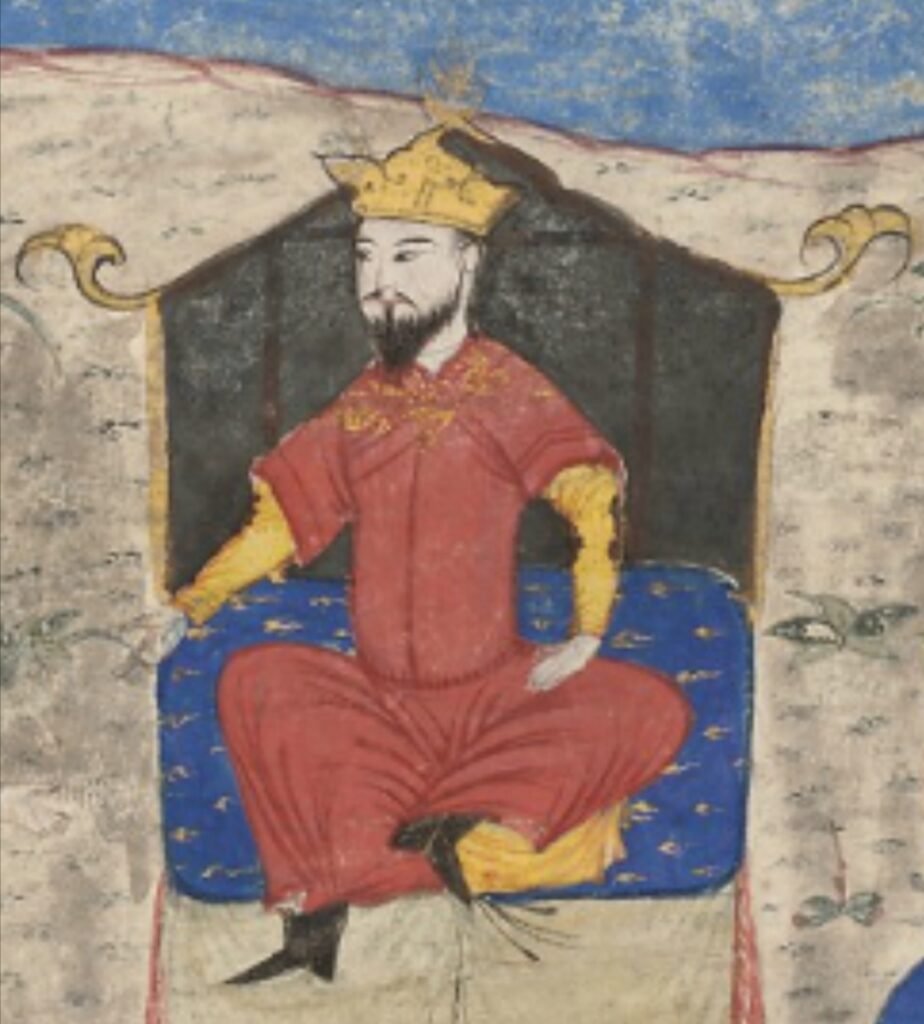
The second Sultan of the Great Seljuk Empire was Sultan Alp Arslan. Alp Arslan, also known as Muhammad ibn Daud, was the nephew of Sultan Tughril and the son of Chagri Beg, who established the Great Seljuk Empire in the eastern Iranian city of Nishapur in 1038 CE. In the year 1063 CE, he took the Seljuk throne.
Rise to power
After his father’s passing in 1059, Alp Arsalan presided as Khurasan’s governor before taking the kingdom. Arslan’s infant brother (relative) Sulaiman bin Qutulmish (Suleiman ibn Qutalmish) was named as Sultan Tughril’s heir after his passing. As a result, Arslan’s uncle Qutulmish disputed his claim to the throne. They thus clashed in 1063’s Battle of Damghan. In the conflict, Alp Arslan triumphed over his uncle Qutulmish and assumed the Seljuk crown.
Later Suleiman, the son of Kutalmish (Qutulmish) founded a separate Seljuk Sultanate of Rum in 1077 in Anatolia.
As a Sultan
As soon as Alp Arslan settled his position in Iraq, he undertook a new campaign in eastern Anatolia to consolidate his control. In 1064, he added Armenia and Georgia to his rule. This was a big milestone achieved by the Sultan to open his ways to march deeper into Anatolia.
For a good 40 years before the confrontation between Alp Arslan and Byzantine Emperor Romanos IV, Asia Minor had been penetrated by migratory Turkish groups in search of pastureland, with whom the Byzantines had proved wholly incapable of dealing. As a result, Emperor Romanos IV decided to check the Turkish raids and influence in the region and led a great army eastwards. Alp Arslan seized the opportunity to divert his army to confront the emperor who had given shelter to his Nawakiyya enemies.
Both armies met in the fields of Manzikert (now in modern-day Turkey). Sultan Alp Arsalan crushed the Byzantines in the battle and the emperor Romanos IV was captured by the Seljuks. When Emperor Romanos IV was brought as a prisoner in front of the Sultan, a famous conversation took place between the two:
Alp Arslan: What would you do if I was brought before you as a prisoner?
Romanos: Perhaps I’d kill you, or exhibit you in the streets of Constantinople.
Alp Arslan: My punishment is far heavier. I forgive you and set you free.
According to Peacock, “Manzikert is conventionally considered one of the great turning points in world history, opening the way to the collapse of the Byzantine empire in Anatolia and the establishment of Turkish rule there. However, both Byzantine and Muslim sources agree that Alp Arslan offered Romanus generous peace terms, involving merely the concession of a few frontier fortresses such as Edessa and the payment of an indemnity.”
The Seljuks did not move into Anatolia until after the death of Alp Arslan (1072), as Alp Arslan still considered the Fatimids of Egypt as his primary objective. Later Suleiman ibn Qutulmish was appointed as governor of Seljuk possessions in Anatolia.
Death
After his thumping victory over the Byzantines, Alp Arslan annexed much of western Asia into his empire. He now turned East and wanted to subdue his Kara-Khanid (Qarakhanid) enemies. On his way to the Qarakhanid campaign, his armies captured the Berzem Fortress, located on the bank of the Oxus river near Merv. There he was stabbed by Yusuf al-Khwarezmi or Yusuf al-Harani, the commander of the fortress.
According to 12th-century Seljuq historian Muhammad bin Ali Rawandi, “… A few slaves from the lower ranks of the army seized the fortress and brought the fortress commander, named Yousef-i Berzemî, as a prisoner to the Sultan’s throne. The Sultan asked Yousef about matters but Yousef did not respond properly so the Sultan ordered that Yousef be put to death. Realizing that he had no hope of living, Yousef took a dagger from his boot and attacked the Sultan.”
Although the Sultan’s personal slaves and soldiers wanted to hold Yousef, the Sultan bellowed, grabbed his bow and arrow, and fired at Yousef but missed. Yousef then reached the Sultan and wounded him.”
Four days later, he died because of his wounds and was buried at Merv. Sultan Alp Arslan was succeeded by his son Melik Shah.
