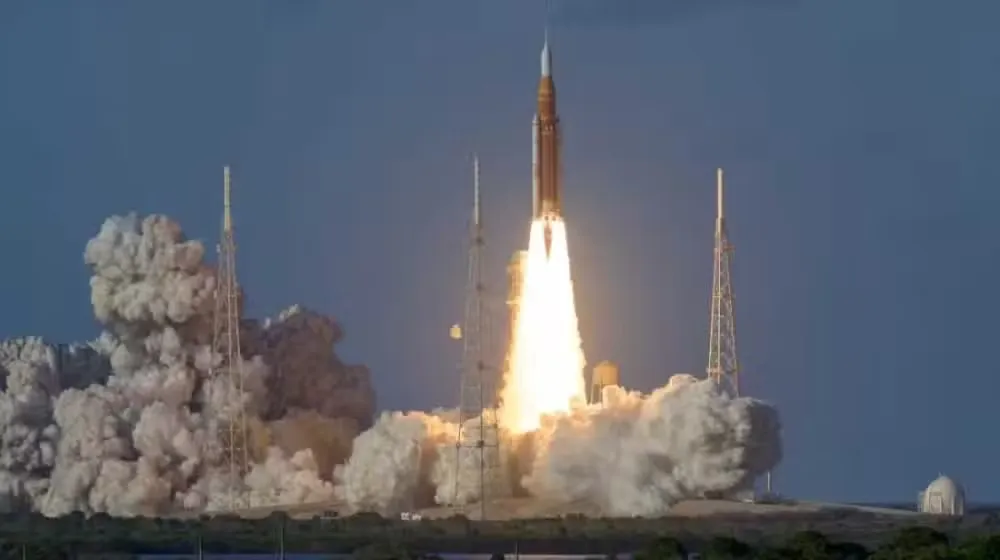
Four astronauts lifted off from Florida on Wednesday as the United States took its most significant step in decades toward returning humans to the Moon, marking a historic milestone in modern space exploration.
The mission, Artemis II, launched at 6:24 pm local time from Kennedy Space Center, where NASA’s powerful Space Launch System rocket carried the Orion spacecraft into orbit.
The crew includes American astronauts Reid Wiseman, Victor Glover, and Christina Koch, alongside Canadian astronaut Jeremy Hansen. Together, they represent the first humans to journey beyond low-Earth orbit since the Apollo era.
First Crewed Lunar Mission in Over Five Decades
Artemis II is the first crewed flight under NASA’s Artemis program and the first human mission toward the Moon since Apollo 17 in 1972. During the 10-day mission, the astronauts will travel nearly 406,000 kilometers, looping around the Moon before returning to Earth.
Although the crew will not land on the lunar surface, the mission is designed to rigorously test Orion’s life-support systems, navigation capabilities, and performance in deep space—critical steps ahead of future lunar landings.
Testing the Path to the Moon and Beyond
Shortly after launch, the Orion capsule successfully separated from the rocket’s upper stage. Astronauts then carried out early in-flight checks, including manually steering the spacecraft to confirm crew control in case automated systems fail.
NASA officials describe Artemis II as a full-scale rehearsal for upcoming missions that will place astronauts on the Moon’s surface later this decade.
Stepping Stone to a Lunar Base and Mars
NASA Administrator Jared Isaacman called the launch a defining moment for human spaceflight, saying the mission lays the foundation for a sustained presence on the Moon.
The Artemis program, launched in 2017, aims to establish long-term lunar operations and use the Moon as a proving ground for future missions to Mars. Following the uncrewed Artemis I mission in 2022, Artemis II marks the program’s transition to human exploration.
The next phase, Artemis III, is expected to land astronauts near the Moon’s South Pole using a lunar lander developed by SpaceX, potentially by 2028. The mission also unfolds amid growing global competition, as China plans its own crewed lunar landing around 2030.
Moments before liftoff, Canadian astronaut Jeremy Hansen summed up the mission’s significance in a message to mission control: “We are going for all humanity.”
NASA is livestreaming the mission and will continue to share updates as the crew undertakes humanity’s most ambitious journey into deep space in more than half a century.
