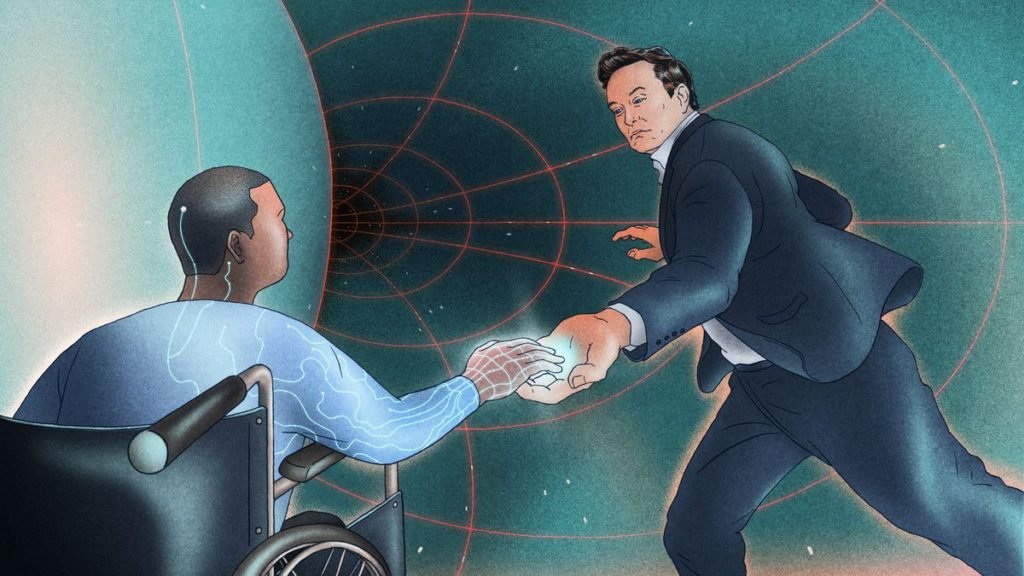
Elon Musk, the visionary entrepreneur behind Tesla and SpaceX, has been making waves in the tech world with his groundbreaking venture, Neuralink.
Launched in 2016 and unveiled to the public in 2017, Neuralink is focused on creating a symbiotic relationship between the human brain and artificial intelligence (AI).
Musk’s vision extends beyond mere talk, as the company claims to have successfully implanted its brain interface technology into a human patient in January 2024.
Key Developments:
- Innovative Technology: Neuralink is developing a coin-sized chip designed to be embedded in a person’s skull, with ultra-thin wires extending into the brain. This chip, equipped with 1,024 electrodes, can both record and potentially stimulate brain activity. The wireless transmission of data from the chip to computers allows for in-depth study and analysis.
- Robotic Implantation: To streamline the implantation process, Neuralink has introduced a robot capable of automatically inserting the chip into the brain. Musk claims this process could be as simple as LASIK eye surgery, emphasizing the machine’s potential to adjust for the movement of a patient’s brain during surgery.
- Animal Demonstrations: Neuralink showcased its technology with live demonstrations on animals, including a pig named Gertrude in 2020 and a monkey named Pager in 2021. While some experts find the neuroscience aspects to be moderate, the wireless relay from the Neuralink chip is seen as a significant advancement for the welfare of test animals.
- Controversies: In February 2022, an animal rights group raised concerns about the treatment of monkeys used in Neuralink research, citing documents indicating “extreme suffering.” Neuralink refuted the accusations, emphasizing its commitment to humane practices.
- Human Testing Timeline: Despite initial claims by Musk that Neuralink could begin human testing in 2020, the timeline has been pushed back. Musk now suggests that human implantation may commence in 2022, pending FDA approval. The company aims to focus initially on individuals with severe spinal cord injuries.
- Executive Changes: Max Hodak, Neuralink’s co-founder and president, left the company in April 2021. In February 2022, he disclosed his involvement with a rival biotech company, Synchron, and expressed confidence in both companies advancing neural interface technology.
- Family Ties: Musk, who has nine known children, welcomed twins with Shivon Zilis, Neuralink’s director of operations and special projects, in November 2021. Zilis, a former Tesla executive, adds a familial connection to Neuralink’s executive team.
Future Applications and Elon Musk’s Vision:
Looking ahead, Neuralink envisions immediate applications in treating neurological disorders like Parkinson’s and aiding individuals with quadriplegia.
Musk’s long-term vision involves achieving symbiosis between human consciousness and artificial intelligence, addressing what he perceives as the existential risk associated with digital superintelligence.
Also read: Elon Musk suffered a mental breakdown after buying Twitter: author
While Musk has made ambitious claims about Neuralink’s potential, experts remain skeptical, emphasizing the need for caution in performing brain surgery for non-essential purposes.
Neuralink’s Telepathy device, enabling control of devices through thought, is positioned as the company’s first commercial application for those who have lost the use of their limbs.
Conclusion:
As Neuralink continues to push the boundaries of neurotechnology, the world watches with anticipation. Musk‘s ambitious goals, coupled with the tangible progress seen in animal demonstrations and the reported human implantation, position Neuralink at the forefront of brain-computer interface innovation.
