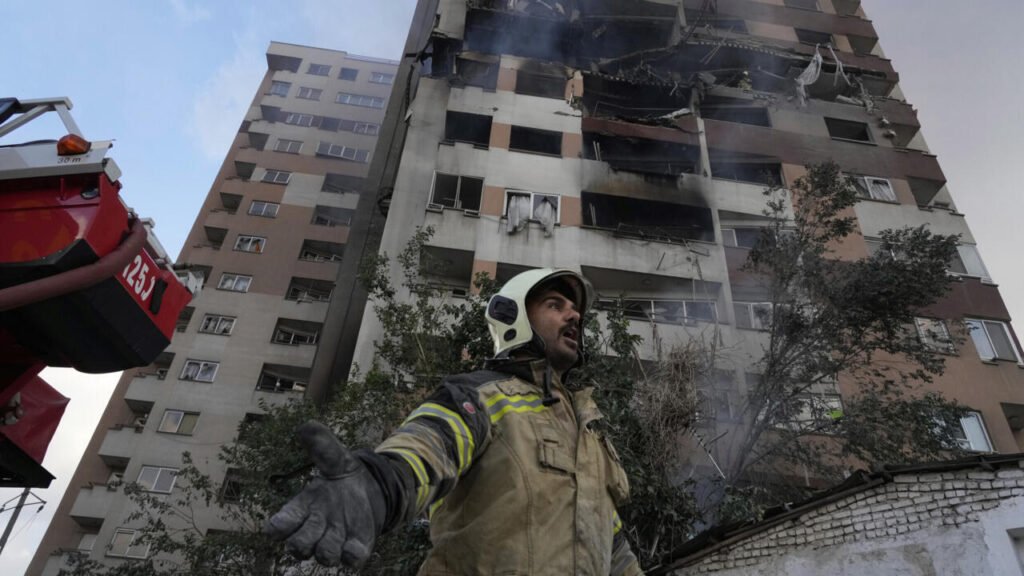
Imagine a city of over ten million souls—a bustling metropolis teeming with students, mothers, doctors, taxi drivers, and schoolchildren—suddenly ordered to evacuate under threat of catastrophic annihilation. This is not fiction. This is Tehran, a city more populous than New York, now facing an ominous ultimatum from a former U.S. president: “Evacuate immediately.”
The justification? Not nuclear enrichment, not a confirmed military threat, but vague, unsubstantiated accusations cloaked in political hysteria and strategic ambiguity.
If this becomes the new standard of Western military doctrine—targeting civilian population centers under the guise of deterrence—then the fire ignited in the Middle East today may well consume the very cities of the West tomorrow. A precedent has been set, and it is a dangerous one.
The recent warning issued by Donald Trump to evacuate Tehran—despite no nuclear site existing within the city—represents an unprecedented level of recklessness in American presidential history. This was not a tactical message. It was a blanket threat of total destruction against one of the world’s oldest and most culturally rich capitals.
This wasn’t about halting nuclear proliferation. That can be achieved through diplomacy and IAEA oversight, as has been done in the past. Instead, this appears alarmingly synchronized with Israel’s expansionist war ambitions and American attempts to reassert military dominance in the region. It raises urgent and uncomfortable questions:
- Is the U.S. preparing to provide Israel with military cover in a broader conflict?
- Are “dirty bombs” or other prohibited weapons being considered behind closed doors?
- And perhaps most gravely: Is the world’s most powerful nation endorsing the idea that civilians are fair game?
Has America forgotten Hiroshima and Nagasaki? The atom bombs dropped in August 1945 did not just decimate military infrastructure—they obliterated entire communities. Infants were vaporized. Mothers burnt alive. The living were cursed with generations of cancer, birth defects, and trauma.
Those were not acts of tactical precision. They were the world’s first televised massacres—sanctioned by a democratic power and justified as “necessary”.
Targeting Tehran’s civilian population echoes this moral catastrophe, and it revives the same dark question: What kind of civilisation justifies the slaughter of the innocent to flex geopolitical muscle?
If targeting cities becomes an accepted part of modern warfare—if levelling urban centers is rebranded as “strategic deterrence”—then what is to stop others from applying the same logic?
What if tomorrow, drones or missiles rain down on London, Paris, Berlin, or New York, not because of military aggression, but because someone claimed they harbored “ideological threats”? What moral defense will the West mount then?
During WWII, Nazi Germany bombed London into near oblivion. In response, the Allies flattened Dresden and Berlin. The war was not just fought on battlefields—it was fought over civilians’ heads.
Is the world prepared to walk that same path again?
Iran is not Iraq. Tehran is not Tripoli. The regional backlash to such a strike would not be limited; it would be volcanic. The precedent America is setting with its threat is one that others—adversaries and rivals—may eventually use against the West itself.
True leadership avoids the path of annihilation. It persuades with strength, not panic. But threatening the erasure of a city with ten million people? That’s not a calculated move—it’s state terrorism masquerading as foreign policy.
If the world tolerates this, it is tolerating the normalization of civilian annihilation as a strategic tool. This is not deterrence—it is the start of something far worse: a new age where no city, no child, no hospital, and no history is safe.
The Geneva Conventions, the UN Charter, and every major international legal framework prohibit the targeting of civilians in armed conflict. Threats like the one issued to Tehran are not only unethical—they’re illegal.
This is reminiscent of the Nuremberg Trials, where leaders were held accountable for policies that targeted civilian populations. If such trials were valid then, they are valid now. History will remember today’s threats—and perhaps tomorrow’s actions—with the same horror.
Should the West believe that Iran would fold under such pressure, they are tragically mistaken. Iran’s network of regional alliances—spanning from Hezbollah in Lebanon to militia groups in Iraq and Yemen—represents a formidable geopolitical force. They have neither the intention nor the capacity to allow Tehran to fall unchallenged.
Any attack on Tehran would not be an isolated strike—it would ignite the entire region in flames. Israel would not be safer. American bases would not be untouched. Global oil routes would not remain open. Cyberattacks, proxy wars, and drone strikes—all are real, present-day retaliatory options.
Let this be said with complete clarity:
If you declare open season on cities, do not expect your own cities to remain untouchable.
If you threaten ten million civilians, do not act surprised when your own civilians face the same horror.
If you redefine the rules of war, be prepared to live by them.
This is not a game. This is not a simulation. The West has walked too far into its echo chamber, confusing dominance with security. But dominance that rests on the graveyards of innocents is not security. It is a countdown to collapse.
The world doesn’t need more missiles. It needs more memory. The path to peace does not go through mass graves and burning capitals. It begins with courage—the courage to restrain power, to seek diplomacy, and to listen before launching.
America must understand: if it continues down this path, it may wake up one day to find that the world it once dominated is no longer listening, no longer fearing—and no longer tolerating its unchecked aggression.
Today, you threaten Tehran.
Tomorrow, the world may return the favor.
