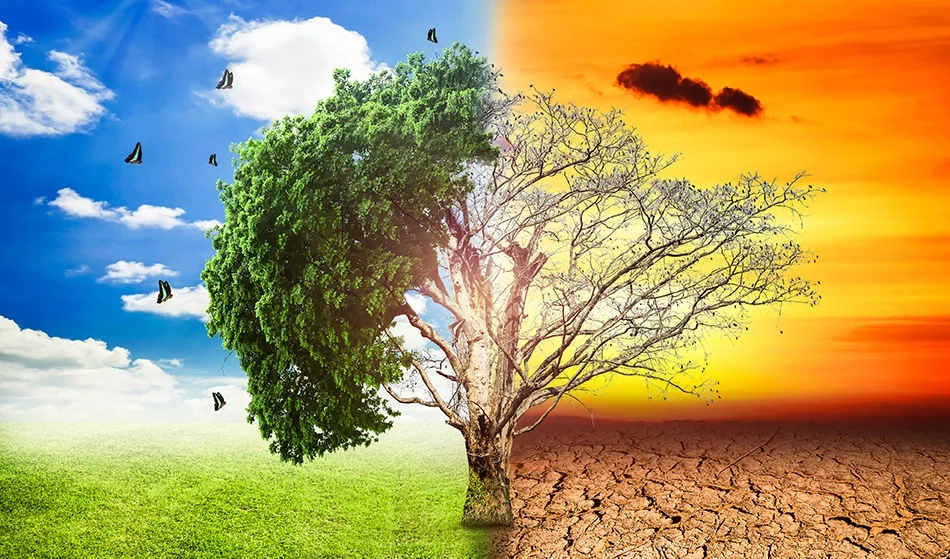
Global warming has been introduced by the scientific population. It arises owing to more and more deforestation. Due to this, it will elicit far more genuine climatic changes than simply a rise in global temperature. Nowadays, the earth’s climate is the result of extremely complex interactions among the atmosphere and oceans land abundances, and living organisms which are all warmed daily by the sun’s energy. When global climate worsens, it means it’s more affected by conservatory gases. The main reason for that is cutting trees. Therefore, the public must avoid cutting the trees and the government must take a serious step regarding this issue. Although Pakistan itself contributes very little to the overall emissions of Greenhouse Gases, it remains one of the most severely hit countries of the world by the process of Global warming. Global warming has affected the climate of Pakistan in the following manners.
Pakistan ranks 16th on the Climate Change Vulnerability Index(CCVI) by Maple Croft, jumping up 13 positions in one year. German watch also places Pakistan as the “most affected” country for 2010 and in the top 10 for 1990-2010 by climatic changes. Climate changes are costing the economy $14 billion a year, which is almost 5% of the GDP. According to the Asian Development Bank, more than 10 million people have been displaced in Pakistan over the last 2 years due to these climate-related disasters. Pakistan‟s economy has been crippled heavily by devastating and repetitive floods during the last decade. In the past 10 years, Pakistan has been hit by floods almost every year. The floods of 2010 and 2011 have emerged as the biggest catastrophes in the country’s history such as the 2010 floods, the melting of glaciers, and recurrent floodings.
The flood of 2010 remains one of the biggest tragedies in the world‟s history, with 20 million people affected by it. The floods resulted in approximately 1,781 deaths, injured 2,966 people, and destroyed more than 1.89 million homes. Although nowhere near the 2010 floods, the 2011 floods also wreaked havoc, and affected 5.3 million people and 1.2 million homes in Sind, as well as inundating 1.7 million acres of arable land. A distressed woman clutches her children as she wades through shoulder-high water in the flood-affected areas of Sind. A Drought is a period of abnormally dry weather due to the lack of rainfall. The chief characteristic of a drought is a decrease in water availability in a particular period and over a particular area. Pakistan‟s economy has been punched heavily by the continuous spell of droughts for the last many years, particularly in the provinces of Baluchistan and Sind. The drought in these areas has reduced the river flows, resulting in the drying up of the irrigation canals, leading to severe agricultural deprivation. It has also been responsible for causing immense losses to poultry and other animals, causing a general deficiency of food and water for people.
The increased temperatures because of the increased GHGs as well as a mismanagement of the water reservoirs need to be blamed for the condition. Tropical cyclones are also a dreaded characteristic of the climate in various parts of Pakistan. As a result of global warming, the frequency of Cyclones has increased over the Arabian Sea during the last 50 years. Moreover, the intensity of these cyclones has also increased during the last quarter of the 20th century. Strong tropical activity in the Arabian sea in 2001, 2004, 2007, 2010, and 2011 shows an increasing trend towards more cyclones, indicating that there are bright chances that future cyclones can directly strike mega-metropolis cities like Karachi and kill thousands of people and may change the way these cities used to live. As an ill effect of global warming, the annual mean surface temperatures in Pakistan have been steadily increasing during the past century. A rise in mean temperature of 0.6-1°C in the coastal areas along with a 0.5 to 0.7% increase in solar radiation over the southern half of the country has been observed. In central Pakistan, a 3-5% decrease in cloud cover with increasing hours of sunshine has also been responsible for increasing the temperatures. The year 2010 broke all records as Mohenjo-Daro, a city in Sind faced a temperature of 53.5 °C, the hottest temperature ever recorded in Asia and the fourth highest temperature ever recorded in the world.
The summer of 2010 caused a temperature of above 50 °C in twelve cities of Pakistan. The scorching heat resulted in the death of at least 18 people. The increasing temperatures due to global warming have resulted in a progressive melting of glaciers, which has resulted in a gradual increase in sea levels. According to the Karachi Tidal Station, an increase in the mean sea level at a rate of 1.1 mm/yr has been recorded during the past 100 years. The ravaging sea continues to engulf the surrounding land and consumes 80 acres a day on average. Six subdivisions of Thatta, which were previously considered extremely prosperous due to extensive agriculture, are now amongst the poorest parts of the country due to the engulfment by the sea. And air pollution is a major public health problem across Pakistan, where an estimated 128,000 people die annually from air pollution-related illnesses, according to the Global Alliance on Health and Pollution. But researchers say the government has downplayed the severity of the problem for years, produced unreliable data, and sought to pass the blame to neighboring India.
Indeed, the environmental protection department of Punjab, the province surrounding Lahore, has not updated its air quality level for several weeks on its website, reporting it at 166 a level of airborne fine particulate matter that the U.S. EPA considers to be “unhealthy” but which the Pakistani government says is Some of the sources for this smog include vehicular pollution with very poor fuel quality being used along with lack of pollution control technologies in our vehicles, industrial pollution, burning of municipal and even industrial waste and brick kilns which again use dirty fuel such as rubber tires,” says Khalid who also heads the Environment and Climate Change Department at the Sustainable Development Policy Institute, Islamabad. Sectoral Emission Inventory for Punjab shows that the major portion of air pollution emissions are coming from the transport sector and it holds a 43pc share in all sectors (power, industry, transport, and crop burning residue). The second major pollutant is an industry whose share is 25pc while the third major pollutant is agriculture which accounts for 20pc. Collectively, the main sectors creating air pollutants and emissions are power, industry, and transport which have 80pc contribution to emissions and pollution, from which Punjab’s photochemical smog conditions arise.
