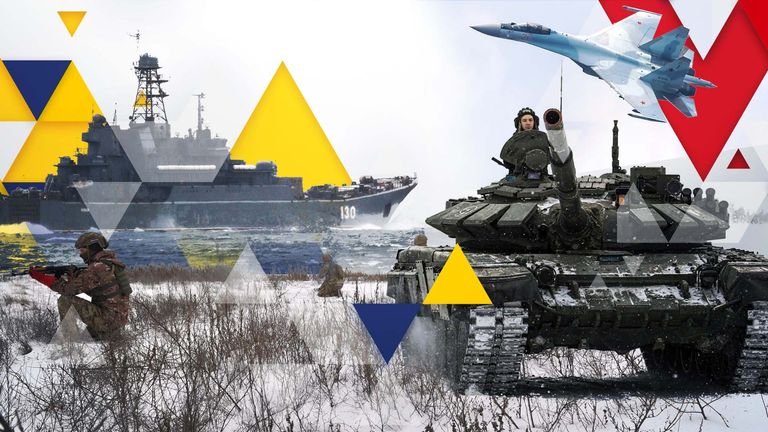
The crisis in Ukraine has escalated with the onset of the year 2022. It took the form of a bone of contention between the West and Russia and now has emerged as a full-scale war with Russia’s attack on her. The conflict has a long history that started at the end of the cold war. The end of the cold war in the 90s and the disintegration of the USSR made the newly formed Russia quite weak, militarily and economically. However, the re-emergence of Russia as an important player in the world arena after the election of Vladimir Putin brought power politics back to the region. This resulted in the annexation of Georgia in 2008 and Crimea in 2014.
Presently, the new escalation witnessed in the Ukrainian region is owing to two major reasons. One is the country’s application for NATO membership and the second is the threats to Russia’s national interests. Russia has always, after her disintegration, tried to maintain a sphere of influence over the past soviet territories. She has done so to safeguard its economic interests as in the current, geo-economic world, strategic interests are now measured in respect of economy. The membership of Ukraine in NATO will harm these strategic interests of Russia wants safe sea land of communication for its energy trade in its eastern region as most of its western and northern part is devoid of such lines due to the freezing atmosphere. Ukraine, being a sovereign state has been adamant to protect its security interests after the annexation of Crimea through membership in the western security bloc – NATO. Against this backdrop, the invasion of sovereign Ukraine has raised many questions under international law with respect to the territorial sovereignty of states and effects on them upon intervention.
As far as the question of sovereignty of Ukraine is concerned, under Montevideo Convention 1933 Article 1 a territory is sovereign and is qualified for recognition by the international community if it possesses four important elements. These are permanent population, a definite territory, government, and capacity to enter into relations. Keeping in view Article 1, Ukraine indelibly possesses all the features of statehood and is therefore regarded as a sovereign state. Consequently, the other question that arises is whether Ukraine possessing sovereignty can enter into any organization or become part of any treaty of its own motion. According to Max Huber, the arbitrator in the Island of Palmas Arbitration case, sovereignty in the relation between States signifies independence.
Independence in regard to a portion of the globe is the right to exercise therein, to the exclusion of any other state, the functions of a state. Among the functions of the state, one of the most important is the capacity to enter into relations and in respect of Ukraine, it is her right after the exclusion of others to enter into the NATO agreement. Moreover, the intervention by Russia in Ukraine is also a pressing issue under international law. Under Article 2(4) of the United Nations Charter, the use of force or threat to use force is not permissible by any member state against the political independence and territorial integrity of any state. Such use or threat if committed is considered as a breach of the peace or an act of aggression under Chapter VII of the UN Charter. In the context of Ukraine, Russia’s assailing her sovereignty gives the former sovereign state under the customary international law; mentioned in Caroline case 1837 and Article 51 of the UN Charter; the right to individual and collective self-defense. Even if such a right of self-defense is not practiced by Ukraine, collective intervention by other sovereign states can be made under the UN Charter to protect her sovereignty.
Another moot point that has arisen under international law with respect to Russia’s invasion of Ukraine is whether such invasion gives sovereign rights to the former over the latter. Under international humanitarian law (IHL), the occupation of a state by another is regarded as a belligerent occupation. Such, occupation does not amount to the exercise of sovereignty over the occupied territory and ceases to remain after the international armed conflict comes to an end. The application of IHL over the conflict between Ukraine and Russia is unequivocal as the two are sovereign states possessing essentials of statehood. Therefore, the attack on Ukraine is directly a violation of international law by Russia which can be legally dealt with by non-military and military measures of the international community including through sanctions, embargoes, and military forces.
Hence, the sovereignty of Ukraine, though its eastern part has been annexed, is in force. Russia’s assault on her amounts to an act of aggression that gives the whole international community right to exercise military and non-military actions against her, mentioned in chapter vii of the charter, that might further escalate the situation. Therefore, to protect the sovereignty of Ukraine and dismiss the doubts of all-out nuclear war, the only route available is in the form of negotiations and diplomacy provided under chapter vi of international law.
