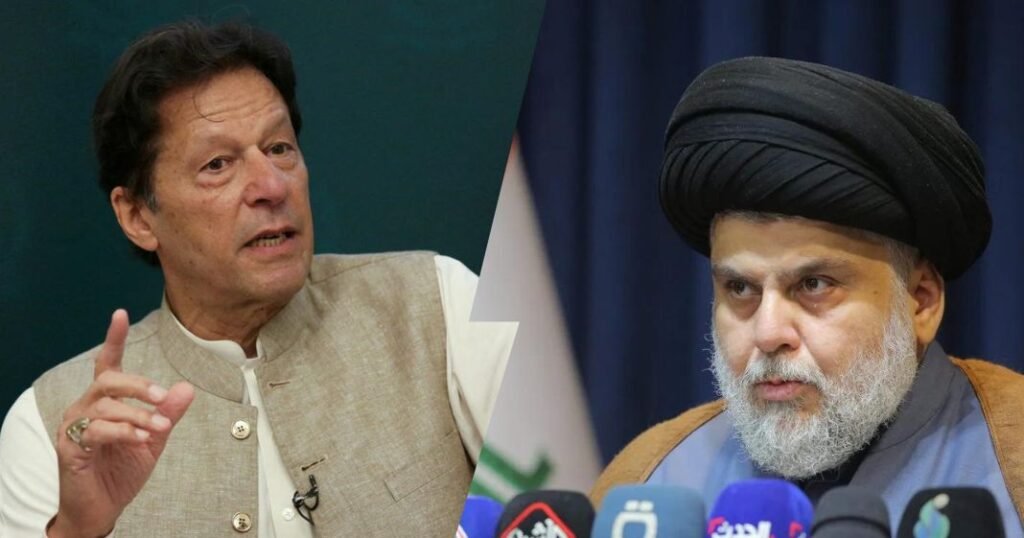
Although Pakistan and Iraq are in widely different regions, we find an astounding parallel in the political narratives and approaches of their two political leaders. This writing piece explores the political narratives and contemporary political activities of Imran Khan and Muqtada Al-Sadr, with a particular, but not exclusive, emphasis on the commonalities between the two. The ground for making this comparison is the astonishing closeness of the narratives and approaches of the two men.
The article discusses the points that demonstrate the resemblance between the two populist leaders’ political moves. The first point of commonality is the populist narrative of revolution and jihad against corruption and foreign involvement in the individual countries’ domestic politics. Secondly, both leaders are running campaigns against coalition groups in their own countries. Finally, Khan and Al-Sadr both are asking for the dissolution of their country’s parliament and fresh elections.
Despite the similarities in the two leaders’ political strategies, there are some differences in the conditions under which these two populist movements are taking place. The most noteworthy contrasts are the magnitude of the opposition experienced by these two political groups in their respective countries, as well as the presence of elements other than coalition opponents. However, before delving into the parallels and contrasts, a quick overview of the two leaders’ struggles and recent political developments in their countries will assist grasp the basis of this comparison.
Imran Khan founded the Pakistan Tehreek-e-Insaf (PTI) political party in 1996. In 2018, Imran Khan formed a coalition government in Pakistan. He was unable to complete his tenure, carrying on the unpleasant legacy of former prime ministers in the country. On 9 April 2022, he was ousted in a vote of no confidence. Since then, he has been pulling massive gatherings and pursuing a popular nationwide campaign for new elections in Pakistan.
Muqtada Al-Sadr is an Iraqi Shia cleric and the head of the Sadrist Party. In the past, Al-Sadr and his party remained part of coalition governments. In the recent elections of October 2021, his party emerged as the largest party securing 73 seats. However, these seats were insufficient to establish a government, and efforts to form a coalition government were unsuccessful. A month ago, Sadrist Party members resigned from their seats in parliament. Since then, Al-Sadr has attracted a massive crowd, now he is demanding the dissolution of parliament and fresh elections.
One of the most striking parallels between Imran Khan and Muqtada Al-Sadr is their nearly identical populist narratives. Since 2013, Pakistan’s Imran Khan has centered his campaign against corruption. However, he has recently shifted his narrative on foreign interference in Pakistani domestic politics. He alleged that his removal was the consequence of a “foreign conspiracy” against him by the United States. He referred to the Pakistan Democratic Movement (PDM) coalition government as an “imported government” which is unacceptable. This year, Imran Khan has also repeatedly asserted in protests that he is not doing politics, but rather jihad. Along the same lines, Muqtada Al-Sadr’s political narrative was previously oriented towards anti-corruption, but he has now altered his narrative to the involvement of Iran in Iraq’s domestic politics. He has been vocal in his opposition to the “Coordination Framework” alliance, which is alleged to be backed by Iran. Muqtada Al-Sadr is portraying his campaign as a “revolution,” somewhat similar to Imran Khan’s narrative of jihad. Hence, the two political leaders are telling a nearly identical story and gaining the support of the masses, particularly the youth.
Secondly, both leaders are facing coalition opponents. In the case of Imran Khan, as previously said, the PDM is in power, and he is continually calling for the end of the coalition government. PDM is a coalition of political parties including the PML (N), the PPP, and other smaller parties. Similarly, Muqtada Al-Sadr is opposing the Coordination Framework’s efforts to establish an Iran-backed coalition government in Baghdad. The coalition just announced their candidate for prime minister. This prompted Al-Sadr and the Sadrist party to mount a more vigorous resistance. Sadrist Party activists breached the guarded Green Zone and stormed the Iraqi Parliament, where they are presently continuing their sit-in. Not to mention that during Imran Khan’s long march, several ardent PTI supporters also penetrated Islamabad’s restricted Red Zone. Thus, Khan is challenging the coalition of PDM in Pakistan while Al-Sadr is resisting the coalition of Coordination Framework.
Lastly, both Khan and Al-Sadr are staging protests against the dissolution of their country’s parliament and general elections. Imran Khan began calling for fresh elections shortly after his ouster on 9 April 2022. He is still mounting pressure and holding protests, urging the PDM government to dissolve the assemblies and hold early elections. Similarly, in Iraq, Muqtada Al-Sadr is protesting having the same demands. The slight difference is that he began to demand early elections very recently. As of now, Al-Sadr supporters are continuing their sit-in outside the parliament, asking that the parliament should be dissolved. Thus, another link between the two leaders’ political moves is the call for the dissolution of parliament and prompt elections.
Although Imran Khan and Muqtada Al- Sadr’s political activities are similar, they are not in identical conditions. The differing degrees of resistance posed by the respective governments to these movements is a major difference. When Imran Khan marched into the capital on 25 May 2022, he was met with severe pushback from the PDM administration. The PDM was able to put a stop to this anti-government demonstration. Furthermore, Imran Khan is at a disadvantage since he no longer has excellent good connections with the country’s establishment. On the contrary, Muqtada Al-Sadr and his followers have not faced such opposition because Iraq’s present government is interim. Instead of clamping down on Sadrist Party supporters, the interim government led by Mustafa Al-Kadhimi has asked demonstrators to be calm and peaceful. Thus, despite numerous similarities, there are distinctions in the circumstances under which Khan and Al-Sadr are making political decision moves.
To conclude, the actions of the two politicians are remarkably similar. Imran Khan of Pakistan and Muqtada Al-Sadr of Iraq both are populist leaders. They both have changed their political narratives from corruption to foreign involvement in their respective country’s politics. Khan and Al-Sadr are opposing coalitions of the Pakistan Democratic Movement (PDM) and the Coordination Framework, respectively. Both men are gaining popular support by using terms like jihad and revolution while seeking the dissolution of their respective countries’ parliaments and fresh elections. Imran Khan and Muqtada Al-Sadr’s political moves are quite similar yet not so similar after all. Despite having many commonalities, there are differences in the conditions in which Khan and Al-Sadr are making similar political decisions. It would be interesting to observe the outcomes of these two leaders’ almost similar actions in their respective conditions.
