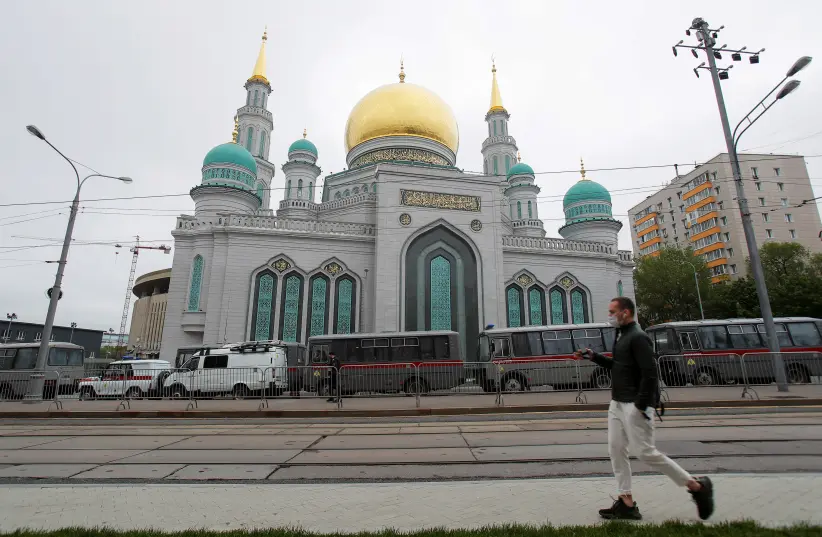
On September 1, Russia will launch Islamic banking for the first time as part of a two-year pilot programme.
Islamic financial institutions have existed in Russia for some time, with a Muslim population of up to 25 million people, but this is the first time the country’s legislation has officially approved their establishment.
On August 4, Russian President Vladimir Putin signed legislation to assess the “feasibility” of Islamic banking.
The pilot programme will be implemented in four Muslim-majority republics: Tatarstan, Bashkortostan, Chechnya, and Dagestan, which already have the most experience with Islamic finance.
Also read: 7 Russians who opposed Vladimir Putin and paid heavy price
If the programme is successful, the new regulation will be implemented throughout the country.
Here’s all you need to know about the new experiment:
What is different about Islamic banking?
Shariah, the Islamic legal system, forbids transactions involving usury or the charging of interest as it is considered an unjust exchange.
Whereas conventional finance is debt-based, with the client bearing all risk and liability in transactions, Islamic banking is asset-based, with profit and risk shared as part of a partnership between the financial institution and the client.
“No bank can benefit from the client’s financial problems and insolvency that often happens in conventional finance,” Madina Kalimullina, the executive secretary of the Russian Association of Experts in Islamic Finance, told Al Jazeera.
“Islamic finance promotes partnership-based relations, which is rarely the case in conventional finance,” she said.
Islamic banking also does not finance socially harmful industries like alcohol, tobacco, and gambling.
Another significant distinction is that Islamic banking does not permit financing speculation, financial derivatives, or “deals with no real asset,” which were previously responsible for the global financial crisis, according to Kalimullina.
Why is Russia introducing Islamic banking?
According to the senior vice president, Oleg Ganeev, of Sberbank, Russia’s largest lender, the Islamic banking sector has an annual growth rate of 40 per cent and is reportedly expected to reach a value of $7.7 trillion by 2025.
Kalimullina said that “the growing market needs regulation and investors and clients protection”, but the Islamic finance market could not use the benefits of state support programmes for mortgage financing and for small and medium enterprises as they are all based on interest-bearing loans, contrary to Shariah.
“These obstacles are partly solved for mortgage finance in the adopted law. It’s expected that the experiment will allow to develop further conditions for Islamic finance development,” Kalimullina said.
Did Western sanctions influence Russia’s decision to launch Islamic banking?
According to Diana Galeeva, an academic visitor at Oxford University in the United Kingdom, Islamic banking is a “long-awaited initiative” that has been discussed in Russia since the 2008 financial crisis, “when banks faced a liquidity shortage and began to look for alternative sources of cash.”
Following the annexation of Crimea from Ukraine in 2014, the “Association of Russian Banks proposed allowing Islamic banking in the Russian Federation and establishing a committee within the Central Bank to regulate the activities of Sharia banks,” Galeeva told Al Jazeera.
The war in Ukraine and Western pressure on Russia’s economic sector are just two of the most recent developments that have accelerated the transition to Islamic banking.
“Every new wave crisis in recent years has prompted Russia to turn further away from the West and toward the East, which in many cases means greater links with economies of Muslim-majority countries,” Galeeva said.
The main reason Russia’s economy has remained resistant to Western sanctions is due to its energy revenues, according to Galeeva, and “Islamic banking will, by comparison, have a very small direct impact.”
The new two-year experiment, however, will “make Russia, and these regions in particular, more attractive to foreign investment from the Middle East and other countries with Shariah finance frameworks.”
Kalimullina expressed hope that the new programme will foster “asset-based financing and risk-sharing partnership relationships.”
“The first group to benefit from the new market are the small and mid-sized enterprises, which are very often under-financed. Islamic finance, as it is well known, is more oriented at financing the real economy with real economic products,” said Kalimullina.
