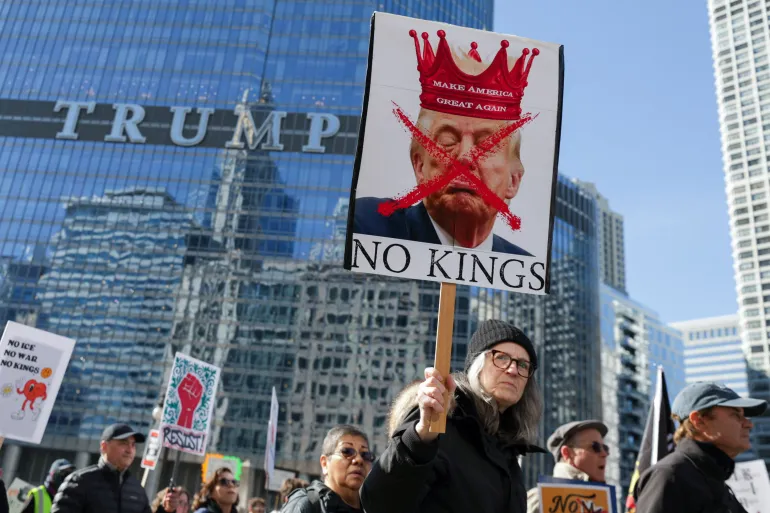
A seismic wave of dissent swept across the United States on Saturday as hundreds of thousands of demonstrators participated in the third iteration of the “No Kings” protests, delivering a thunderous rebuke to the Trump administration’s immigration crackdown, military engagement in Iran, and what organizers are calling a dangerous expansion of presidential power.
The rallies, which unfolded from the marble steps of the Lincoln Memorial to the intersections of rural Main Streets, represent the largest coordinated act of civil resistance since President Donald Trump returned to office in January 2025. Organizers declared the movement a direct stand against “tyrannical rule,” with a collective rallying cry: “Power belongs to the people, not wannabe kings.”
‘Streets of Minneapolis’ Rings Out in St. Paul
One of the most charged gatherings took place in St. Paul, Minnesota, where grief and fury converged over the January deaths of Renee Nicole Good and Alex Pretti, two individuals killed during operations by federal immigration agents.
Tens of thousands lined the streets surrounding the State Capitol, their ranks swelling with high-profile Democratic leaders and a surprise performance by music icon Bruce Springsteen. The legendary rocker delivered a searing rendition of his anti-immigration enforcement anthem, “Streets of Minneapolis,” transforming the capitol grounds into a stage for political defiance.
Clashes Erupt in Los Angeles and Dallas
While the majority of demonstrations remained peaceful, the afternoon saw violent flare-ups in several metropolitan hubs.
In Los Angeles, the atmosphere turned volatile outside the Roybal Federal Building. After demonstrators hurled projectiles at federal officers, agents deployed non-lethal measures to disperse the crowd. Authorities confirmed two arrests following assaults on federal personnel.
Meanwhile, in Dallas, skirmishes broke out between protesters and counter-protesters, leading to several detentions. In New York City, the movement brought Midtown Manhattan to a standstill as police temporarily shuttered streets in Times Square to accommodate the surging crowds marching past Trump Tower.
From the National Mall to Small-Town America
In the nation’s capital, the scene was one of theatrical defiance. Crowds blanketed the National Mall and cascaded over the steps of the Lincoln Memorial. Protesters carried effigies of President Trump, Vice President JD Vance, and other administration officials, with chants of “arrest them” echoing across the reflecting pool.
However, the movement’s strength was also visible in America’s heartland. Demonstrations materialized in towns with populations as small as 10,000—including Shelbyville, Kentucky, and Howell, Michigan—proving that opposition to the administration’s policies on federal immigration enforcement and the war in Iran has permeated even the most rural precincts.
Several states activated the National Guard as a precautionary measure ahead of the rallies, though organizers noted that the protests were overwhelmingly peaceful despite isolated incidents.
White House Fires Back
The White House swiftly dismissed the massive turnout, issuing a statement that characterized the events as “Trump Derangement Therapy Sessions.” Officials accused mainstream media outlets of exaggerating the crowd sizes and the movement’s significance.
President Trump, who has faced mounting scrutiny over his use of executive orders and federal deployments, defended his administration’s actions. In remarks following the protests, he rejected accusations of authoritarian overreach, asserting that his policies are “necessary to restore order” and secure the nation’s borders.
A Movement Gaining Momentum
Saturday’s protests mark the third major mobilization for the “No Kings” movement, following a nationwide demonstration in October that organizers claimed drew nearly seven million participants.
With tensions over immigration enforcement, executive authority, and foreign policy showing no signs of abating, political analysts suggest that the scale of Saturday’s turnout signals a deepening political chasm heading into the summer.
