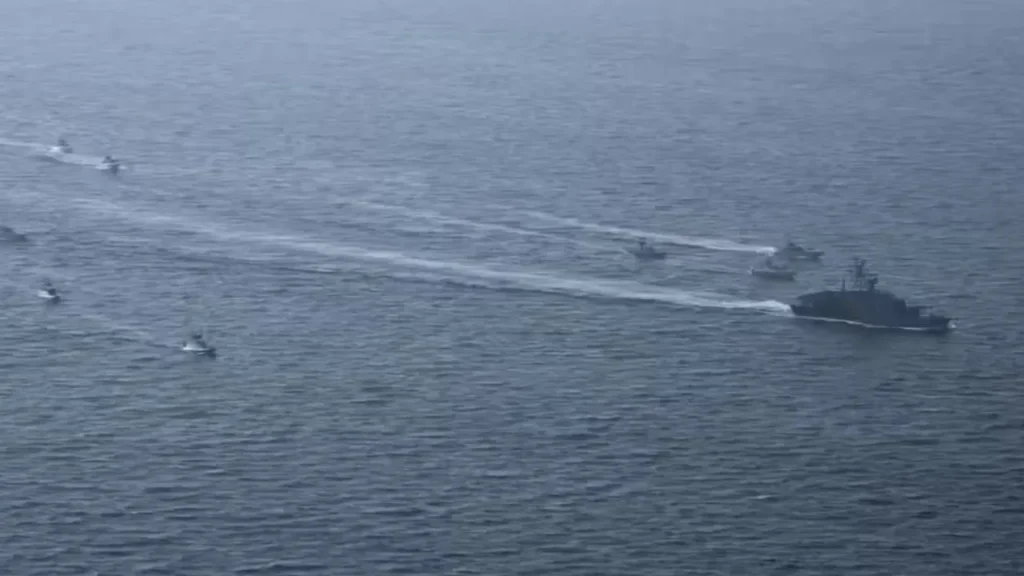
The Iranian Revolutionary Guard Corps (IRGC) has issued a dramatic new ultimatum amid the rapidly expanding Iran–US–Israel conflict, announcing that any Arab or European country that expels the ambassadors of Israel and the United States will be granted what it called “full authority and freedom” to navigate the Strait of Hormuz.
The statement, broadcast by Iranian state media, comes as the IRGC enforces a de facto blockade of the world’s most critical energy corridor. Roughly 20 percent of global oil trade transits the Strait of Hormuz, making any disruption a direct threat to global energy security. Since the conflict intensified, at least 10 commercial vessels have reportedly been attacked or seized in the waterway.
IRGC officials said Iranian forces—not American troops—will “determine the end of the war”, adding that the future balance of power in the Middle East is now “in the hands of Iran’s armed forces”.
Trump Signals Endgame but Threatens Deeper Strikes
US President Donald Trump claimed the current US military campaign has already achieved its objectives and “is going to be ended soon.” However, he simultaneously warned Tehran that Washington could escalate dramatically if Iran continues to disrupt global oil flows.
“If Iran blocks energy supplies, we can go further—much, much harder,” Trump said, reinforcing fears of a wider regional war involving direct US–Iran confrontation.
Iran Shuts Door on Diplomacy
Iranian Foreign Minister Abbas Araghchi rejected any possibility of renewed negotiations with Washington, stating that talks with the US are “no longer on the agenda”.
Also read: Top IRGC generals, nuclear scientists martyred in Israeli strikes on Iran
Araghchi confirmed that Iran is prepared to sustain missile operations for as long as necessary. He also issued a warning over the deployment of US HIMARS rocket systems in neighboring countries, saying, “Nobody should complain if our powerful missiles destroy these systems wherever they are, in retribution.”
Missiles, Airstrikes, and Expanding Battle Zones
On the ground, the violence shows no sign of slowing. In Tehran, emergency crews reached the site of a missile strike that hit a residential area, while thick smoke rose over western parts of the capital following Israeli airstrikes.
Iran has launched repeated missile barrages toward Tel Aviv, while the IRGC claimed responsibility for a missile strike on the US Al-Harir Air Base in Iraq’s Kurdistan region.
The US Central Command said American forces have struck more than 5,000 targets across the region, including at least 50 Iranian naval vessels involved in Hormuz operations.
NATO, Turkiye, and Iraq Drawn In
The conflict is increasingly spilling across borders. Türkiye announced the deployment of a Patriot missile defense system to Malatya after NATO intercepted a second Iranian ballistic missile in Turkish airspace.
In Iraq, Prime Minister Mohammed Shia al-Sudani warned US Secretary of State Marco Rubio that Iraqi airspace and territory must not be used to launch attacks against neighboring states.
Meanwhile, South Korean President Lee Jae Myung acknowledged that Seoul could not prevent the redeployment of Patriot missile batteries from the Korean Peninsula to the Middle East, despite strong domestic opposition.
Mass Evacuations and Energy Market Shockwaves
As tensions rise, foreign nationals are fleeing the region. China confirmed the evacuation of more than 10,000 of its citizens from the UAE, Oman, and Saudi Arabia, citing deteriorating security conditions.
Also read: Ali Mousavi Iran IRGC commander shot dead in clashes
The economic fallout is being felt worldwide. Egypt raised domestic fuel prices by 30 percent, blaming rising import costs linked to the conflict. Despite the turmoil, oil markets showed sharp volatility, with West Texas Intermediate crude falling over six percent to around $88 per barrel.
Rising Civilian Toll
The human cost continues to mount. More than 1,300 civilians have reportedly been killed in Iran since the escalation began. In Bahrain, at least 32 civilians were wounded after a drone attack struck the industrial area of Sitra.
A Conflict Reshaping the Middle East
With diplomatic channels effectively frozen, military escalation accelerating, and the Strait of Hormuz emerging as the central pressure point, analysts warn that control of global energy routes may define the next phase of the war.
The IRGC’s offer of safe passage in exchange for political alignment signals a new, high-stakes strategy—one that could redraw alliances, disrupt oil markets, and reshape regional security for years to come.
