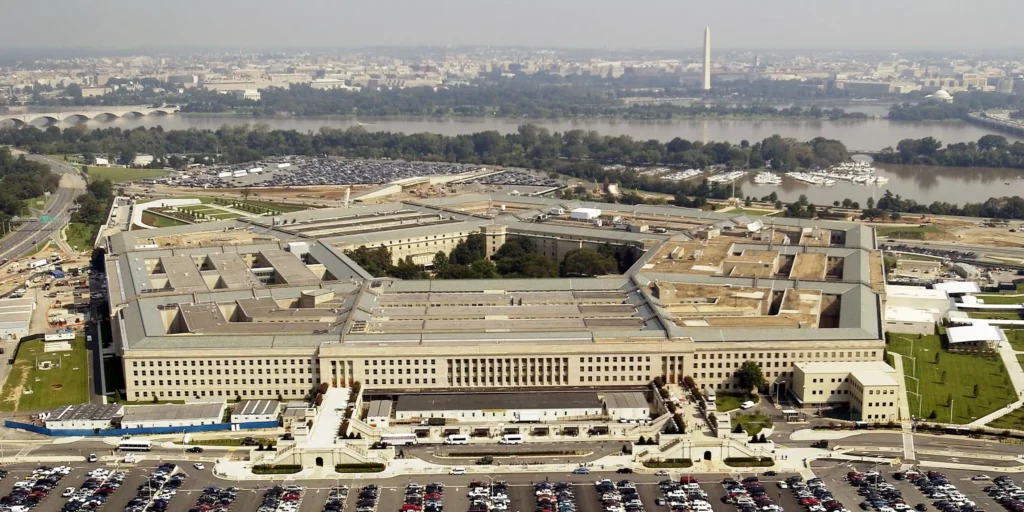
Senior officials from the Trump administration acknowledged in closed-door briefings with congressional staff on Sunday that there was no intelligence indicating Iran planned to attack US forces first, according to two people familiar with the discussions.
The admission came a day after the United States and Israel launched their most extensive military campaign against Iran in decades. US and Israeli officials say the strikes killed Iran’s Supreme Leader Ayatollah Ali Khamenei, sank Iranian warships, and hit more than 1,000 targets across the country.
However, Sunday’s briefings appeared to undermine one of the administration’s central public justifications for the war.
Pentagon Briefings Lasted More Than 90 Minutes
According to Reuters, officials from the Pentagon briefed Democratic and Republican staff from multiple national security committees in both the Senate and House for over 90 minutes.
White House spokesperson Dylan Johnson said the briefings focused on the scope and objectives of the ongoing operation.
During the sessions, officials emphasized that Iran’s ballistic missile program and its regional proxy forces posed a serious threat to US interests. But they conceded there was no intelligence showing Tehran intended to strike US forces preemptively, the sources said.
That acknowledgement contrasted sharply with statements made to reporters a day earlier, when senior officials said Donald Trump ordered the attacks partly due to indicators Iran might strike US forces in the Middle East.
One official said Trump was unwilling to “sit back and allow American forces in the region to absorb attacks.”
Democrats Call It a ‘War of Choice’
Democrats have accused Trump of launching a “war of choice,” questioning the abandonment of diplomatic efforts that Oman had said still held promise.
Trump has argued—without presenting evidence—that Iran was close to acquiring the capability to strike the United States with a ballistic missile.
Sources familiar with US intelligence assessments told Reuters those claims were not supported by intelligence reports and appeared exaggerated.
Scrutiny of the administration’s rationale intensified as the US military confirmed the first American casualties of the conflict.
Scepticism Over Regime Change
Despite the killing of Khamenei, many senior US officials remain sceptical that the joint US-Israeli campaign will lead to regime change in Iran anytime soon.
Before and after the strikes began, Trump and other officials suggested toppling Iran’s governing system was among Washington’s objectives, alongside crippling its missile and nuclear programs. Trump even urged Iranians to rise up against their leaders.
Yet three US officials familiar with intelligence assessments said there is deep doubt that Iran’s weakened opposition could overthrow the entrenched system that has ruled since 1979.
Earlier Central Intelligence Agency assessments presented to the White House warned that if Khamenei were killed, he would likely be replaced by hard-line figures from the Islamic Revolutionary Guard Corps (IRGC) or equally hard-line clerics, rather than reformist leaders.
Officials also noted that no IRGC defections occurred during massive anti-government protests in January—an indicator that a successful revolution remains unlikely.
Iran Responds, US Debates Continue
On Sunday, Iranian President Masoud Pezeshkian announced that a temporary leadership council had assumed the Supreme Leader’s duties. Security chief Ali Larijani accused the US and Israel of attempting to disintegrate Iran and warned separatist groups of harsh retaliation.
Meanwhile, US intelligence agencies continue to debate—without consensus—whether Khamenei’s death will alter Iran’s approach to nuclear negotiations or deter it from rebuilding military capabilities.
Trump himself signaled uncertainty about Iran’s future, saying on Sunday that he planned to reopen communications with Tehran, suggesting Washington does not expect the current government to collapse immediately.
US Casualties Mount as War Continues
The conflict’s human cost is rising. US Central Command said three US troops were killed and five seriously wounded, with several others suffering minor injuries.
US aircraft and warships have now struck more than 1,000 Iranian targets, including underground missile facilities hit by B-2 stealth bombers using 2,000-pound bombs.
A Reuters/Ipsos poll released Sunday showed 27% of Americans approve of the strikes, while 43% disapprove and 29% remain undecided, highlighting growing domestic divisions as the war enters a critical phase.
