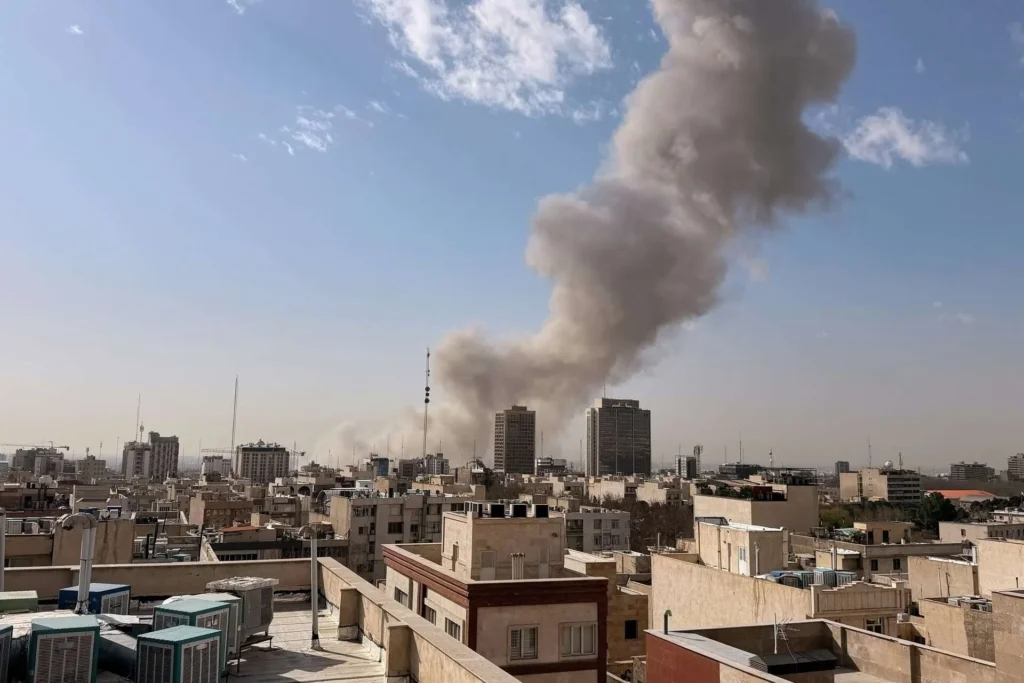
Israel carried out a rare daylight strike on Tehran on Saturday, sending plumes of smoke into the Iranian capital’s downtown area and sharply escalating tensions already running high over Iran’s nuclear program, according to the Associated Press.
The exact target of the attack was not immediately confirmed. However, the strike comes amid an intensified US military presence in the region, where fighter jets, naval vessels, and air defense systems have been deployed in an effort to pressure Iran into reaching a new agreement over its nuclear activities.
Israel’s Defense Minister Israel Katz described the operation as a move “to remove threats,” without providing further details. Witnesses in Tehran reported hearing a powerful explosion, while Iranian state television later acknowledged the blast but did not specify its cause.
At the same time, air-raid sirens were activated across Israel, with the Israeli military saying it had issued a “proactive alert” to prepare civilians for the possibility of missile launches toward Israeli territory.
The US military declined to comment on the strike, but the incident follows weeks of heightened rhetoric from Washington. Earlier in February, US President Donald Trump warned that “really bad things” would occur if Tehran failed to reach a deal limiting its nuclear ambitions.
The attack also comes shortly after a third round of US-Iran talks in Switzerland, where negotiators sought to ease the long-running standoff. Ahead of those discussions, US Secretary of State Marco Rubio said Iran’s refusal to address its ballistic missile program alongside its nuclear activities remained a “big, big problem” for Washington.
Iran has signaled conditional flexibility on its nuclear program but has consistently rejected including missile development in negotiations. Frustration in Washington has been growing, with the White House previously stating that Tehran was failing to meet core US demands.
Earlier this month, Iran reportedly warned in a letter to Antonio Guterres that it would respond “decisively” to any military aggression.
The rising geopolitical risk has rattled global energy markets. Oil prices climbed to six-month highs, driven by fears of supply disruptions in the Middle East.
Iran, a founding member of OPEC, plays a central role in global energy flows and sits astride the strategically vital Strait of Hormuz, through which roughly 20% of the world’s oil supply transits.
Tensions between Washington and Tehran have flared repeatedly in recent years. Last June, the US struck three Iranian nuclear facilities, inflicting what intelligence assessments described as severe damage. Iran later retaliated with missile strikes on a US air base in Qatar, causing limited damage and no reported casualties.
With diplomacy faltering and military posturing intensifying, analysts warn that the region faces a growing risk of miscalculation that could rapidly spiral into a wider conflict with global economic consequences.
