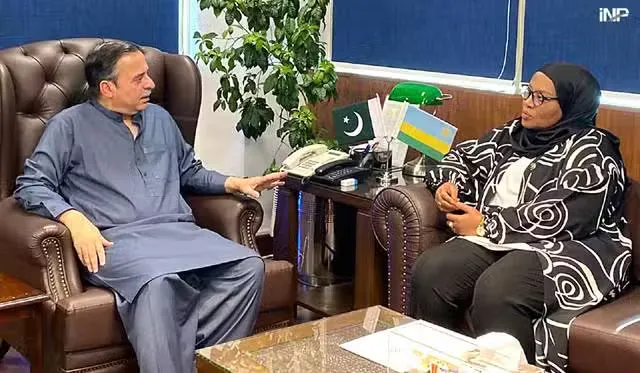
Pakistan and Rwanda have agreed to move toward direct trade and shipping links, identifying improved supply chain connectivity and reduced transit costs as immediate priorities to deepen bilateral economic cooperation.
The understanding was reached during the Rwanda Coffee Festival in Islamabad, inaugurated by Federal Minister for Commerce Jam Kamal Khan.
On the sidelines of the event, the commerce minister held talks with Rwanda’s Minister of Trade and Industry Prudence Sebahizi, with both sides agreeing to establish direct supply chains, strengthen business-to-business engagement, and expand cooperation across multiple sectors.
Coordinator to the Prime Minister for Commerce Rana Ihsaan Afzal Khan was also present at the meeting.
Expanding Cooperation Across Key Economic Sectors
Both countries agreed to widen collaboration in trade, agriculture, manufacturing, logistics, and investment, with an emphasis on building structured and predictable commercial linkages.
Also read: South African white rhinos facing extinction moved to Rwanda
Addressing the event, Jam Kamal Khan said Pakistan and Rwanda, as agro-based economies, shared strong complementarities at a time when global food security had become a strategic concern. He said the engagement aimed to unlock untapped trade potential through long-term, institutionalized partnerships.
Coffee and Tea Trade Opportunities Highlighted
The commerce minister noted that Rwanda’s exports to Pakistan had traditionally been dominated by tea, but coffee consumption in Pakistan is rising rapidly, particularly among younger consumers.
Pakistan currently imports tea worth nearly $3 billion annually, while coffee is steadily transitioning from a niche product to a mainstream consumer item.
Kamal Khan said Rwanda’s premium-quality coffee, competitive pricing, and geographic positioning gave it a natural advantage. He added that Pakistan’s market of over 250 million people could also serve as a gateway for Rwandan coffee exports to Central Asia, western China, and neighboring regions.
He also referred to Pakistan’s ongoing tariff rationalization policy, under which tariff lines are being gradually reduced to enhance competitiveness.
Pakistan’s Export Strengths and Import Interests
On the export side, the commerce minister highlighted Pakistan’s strengths in:
-
Rice
-
Textiles
-
Leather and footwear
-
Sports goods
-
Surgical instruments
-
Pharmaceuticals
-
Home appliances and electronics
-
Agricultural machinery
He said Pakistan had already begun exporting tractors to African markets and was keen to diversify trade with Rwanda on a mutually beneficial basis.
Pakistan also expressed interest in importing Rwandan avocados, pulses, lentils, and beans, with assurances of facilitation in phytosanitary certification through cooperation between relevant authorities.
Rwanda Sees Pakistan as a Major Market
Rwanda’s trade minister described Pakistan as a major potential market and said Rwanda was actively diversifying exports beyond tea to include speciality coffee, spices, and other value-added products.
He said the coffee festival was part of a broader strategy to introduce Rwandan coffee to Pakistani consumers.
Also read: UK due to send first flight of asylum seekers to Rwanda
Sebahizi also highlighted Rwanda’s role as a regional trade and distribution hub, offering access to a market of over 1.4 billion people under the African Continental Free Trade Area (AfCFTA).
He noted that Pakistani rice, both basmati and non-basmati, is consumed in Rwanda and re-exported to other African markets.
Direct Shipping Routes to Cut Time and Costs
Both sides emphasized the need to establish direct supply chains to reduce reliance on transshipment through third countries. Rwandan officials said discussions were under way with Pakistan’s maritime authorities to significantly reduce shipping times and costs, noting that current transit periods of up to 45 days could be shortened.
The ministers also reviewed progress on a proposed memorandum of understanding (MoU) on trade and economic cooperation, which has already been exchanged through diplomatic channels.
Rwanda said only minor technical adjustments remained and expressed confidence that the agreement could be finalized soon.
Karachi–East Africa Sea Routes Under Discussion
Separately, Federal Minister for Maritime Affairs Muhammad Junaid Anwar Chaudhry and Rwandan High Commissioner Harerimana Fatou discussed proposals to establish direct sea routes from Karachi to East African ports, including Djibouti and Mombasa.
The discussions included plans to reduce shipping costs by up to 30 percent and shorten transit times through a Karachi–Djibouti route.
The maritime affairs minister said Gwadar was being positioned as a future export hub for Africa, supporting Pakistani exports while facilitating imports of Rwandan tea, coffee, and avocados.
He added that direct maritime links would improve connectivity for Rwanda, despite its landlocked status, by using Djibouti and Mombasa as key gateways.
