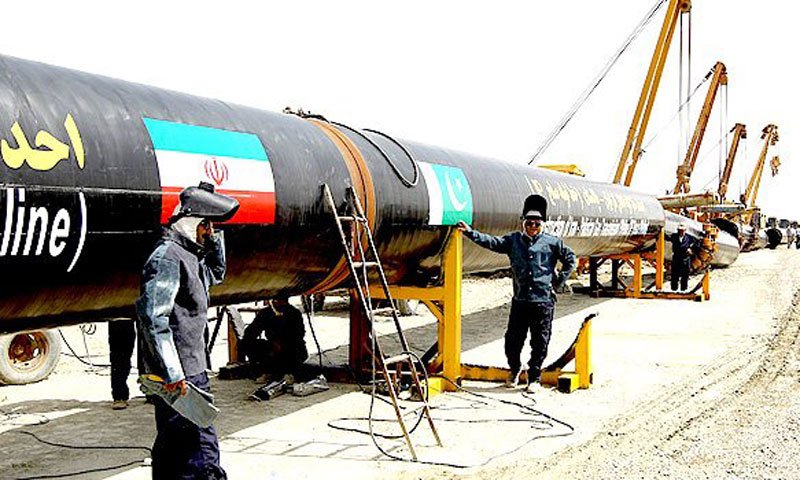
Pakistan rethinking to complete Iran gas project avoiding US sanctions. The governing bodies have begun developing a strategy to restructure the long-stalled Iran-Pakistan (IP) gas pipeline project in order to avoid US sanctions and the $18 billion penalty by Tehran, according to top officials in the Law Division.
“Under the new option, Pakistan may not purchase the gas directly from Iran, but through a third party or a powerful country to escape the US sanctions imposed against Iran for its nuclear ambitions. Iranian authorities are also on the board.”
The interim energy minister was asked if the authorities are seeking to reorganize the project to avoid US curbs and a $18 billion penalty, but he did not respond until the publication of this story.
“Pakistan has so far failed to lay down the pipeline in its territory in the wake of US sanctions against Iran whereas Tehran has laid a pipeline from a gas field to the point bordering Pakistan. Pakistan has been very sensitive and careful in implementing the project as it never wanted to be the victim of US sanctions.”
Iran has been pressing for no sanctions on gas commerce and, more crucially, pipeline building into Pakistani territory.
In the most recent scenario, in January 2023, Iran formally requested that Pakistan construct a portion of the gas line project on its territory until February-March 2024, or face a $18 billion penalty.
Also read: Why $6 Billion US-Iran deal is under discussion after Hamas attack
“When Pakistan’s delegation visited Tehran in November-December 2022, Iranian authorities had said that the US sanctions on Iran were illegal and Pakistan, and under the revised agreement, Pakistan was bound to erect the pipeline in its territory till February-March 2024. Iran had already completed part of the pipeline in its own territory from the gas field to the Pakistan border.”
The Gas Sales Purchase Agreement (GSPA) was signed in 2009 for a period of 25 years, but the project never materialised.
Almost 12 years have gone since the agreement was signed, and the pipeline’s three-year construction term in Pakistani territory has been squandered.
Under the GSPA, Pakistan was obliged to lay down a 781-kilometer pipeline from the Iranian border to Nawabshah on Pakistani territory.
Under the initial deal, Pakistan was obligated to pay Iran $1 million every day beginning January 1, 2015, as a penalty.
In addition, if Iran seeks arbitration, Pakistan would be forced to pay billions of dollars as a penalty.
The project was to be carried out using a segmented technique, which required Pakistan to construct the pipeline on its soil and Iran to lay the pipeline on its side.
The project was supposed to be finished by December 2014 and work by January 1, 2015.
Pakistan made numerous attempts to get information about how US sanctions would be affected if it decided to build a gas pipeline through the US embassy, but no response was received.
“Now the Attorney General’s Office (AGO) has been tasked to make contacts with US relevant departments to know what US sanctions would impact Pakistan if Islamabad decided to complete the project.”
According to sources, top officials in the Law Division and the Ministry of Energy have begun exploring the possibility of restructuring the IP gas pipeline project so that it is completed and the $18 billion fine is also avoided.
As Pakistan rethinking to complete Iran gas project avoiding US sanctions, the authorities are attempting to include a third party or a strong nation that is unconcerned about US sanctions in the project transaction.
“Pakistan will purchase the gas from a third party and this is how the project will be completed setting aside the sanctions and gas intake will also be ensured.”
