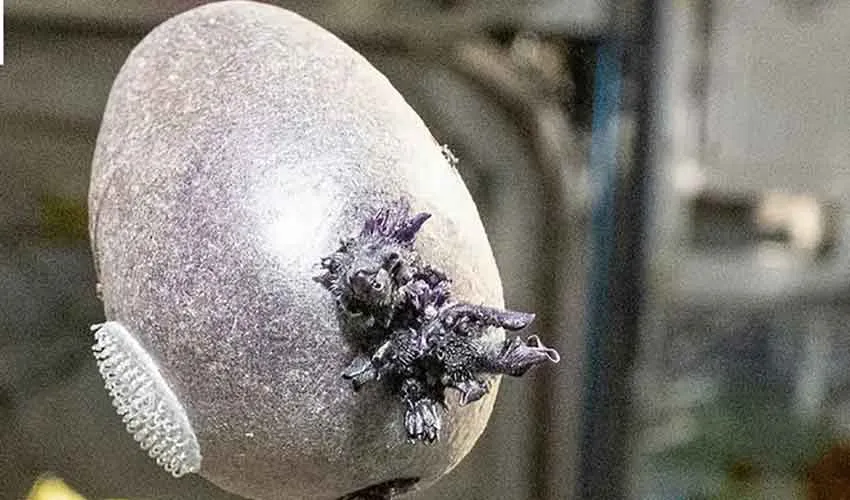
A strange and otherworldly image shared by a NASA astronaut aboard the International Space Station sent social media into a frenzy this week, with many users convinced they were looking at an alien egg or some form of extraterrestrial organism emerging from its shell.
The purple, egg-like form appeared to show a creature-like shape breaking free, triggering wild speculation across multiple platforms. But the reality, as the astronaut later confirmed, proved to be far more down to earth and unexpectedly humorous.
Not an Extraterrestrial Organism But an Ordinary Potato
The astronaut clarified that the bizarre object was not an alien at all but an ordinary potato whose sprouting roots had assumed an unusual and almost monstrous form due to the effects of microgravity. Without the directional pull of gravity, potato sprouts grow in chaotic and often surprising patterns, producing shapes that can easily be mistaken for something alien.
On the social media platform X, the astronaut humorously named the specimen Spudnik 1, a clever play on Sputnik, the first artificial satellite launched into space. He explained that the potato had been secured with a special Velcro hook within a temporary lighting system designed to enable plant growth in the weightless environment of the orbiting laboratory.
Inspiration Came from The Martian
The astronaut revealed that the idea for the impromptu experiment came from the hit film, The Martian, in which astronaut Mark Watney, played by Matt Damon, famously grows potatoes on Mars to survive after being stranded alone on the red planet. That science fiction concept has now inspired real-world experimentation aboard the International Space Station.
According to the astronaut, potatoes are a highly efficient crop in terms of nutrition, caloric density, and growth rate, which means they may play an important and practical role in future long-duration space missions to the Moon, Mars, and beyond.
NASA’s History of Space Gardening
It is worth noting that NASA has previously conducted a wide range of plant growth experiments in space, including lettuce, kale, and zinnia flowers. These experiments aim to provide astronauts with additional fresh nutrition during extended missions, as well as to study how plants adapt to microgravity before humanity attempts to grow food on other worlds.
The Vegetable Production System, known as Veggie, has been operating aboard the International Space Station for several years, successfully demonstrating that crops can be cultivated in space. Potatoes, however, represent a next step toward calorie-dense staple crops that could sustain crews for months or years away from Earth.
Spudnik 1 Captures the Internet’s Imagination
While the alien egg theory has been officially debunked, Spudnik 1 has captured the internet’s imagination in a different way. The image stands as a reminder that in the weightless void of space, even the most ordinary Earthly objects can appear extraordinary, mysterious, and just a little bit alien.
As one social media user put it, it is not an alien invasion. It is just a potato on a Velcro hook. And that might be even more fascinating.
