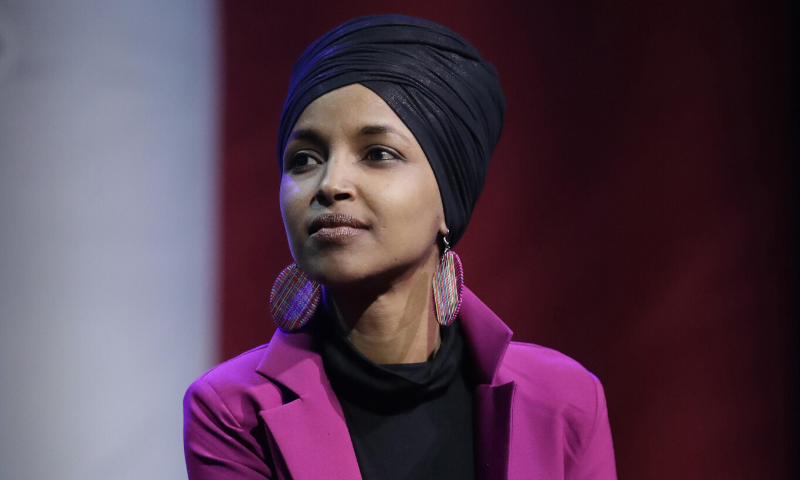
LAHORE: US Congresswoman Ilhan Omar has said that visiting victims of Indian ceasefire violations and “watching them suffer” has made it more important than ever to bring the Kashmir problem to the attention of the US Congress.
When asked about her forthright stance on the issues of Kashmir and Palestine, she responded, “Having visited the Kashmiri people in Azad Jammu and Kashmir (AJK), who nursing gunshot wounds due to ceasefire violations by India, is a great experience.”
She stated that her own experience has made her feel compelled to “speak out for human rights and dignity.”
The US Congresswoman visited the Line of Control (LoC) in AJK and met with a number of top government officials, including the president, prime minister, and cabinet members, as well as political party leaders, during her four-day tour at the request of the Pakistani government.
She also went to Lahore’s Walled City.
“I had not had the opportunity to visit the location in person,” Ilhan remarked, adding that she had always raised Kashmir and Palestine issues in Congress. Meeting the people face to face and asking them how they want to work with me as a legislator and champion for (human) rights was a nightmare.”
When asked if she would discuss the problem in Congress, she stated that meeting the individuals in person and witnessing their suffering made the need to raise the issue in Congress more pressing than listening to others. Ilhan described her own narrative as one of “struggle and success.”
“I was born in Somalia but had to abandon the country due to civil war and resided in Kenya for four years before being sponsored to come to the United States of America with my family” (USA).
“For the past 20 years, I’ve been able to pursue my studies and live in a community of warm-hearted individuals, despite Minnesota’s bitter weather.” In the United States Congress, I represent members of my community.
“I am someone who has been subjected to oppression and violations of human rights since I was a child, and since I have been placed in a position of authority by the people, I believe it is my responsibility to advocate for those who do not.”
Living alongside the disadvantaged and facing economic hardships, those who had not had full access to educational options, and those who were confronted with Islamophobia and racial prejudice, she added, had equipped her to fight for the poor and exploited.
The US lawmaker said the Pakistani diaspora created a strong tie between Pakistan and the US, noting that the two countries’ relations have improved over the last 75 years.
She claimed that the Pakistanis’ entrepreneurial spirit, ingenuity, and concentration on expanding technology and healthcare had helped the Americans.
Many Americans’ first encounters with Pakistanis, she noted, occurred when they encountered them as their doctors and surgeons. She went on to say that the face-to-face meetings solidified equal and mutually beneficial diplomatic connections.
“I have been touched by the goodwill of the political leaders in Pakistan, who set their differences aside and greeted me with open arms during my visit to the federal capital,” the US representative said of her first visit to Pakistan.
She disregarded any bad perceptions about Pakistan that (foreign) visitors might have, claiming that they would be pleasantly surprised to learn how smooth and enjoyable her trip had been.
In response to a query on her visit to Pakistan, Ilhan replied, “I cherished every minute of it.”
The US lawmaker said she was thrilled to find a church, a Sikh temple, and a Hindu temple in close proximity to a mosque when she toured Lahore’s old walled city, which she described as the best example of cultural tolerance.
She stated that visiting Pakistan will assist (foreign) visitors in overcoming their reservations about the country.
Ilhan commended the Pakistani government and people for their kindness, generosity, and hospitality, adding she was treated like a family member throughout her brief visit.
In a message to the Pakistani diaspora in the United States, she stressed the need of their participation in civil society and the electoral process in order to carve out a place in the US political scene. The US representative told the Pakistani girls and women that their youth had infinite possibilities.
Women had to realise their inner potential in order to achieve exterior emancipation; they had to believe in their own abilities, and society would not change unless they were willing to fight for their own and others’ rights.
She advised women from Pakistan’s minorities to participate actively in politics in order to be heard.
