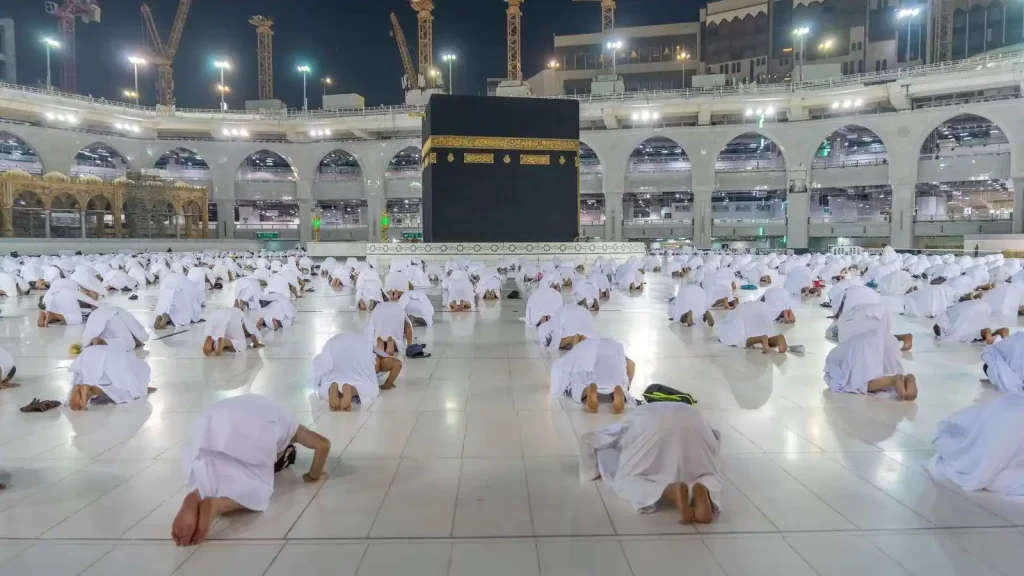
The Saudi government issues new travel advisory for Pakistani Umrah pilgrims.
The Saudi embassy has also notified all Umrah operating agencies and airlines in Pakistan of the new travel advisory.
Under the new rules, Pakistani Umrah pilgrims under the age of 40 will be able to travel to Makkah without the accompaniment of family.
As the Saudi government issues new travel advisory, the new rules also eliminate the requirement for Pakistani women under the age of 40 to travel on the Umrah pilgrimage with a male companion.
The requirement that women travel in groups without male companions has also been lifted.
The ʿUmrah is an Islamic pilgrimage to Mecca (the holiest city for Muslims, located in the Hejazi region of Saudi Arabia) that can be undertaken at any time of the year, in contrast to the Ḥajj, which has specific dates according to the Islamic lunar calendar.
In accordance with the Shariah (Law of Islam), for both pilgrimages, a Muslim must first assume Ihram, a state of purification achieved by completing cleansing rituals, wearing the prescribed attire, and abstaining from certain actions.
This must be attained when reaching a Miqat, a principal boundary point in Mecca, like Dhu ‘l-Hulaifah, Juhfah, Qarnu ‘l-Manāzil, Yalamlam, Zāt-i-‘Irq, Ibrahīm Mursīyah, or a place in Al-Hill. Different conditions exist for air travelers, who must observe Ihram once entering a specific perimeter in the city.
Umrah requires Muslims to perform two key rituals, Tawaf and Sa’i. Tawaf is circling around the Kaaba seven times.
For men, it is recommended to do the first three circuits at a hurried pace, followed by four rounds at a more leisurely pace.
This is followed by Sa’i between Safa and Marwah in the Great Mosque of Mecca, a walk to commemorate Hagar’s search for water for her son and God’s mercy in answering prayers. Pilgrims conclude the pilgrimage with Halq, a partial or complete shortening of the hair.
