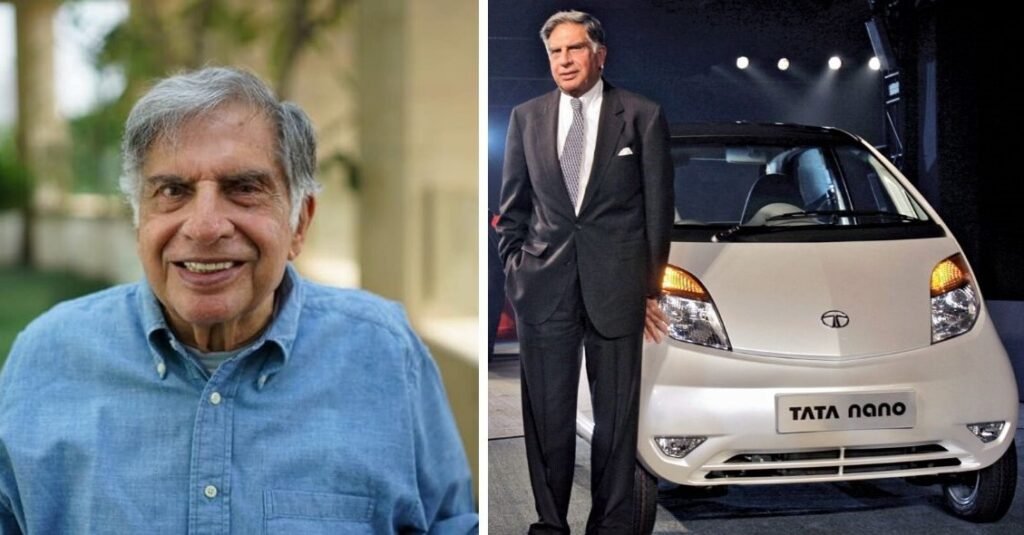
Ratan Tata’s dream project Nano
On a rainy day in November 2003, Ratan Tata, Chairman of Tata Sons, noticed a family of four on a scooter, with the father driving and a young child standing in front, behind the handlebars, and the wife sitting behind him with another child on her lap.
Ratan Tata was moved by this incident and wondered if he could conceive a safe, affordable, all-weather mode of transportation for such a family. After four years, Ratan Tata realized his dream with the launch of the Nano -People’s Car- in Delhi.
“Today’s story started some years ago when I observed families riding on two-wheelers, the father driving a scooter, his young kid standing in front of him, his wife sitting behind him holding a baby and I asked myself whether one could conceive of a safe, affordable, all-weather form of transport for such a family,” Tata said while unveiling Nano in New Delhi.
He said, “This is been referred to as one man’s dream and indeed it was.”
“This singular observation sparked several provocative questions about the possibility of creating an affordable “people’s car”. The two-wheeler observation [with the family of four piled on the scooter] got me thinking that we needed to create a safer form of transport,” Tata was quoted as saying in The Innovator’s DNA – a book written by Jeff Dyer, Hal Gregersen, Clayton Christensen.
Former Tata Sons Chairman Cyrus Mistry on Tuesday called Ratan Tata’s brainchild Nano a loss-making project. He also said that any turnaround strategy for Tata Motors required it to shut it down, but was not done due to emotional reasons.
“The Nano product development required concept called for a car below Rs 1 lakh but the cost was always above this. This product has consistently lost money, peaking at Rs 1,000 crore,” Mistry wrote in his five-page email written a day after he was sacked as the Chairman of Tata Sons.
Ratan Tata made a statement in January 2008, stating that he was aware of a very steep increase in input prices for steel, tyres, and various other sundry inputs, which could lead to an increase in the final price of the car. He went ahead with the initial price of Rs 1 lakh, however, because it was a promise he made to the people.
“Since we commenced this exercise four years ago, we are all aware that there has been a very steep increase in input prices of steel, tires, and various sundry inputs. Bearing all this in mind, I would like to announce today that the standard car will in fact have a dealer price of 1 Lakh only, VAT and transport being extra. Now having said that I just want to say that that is because a promise is a promise and that’s what we would like to leave you with,” Tata had said.
Tata kept his word, but Nano couldn’t. In fact, despite an installed capacity of 2,50,000 cars per year, the Sanand car factory produced only 42,561 cars in the two-year period between January 2014 and December 2015.
Nano sales have been declining since 2011-12 when it sold 74,521 vehicles, but sales dropped to 53,847 vehicles in 2012-13, 21,130 vehicles in 2013-14, and 16,903 vehicles in 2014-15.
Also read: When Ratan Tata criticized Mukesh Ambani’s Antilia worth Rs. 15,000 crores
Earlier in 2014, Tata attempted to reposition the brand from a low-cost microcar to a ‘smart city car’ with the launch of the Nano Twist, but the project failed once more.
Despite Tata’s several attempts to revive the Nano project, including the GenX which had an automatic transmission, the sales never took off.
Ever since Mistry called Nano a loss-making project, many have started questioning Tata’s decision to continue with the production.
However, Maruti Suzuki India Chairman RC Bhargava backed Ratan Tata for his attempts to offer affordable cars to the masses.
“The intention was a good intention and Tatas tried to fulfill that intention. Anyway, we could not have done it. I think he needs credit for having attempted it,” DNA quoted Bhargava as saying.
