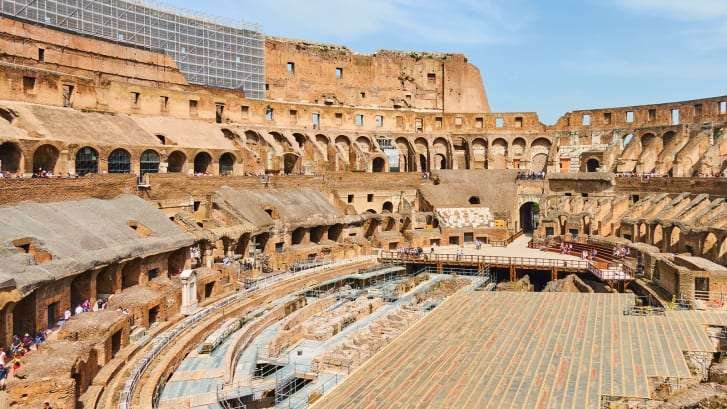
Roman concrete, in many cases, has proven to be longer-lasting than its modern equivalent, which can deteriorate within decades. Now, scientists behind a new study say they have uncovered the mystery ingredient that allowed the Romans to make their construction material so durable and build elaborate structures in challenging places such as docks, sewers, and earthquake zones. How Roman buildings have survived so long?
The study team, including researchers from the United States, Italy, and Switzerland, analyzed 2,000-year-old concrete samples taken from a city wall at the archaeological site of Privernum, in central Italy, and are similar in composition to other concrete found throughout the Roman Empire.
They found that white chunks in the concrete, referred to as lime clasts, gave the concrete the ability to heal cracks that formed over time. The white chips previously had been overlooked as evidence of sloppy mixing or poor-quality raw material. “For me, it was tough to believe that ancient Roman (engineers) would not do a good job because they really made a careful effort when choosing and processing materials,” said study author Admir Masic, an associate professor of civil and environmental engineering at the Massachusetts Institute of Technology.
“Scholars wrote down precise recipes and imposed them on construction sites (across the Roman Empire),” Masic added. The new finding could help make manufacturing today’s concrete more sustainable, potentially shaking up society as the Romans once did.
“Concrete allowed the Romans to have an architectural revolution,” Masic said. “Romans were able to create and turn the cities into something that is extraordinary and beautiful to live in. And that revolution basically changed completely the way humans live.”
Concrete is essentially artificial stone or rock, formed by mixing cement, a binding agent typically made from limestone, water, fine aggregate (sand or finely crushed rock ) and coarse aggregate (gravel or crushed rock). Roman texts had suggested the use of slaked lime (when lime is first combined with water before being mixed) in the binding agent, and that’s why scholars had assumed that this was how Roman concrete was made, Masic said.
With further study, the researchers concluded that lime clasts arose because of the use of quicklime (calcium oxide) the most reactive, and dangerous, dry form of limestone when mixing the concrete, rather than in addition to slaked lime. Additional analysis of the concrete showed that the lime clasts formed at extreme temperatures expected from the use of quicklime, and “hot mixing” was key to the concrete’s durable nature.
“The benefits of hot mixing are twofold,” Masic said in a news release. “First, when the overall concrete is heated to high temperatures, it allows chemistries that are not possible if you only used slaked lime, producing high-temperature-associated compounds that would not otherwise form. Second, this increased temperature significantly reduces curing and setting times since all the reactions are accelerated, allowing for much faster construction.”
How Roman buildings have survived so long? For many years, researchers had thought that volcanic ash from the area of Pozzuoli, on the Bay of Naples, was what made Roman concrete so strong. This kind of ash was transported across the vast Roman empire to be used in construction and was described as a key ingredient for concrete in accounts by architects and historians at the time.
