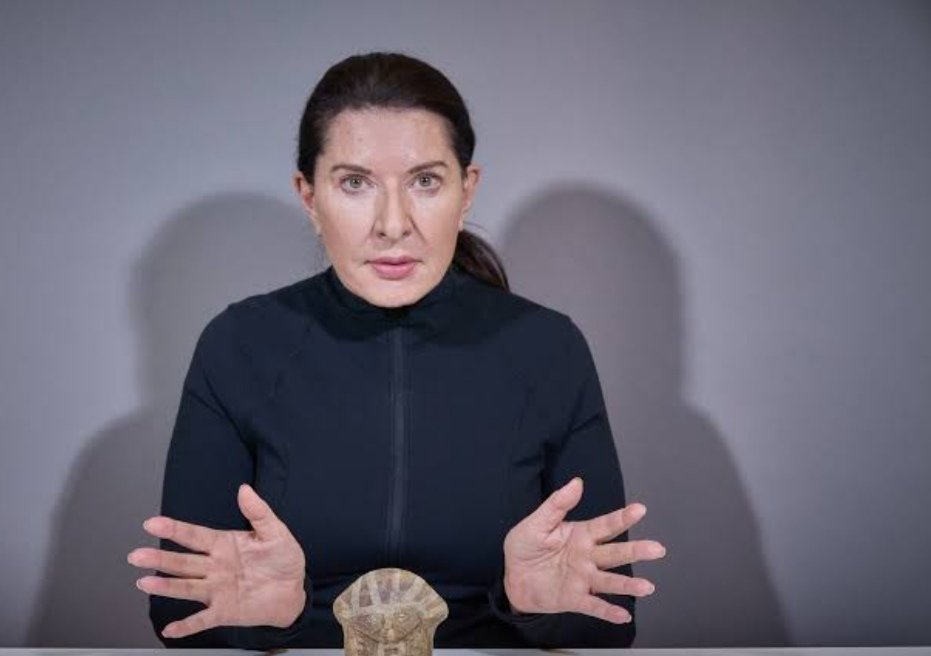
What does Marina Abramovi’s Law of Life, aloneness & silence say?
“An artist should stay and gaze at the stars in the night sky for a long time.”
In his magnificent reflection on what it really means to be an artist, E.E. Cummings wrote, “The Artist is no other than he who unlearns what he has learned, in order to know himself.” But if, as the great artist Ben Shahn claimed, “all art is based upon nonconformity,” and if letting go of our cultural conditioning is crucial to the creative process, then why do we have such a voracious appetite for the writings, daily routines, and manifestos of renowned artists?
That tension between guidance and rebellion is what Marina Abramović (b. November 30, 1946) plays with in a piece titled “An Artist’s Life Manifesto,” which opens the twelfth chapter of Walk Through Walls — the magnificent memoir that gave us Abramović on art, fear, and taking risks.
The manifesto is divided into three parts — an old-fashioned list of rules of personal conduct, the kind which artists like Eugène Delacroix and André Gide kept in their diaries in the nineteenth century; a portion devoted to the artist’s relationship with silence, that ennobler of speech and fertilizer of the imagination; and a section dedicated to the relationship with solitude, that seedbed of self-discovery and supreme fuel for creative work.
What does Marina Abramovi’s Law of Life, aloneness & silence say?
To be sure, the manifesto itself bears the characteristic fusion of sincerity and subversion that marks Abramović’s work — although the tenets are rooted in the earnestness of her own experience, it is an undeniable contradiction for an artist who has spent half a century defying the dogmas of art by inventing new forms to prescribe a set of dicta for artists to follow. Out of that deliberate contradiction arises a testament to philosopher Jacob Needleman’s abiding assertion: “There is always something more than two opposing truths. The whole truth always includes a third part, which is the reconciliation.”
Abramović writes:
AN ARTIST’S CONDUCT IN HIS LIFE:
An artist should not lie to himself or others
An artist should not steal ideas from other artists
An artist should not compromise for himself or in regards to the art market
An artist should not kill other human beings
An artist should not make himself into an idol
An artist should avoid falling in love with another artist
AN ARTIST’S RELATION TO SILENCE:
An artist has to understand silence
An artist has to create a space for silence to enter his work
Silence is like an island in the middle of a turbulent ocean
AN ARTIST’S RELATION TO SOLITUDE:
An artist must make time for the long periods of solitude
Solitude is extremely important
Away from home,
Away from the studio,
Away from family,
Away from friends
An artist should stay for long periods of time at waterfalls
An artist should stay for long periods of time at exploding volcanoes
An artist should stay for long periods of time looking at fast-running rivers
An artist should stay for long periods of time looking at the horizon where the ocean and sky meet
An artist should stay for long periods of time looking at the stars in the night sky
What does Marina Abramovi’s Law of Life, aloneness & silence say?
During our recent public conversation in San Francisco, Abramović shared three more life-rules she borrowed from her dear friends Lou Reed and Laurie Anderson:
1. Have a good bullshit detector.
2. Fear nothing and no one.
3. Be tender.
