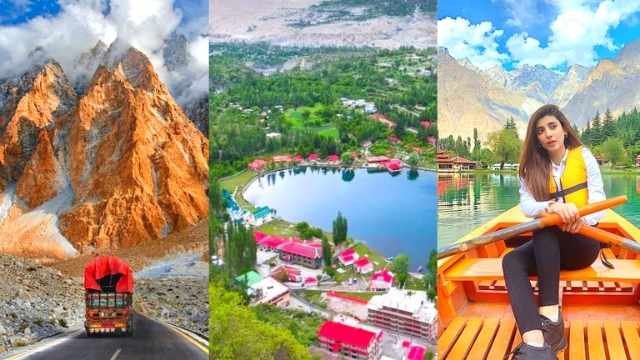
Gilgit-Baltistan (GB) formally commemorates its independence from the Dogra family’s reign in Kashmir on November 1. As a result of a violent freedom fight, Gilgit was liberated on November 1, 1947, and Baltistan was liberated in 1948.
Gilgit Baltistan residents have never agreed to be a part of the disputed state of Jammu and Kashmir, over which Pakistan and India have been at odds since their independence in 1947, despite protests from India and even some Kashmiris, and despite the fact that it appears on Pakistani maps as a part of a region whose status is still up for debate. In order to comprehend why it is helpful to consider the past.
Present-day Great Britain was a part of the State of Jammu and Kashmir, one of the biggest princely states in India, before it attained independence. Following the signing of a treaty between the British and Gulab Singh of the Dogra dynasty, this state was established in 1846.
Gulab Singh, who presided over Jammu as the king of the Sikh empire during the first Anglo-Sikh war (1845–1846), decided to support the British East India Company by remaining neutral. The East India Company sold Singh Kashmir in 1846 for 7.5 million then-current rupees as a token of appreciation for his faithfulness during the conflict. Gulab Singh subsequently became the first Maharaja of Jammu and Kashmir thanks to this agreement.
The province of Jammu, the province of Kashmir, the district of Gilgit, and the district of Ladakh made up the princely state of Jammu and Kashmir. Before the Treaty of Amritsar, in 1840, Gulab Singh’s Dogra army conquered and annexed what is now known as Baltistan. Baltistan was included in district Ladakh as the Skardu tehsil under the new administrative structure.
Recognizing the geostrategic significance of this territory and anticipating a potential Russian invasion from Central Asia, the British intervened directly and established the “Gilgit Agency” to take control of the region. Beginning with this, Gilgit was under combined British and Dogra authority. While military and security affairs were given to the British Indian Government’s direct supervision, civil administration remained under the control of the Dogra kings.
The British Indian Empire’s primary objective was to secure its northern frontier. The Gilgit Scouts are a local paramilitary group that was established and given that name by the British. Under a 60-year lease, the British took over the Dogra ruler’s control of the Gilgit Agency in 1935. The Baltistan region, however, continued to be directly ruled by the Dogras.
The British abruptly terminated the lease two weeks before India and Pakistan gained their independence. Major General Scott, the British army’s top commander in Kashmir, arrived at Gilgit on July 30, 1947. Brigadier Ghansara Singh, a governor appointed to Gilgit by the Maharaja of Kashmir, accompanied him. According to the leasing agreement, the British offered to give Gilgit to the State of Jammu and Kashmir. Brig Ghansara Singh succeeded Col. Roger Bacon, a British political agent, as director of the Gilgit Agency on August 1. The region came under the Maharaja’s rule once the Union Jack was taken down.
The complexity of GB’s predicament stems from the fact that, despite 75 years of independence, it has yet to succeed in its goals. The British people fervently celebrate their independence each year. The battle to include the area in Pakistan goes on, though.
Various Pakistani administrations have attempted in the past to control GB concerns through reforms and executive measures. The area recently gained new attention after the federal government revealed plans to grant GB provincial recognition. It appeared that GB had finally decided to integrate with Pakistan. The crucial question, though, is whether the Pakistani government can make this audacious move and include Great Britain in Pakistan’s constitution rather than issuing another executive order.
