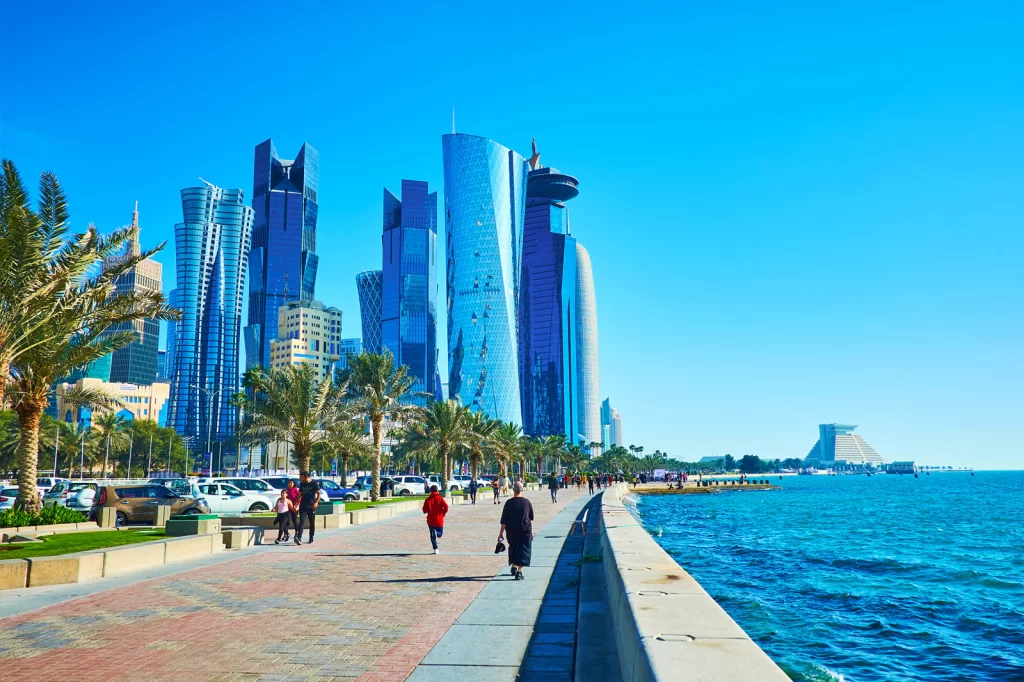
A crucial US partner in the Middle East, oil- and gas-rich Qatar is famous for hosting the World Cup of football. In the Middle East, where it is located, Qatar, which is hosting the World Cup of football, is a crucial US partner.
The following five facts concerning the barren peninsula:
1. Small but mighty
With a population of 2.9 million, the majority of whom are foreign workers, Qatar is one of the smallest Arab countries.
Up until 1971, the nation was a British protectorate.
Since the middle of the 19th century, it has been governed by the Al-Thani family, a monarchy. After his father, Sheikh Hamad bin Khalifa Al-Thani, abdicated in 2013, Sheikh Tamim bin Hamad Al-Thani became the new emir.
In October 2021, the nation’s first-ever legislative elections were held. One of the 45 seats in the Shura Council was not secured by any of the 26 female candidates.
2. The Shard’s owner
One of the biggest producers and exporters of liquefied natural gas worldwide is Qatar.
The World Bank estimates that its per capita GDP will be $61,276 in 2021, making it one of the highest in the world and 2.5 times Saudi Arabia’s.
One of the largest sovereign wealth funds in the world, the Qatar Investment Authority, has lavishly spent to acquire important landmarks and luxury brands in Europe, such as Britain’s Harrods department store, London’s Shard skyscraper, and France’s Balmain fashion firm.
3. Conflict with Saudi
Between June 2017 and January 2021, Qatar survived a serious diplomatic crisis and a three-and-a-half-year blockade by its Gulf neighbours with only minor economic harm.
Since the pro-democracy uprisings of the Arab Spring, which Doha had backed but other Gulf rulers had not, tensions had been building.
Saudi Arabia, the United Arab Emirates, Bahrain, and Egypt severed ties with Doha after accusing it of fostering close ties with Iran, a regional rival, and supporting terrorism. Doha refuted these accusations.
In exchange for ending its isolation, Riyadh and its allies made a number of demands on Qatar, including that it shut down Al Jazeera, a groundbreaking pan-Arab news channel that was charged with acting as a megaphone for the Arab Spring protesters, and stop economic cooperation with Iran.
Under pressure from the US, which views Saudi Arabia and Qatar as important friends, Qatar rejected the demands and endured the blockade, which was eventually lifted.
4. Splurging lavishly on Neymar
Qatar has invested billions of dollars in both domestic and international sports, acquiring Paris Saint-Germain, the top football team in France, in 2011. Neymar, a Brazilian, was famously purchased for a staggering 222 million euros in 2017.
The first-division club KAS Eupen in Belgium is also owned by Qatar Sports Investments (QSI), and on October 10 it was revealed that QSI would purchase roughly 22% of Sporting Braga in Portugal.
In an effort to improve its image internationally, the Gulf state has hosted a number of international sporting events, including the Asian Games in 2006, the Asian Cup of Nations in 2011, and the world athletic championships in 2019.
5. Rights were skewered
Since Qatar unexpectedly won the bid to host the World Cup, attention has been focused on its record on human rights, notably how it treats migrant labour.
Reports of several fatalities and injuries at Qatar’s massive building sites, which the Qatari government has vehemently disputed, together with allegations of punishing work hours, appalling living conditions, and workers being deported for protesting unpaid salaries have stirred up controversy.
In response to the criticism, the Qatari government implemented a minimum salary, scrapped a programme that provided companies tight authority over workers, and tightened regulations on working in the summer heat.
