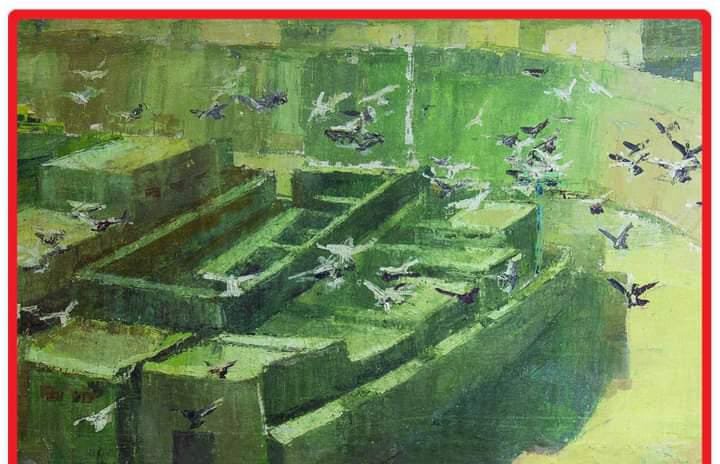
The shadows combine, one on top of the other, warm in their deepening hues, forming and sculpting a mauve presence with earthier tones. They have a close and personal impact on the landscape, quietly evidencing the lives they hold with their firm presence.
The shadows cast by Mussarat Mirza’s canvases—permeable, breathing shadows that appear to attest to a living presence in a process and continuity. The soft, black layers of the shadows were kept apart by the suffused light that was forcing its way in from a vantage point. Canvases by Mussarat Mirza depict actual experiences rather than landscapes.
The environment she creates is an interior testament to an exterior reality because it is devoid of humans. She was born in Sukkur, Sindh, and still resides and works there. A room’s interior, an alley between mud-walled homes, an abandoned flight of stairs, a silent hallway, a corridor, and the tops of distant mud-covered rooftops are all examples of spaces that are illuminated but suspended in the dust. Her art is a testament to her close connection to the earth, which is not only shown in it but also reflected in her relationship with it. a strong bond that resists the subject matter while remaining firmly anchored in it.
The inner sight, the palpable bodily presence that holds the fleeting, registers the supreme beauty of her creations. The mystery, silence, and warmth of their creation are suspended in the breath that remains suspended in her painting, the wonder, reverence, and majesty of which they invite.
Mussarat Mirza has shunned the established art scene in favor of residing in Sukkur and teaching at the University of Sindh Jamshoro. An encounter with a way of life that still depends on the land for sustenance, where the cyclical nature permeates the rhythm of life and the diurnal rhythm holds sway, where the ebb and flow of life is accepted with patience and surrender at a greater mystery that unfolds over the land that holds the bounty and income of people in its grasp. A humility resulting from being in close proximity to a place with the ability to bestow blessing or withhold it, a witness to a far bigger power that is uncontrollable and untamed by man and is older than time.
She incorporates this acceptance and surrenders it throughout her work. The lack of definition is replaced by a strong presence, the layered shadows highlight the space, and the dim light acts as a lighthouse. It seems as though the mystery of life is still hidden in the shadows, with the varying light showing some things and concealing others while still remaining a beacon that is always just out of reach.
Her mauve and earth tones are used to create delicate yet substantial spaces and buildings. as observers of life’s continuity and progression. Being raised by a father who valued the arts, he fostered and supported Mussarat Mirza’s artistic proclivity. And the faith that cultivated her talent manifests in her paintings as one generation gives way to the next. It manifests as the potent unseen force that upholds belief in the invisible. Potential is always a promise, a bet, or a blossom waiting to open; the only thing that can give it the nourishment and care it needs is trust. a gift passed down from one generation to the next, from its beginning to its conclusion. Her work exudes a strong sense of presence and a belief in a personal awakening and inner light. When a seed is sown, a slow, painstaking process sees it through to growth and fruition. This slow, painstaking process is witnessed by the walls, corridors, and stairs.
Much like the light that controls the daily cycle of life, her canvases develop as they are viewed. As night gives way to day, light gently permeates the pitch-black depths of the night and illuminates them. And as the day intensifies and the sun rises higher in the sky, it casts a dazzling midday brightness that rules over everything, making the shade and shadow of buildings a welcome haven. Until the sun starts to cross the meridian and the shadows start to grow longer. Mussarat Mirza has a close relationship with this light, depicting it on her canvases with an ease that belies the sensitivity with which she captures this aspect. The canvases in the body of work on display at the Koel Gallery span nearly five decades from 1968 to 2021 and share the same rich, expressive character. However, the deceptively straightforward nature of the diurnal cycle necessitates observation of a reality that calls for comprehension and resilience in the face of life’s uncertainties. a level of comprehension that enables trust, faith in life, a sense of belonging, and a connection to all of its components.
Few artists are able to captivate the audience with such depth that the viewer is enthralled in the exploration of the alleyways as a physical exploration and as a communion with the ephemeral quality of the land that the artist imbues in her work, a quality of universal values that hold sway in their gentle permanence, much like the light that the artist skillfully crafts as a metaphor and as a seductive beacon.
From August 27 to September 27, 2022, the Koel Gallery will host Har Ja Tu: In the Realm of Light, a retrospective exhibition of Mussarat Mirza’s paintings from 1968 to 2021, which was organized by Maha Malik.
