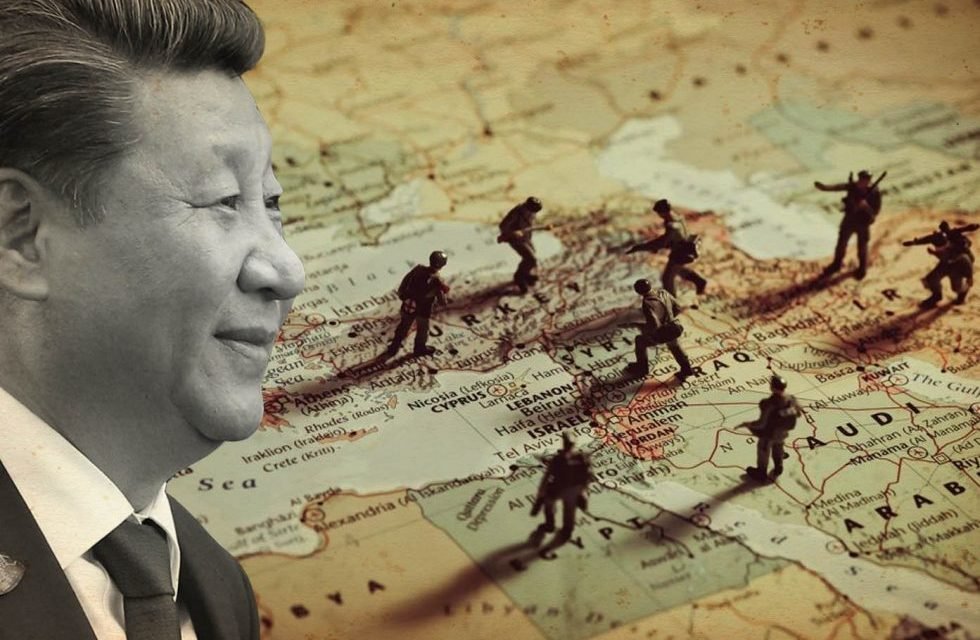
Since the early 1900s, the U.S.A has been enjoying its status as a global superpower. In the past 100 years or so, the country’s economic power has grown exponentially along with its influence on various countries. Many have tried to dethrone the US from its seat of power, but all in vain. No single nation has been able to replace America as the new global superpower. Until now. And this nation is undeniably China.
China gained its independence in 1949 and since then, it has done nothing but grown not only economically but also militarily. Mao Zedong, leader of the Communist Party and the People’s Republic of China (PRC) provided the stepping stones for China to emerge as a modern country. He implemented many social and economic changes such as ‘The Great Leap Forward’ which collectivized agriculture and industrialized China and the ‘Cultural Revolution’ under the hat of which Mao incited Chinese citizens to break free from Imperialist and Bourgeoise elements in society. However, both of these reforms did more harm than good as they caused famine, self-imposed civil war, and state-led human extermination. In 1976, Mao Zedong died and a power struggle took place. The victor was Deng Xiaoping. Deng completely abandoned Mao’s policies and implemented new, radical changes. He introduced Capitalism and Socialism while also opening China to the international community. Farmers were now allowed to cultivate their own land; entrepreneurs were allowed to start businesses and foreigners were allowed to invest. During Deng’s government, China’s GDP increased from $149.5 billion to $347.8 billion which is an approximate 57% increase.
In 1993, Jiang Zemin, a prominent Chinese politician became the president of the PRC. He reduced state ownership of over 300,000 industries and issued a privatization plan in 1997. In 2001, China entered the World Trade Organization (WTO). This ushered in a new, prosperous era for China. Tariffs on exports and imports were reduced and multinational companies flocked to China, which led to the PRC becoming the manufacturing hub of the world. And that was the turning point for China’s economy. In 2003, Hu Jintao succeeded Zemin as president of the PRC. Under Jintao’s regime, China saw its economy grow drastically. The economy grew 75% in his first term and per capita income almost doubled from $1000 to $2000. Jintao managed to avoid an economic crisis in 2009 and he greatly improved relations with Taiwan and the international community. 2 reporters from the New York Times had commented on China during Jintao’s government, “China had become a $5 trillion industrial colossus, a growing military force, and, it sometimes appears, a model of authoritarian decisiveness, navigating out of the global financial crisis and sealing its position as the world’s fastest rising power.”
In 2013, Xi Jing ping became the president and paramount leader of China. He is perhaps the most powerful Chinese leader since Mao Zedong himself and has been ranked as the world’s most influential man by Forbes in 2008. The two main areas that Xi has diverted his attention to are trade and the military. One major initiative that Xi Jinping has undertaken is the One Belt One Road (OBOR) system. The OBOR is a globe-spanning plan with the purpose of strengthening trade, infrastructure, business, and investment links between countries. The ‘road’ refers to maritime shipping routes running from China to Southeast Asia, Central Asia, South Asia, the Middle East, and even Europe. The ‘belt’ on the other hand refers to overland routes stretching from China, through Central Asia, all the way to Europe. An estimated 65-80 countries are part of this plan. Together, these countries account for more than 30% of the world’s GDP, 62% of the world’s population, and 75% of known energy reserves. Due to the OBOR, China has been able to extend its influence over many countries, perhaps even more than the U.S. Furthermore, China has a grasp on virtually every industry. This includes real estate, power, consumer electronics, hotels, sports, mining, and tourism.
Elon Musk has also commented on China’s rapid economic growth. “A thing that will feel pretty strange is that the Chinese economy is probably going to be at least twice as big as the United States’ economy, maybe three times. If you have half the resources of the counter-party then you better be really innovative, if you’re not innovative, you’re only going to lose. It would only require getting to a GDP per capita half the size of the United States for their economy to be twice the size of ours.” The GDP of China in 2020 was 14.7 trillion, compared to 20.94 trillion of the U.S.A. However, China’s exports are already stumping those of the U.S and they are only bound to grow. As for the military, Xi Jinping has focused on not only weapon development but also troop training and intelligence. It has produced and tested various missiles, planes, and ships that compete with the world’s best armies. In conclusion, by 2030, China will have cemented itself as the global superpower. Statistics prove that it would have the largest economy, most political power, and highest influence.
