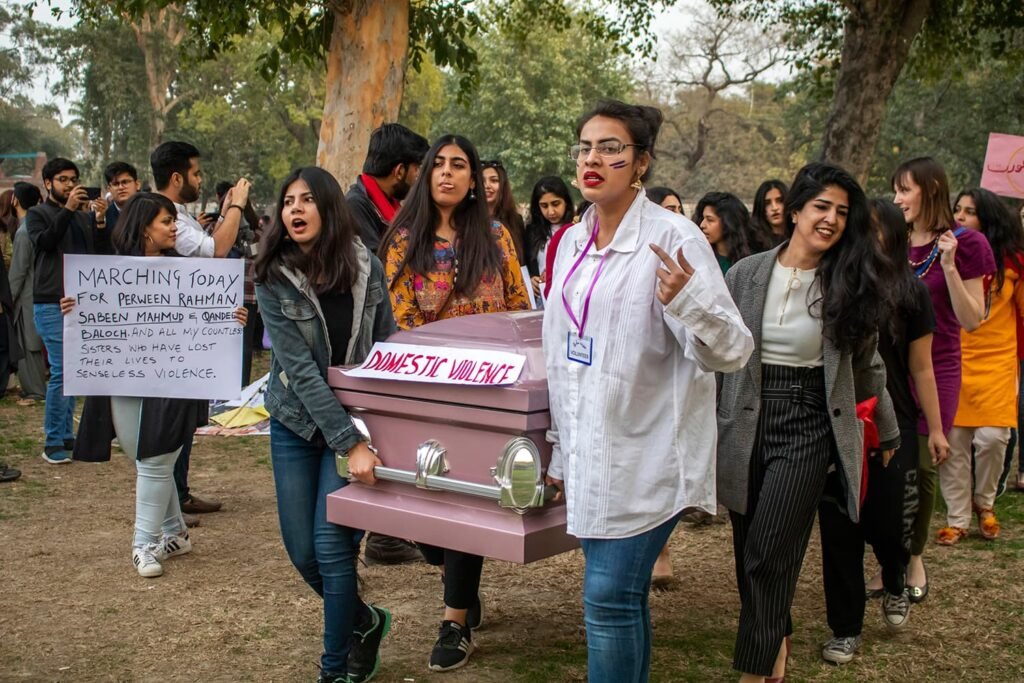
If you ask someone in the country a question about what is feminism. The most probable answer would be it’s a shameful act and it’s a word an idea developed by infidels to misguide the ummah’s women. I don’t agree, for me, feminism is an economic and political system where women get equal rights compared to men, may it be in work, pay, rights, or in society in general. In feminism, there is a need for an economic system where men and women are equally paid per their work. Meaning in certain places, a male person is paid more than a female for the same work or service, which to be quite honest isn’t fair. But for the most part, it is the women’s job to choose the correct career for their selves, meaning there are no brick workers in Pakistan, the country’s culture does not allow it. It is for the most part a very western problem (Equal Pay). Countries like the United States, the UK, and some European countries are overcoming these barricades.
In Pakistan, a South Asian Muslim country, Feminism has a quite new and different approach, here feminism is not about equal pay, and equal rights but is complicated by them even more. It became the main tool for liberals’ and rightists’ war on social media to defend their opinions and degrade others. They (Feminists of Pakistan) think that women are treated as slaves. But in Pakistan People have a lot of respect for women. Working women are cheered, and celebrated in this society, Most Pakistani young women do jobs, respectful and gallant jobs. Since 2018 on women’s day the so-called feminists of Pakistan do an “Aurat March” to protest gender violence and claim their rights: Their slogan “Mera jism Meri Marzi” which I would describe as Laughable, absurd, diverting, and chucklesome. They arrange these marches for women to be liberated, woke, and get the so-called “Azaadi” (freedom) from the Alpha-males.
The Aurat March’s main slogan is that they will do and can do anything with their body as they wish, which is in opposition to the socio-cultural and religious values of the country and the teachings of Islam itself. In the coming Aurat March these slogans had other variations such as Meri Zindagi Meri Marzi ( My life, my choice), Meri Zindagi Mere Faisalay (My life, my decisions),Meri Zindagi Mera Ikhtiyar ( My life, my discretion), Mera Mazhab Meri Marzi 9 My religion, my choice), Mera Wajood Meri Marzi (My existence, My choice), Mera Poster Tumhari Marzi ( My poster, your choice?). Slogans like Nazar teri gandi aur purdah mein keroun (Why do I adopt veil cause of your bad habit of ogling), Agar dupatta itna pasand hai tou apni aankhon pe bandh lo (If you like a scarf this much then tie it on your eyes), Tu kare tou Stud, Mai Karun tou Slut (If you do it then Stud but If I do it then Slut), Khana khud garam karo (Ready the food yourself) of Aurat March were highly criticized by the religious right in Pakistan as they were thought to be in nonconformity with the societal and ethical values in the country. It was termed vulgar by clergy and a panel by National Assembly called it Immoral.
The Pakistani feminists didn’t address the real women issue but rather shameless, immoral, overt, and brash propaganda in a Muslim country where women are respected. In their Aurat March, they dance in front of hundreds of people, for what? You ask, for Liberalism their answer. The idea of feminism in Pakistan is in itself is unfounded, they want a problem to be solved which doesn’t exist, what they want is unrealistic. It was also debated on national media with rights activists vouching for it and clergy calling it un-Islamic. Clergy oppose feminist slogans, including “my body, my choice,” as such attitudes contradict a fundamentalist belief that humans do not have autonomy over their bodies. If it were for equal rights, the Pakistani people would have supported the movement, but the main objective is neither in the interest of the public nor the states. It conflicts with religious norms.
For people like them. I always recall poetry by Dr. Allama M. Iqbal (RA) – from Bang-e-dara, Tehzeb e-Hazir. (The present civilization).
نئے انداز پائے نوجوانوں کی طبیعت نے
یہ رعنائی، یہ بیداری، یہ آزادی، یہ بے باکی
تغیّر آگیا ایسا تدبّر میں، تخیّل میں
حیاتِ تازہ اپنے ساتھ لائی لذّتیں کیا کیا
رقابت، خودفروشی، ناشکیبائی، ہوسناکی
فروغِ شمعِ نَو سے بزمِ مسلم جگمگا اُٹھّی
مگر کہتی ہے پروانوں سے میری کُہنہ اِدراکی
“تو اے پروانہ! ایں گرمی ز شمع محفلے داری
چو من در آتشِ خود سوز اگر سوزِ دلے داری”
The views expressed in this article are the author’s own and do not necessarily reflect The Asian Mirror’s editorial policy.
