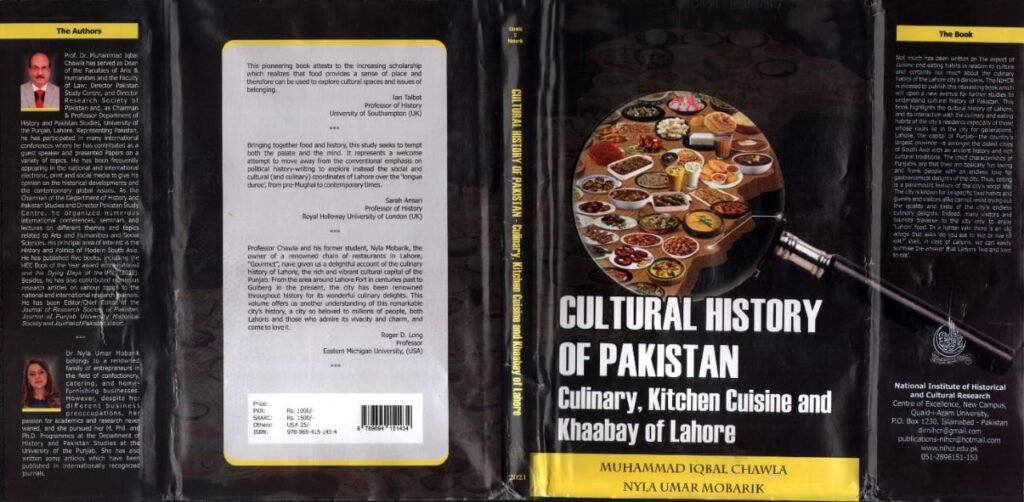
Lahore is known for exotic cuisine and Lahoris are known as great eaters of rich foods. Foods are produced and consumed worldwide but why have Lahoris developed a particular reputation in this regard? “Cultural history of Pakistan (culinary, kitchen and khaabay of Lahore)’’ co-authored by Professor Dr. Muhammad Iqbal Chawla, a former Dean of Social Sciences and ex-Chairman of the History Department at the Punjab University and Nyla Umar Mobarik attempts to answer these and related questions.
To have “more’’ is rooted in the etymology of Lahore which means ‘’La hore’’ (bring more). Its reputation as a city of “high culture’’ first developed in the times of the Great Mughals as the historical accounts of those times compared this city with Constantinople and unrivaled in wealth and cultural finesse with any city of Asia and Europe; no wonder Abul Fazl termed it as ‘’the great resort of people of all nations.’’ This reputation of Lahore was further strengthened by the romantic European writers, in particular Thomas Moore and Rudyard Kipling, who were enchanted by the city’s fanciful architecture, colorful crowds and exotic customs.
Lahori khaabays include dishes such as pulao, biryani, nihari, hareesa, qorma, etc. Interestingly, these are not indigenous dishes of this city rather they were imported from Central Asia and Persia, particularly when Mughal Emperor Humayun returned from exile in Persia. All khaabas are meat-based dishes, however, Lahoris being inhabitants of hot climates prefer to cook their khaabas in mutton which generate less heat than beef, the latter being the preferred choice of the people living in the colder regions. The khaabas are rich in ghee because the Lahoris regard ghee as the best source of energy, a popular saying among them in this regard is ’jo kare gheo, na kare ma te na kare peo’ (no mother or father can do for you what ghee can).
The eating habits of Lahoris went through a change with the opening up of restaurants in the colonial era. Those who began to dine out were frowned upon as “sharabi kababis’’ (the consumers of alcohol and meat). It was not entirely untrue because some of these restaurants did serve a bottle of beer for less than a rupee and a peg of whisky for just sixty paisas. By the end of the 1930s, the Standard restaurant on the Mall ushered in a ‘’tea revolution’’ whereby for a “princely sum’’ of one rupee and twenty-five paisas one could drink as much tea and eat as many pastries and sandwiches as one liked. It will not be out of place to mention that there were no tea shops in the early 1930s and the city dwellers were hooked to this drink by a tea company that distributed free tea with rusk and kulchas. On the heels of tea appeared the first ice cream parlor at the Carry Home restaurant on the Mall, however, the honor of introducing a high-quality ice cream HICO (Happy Ice Cream Company) goes to an Iranian named Mohsin Shirazi who is also credited for introducing the first international soft drink Coca Cola in Lahore.
No account of the cultural history of the city can be complete without a mention of its intellectual class which gathered at the Tea House and Coffee House. While the Tea House was a haunt for the poets and writers, the Coffee House was a hub for journalists, artists, lawyers, and politicians whereas some poets like Munir Niazi and Nasir Kazmi frequented both places. While the Tea House was dimly lit and served in poor crockery, the Coffee House had a pleasant ambiance where a cup of coffee cost just twelve paisas. Notable Pakistani historian K.K Aziz, who frequented the Coffee House both before and after the partition has noted that he met more Leftists in the Coffee House than in the office of the Communist Party at McLeod Road.
While the intellectuals reveled in the smoky and steamy atmosphere of these places, the political elite of the Punjab province got together with their “Gora Sahibs’’ in the Gymkhana Club at the Lawrence Garden that provided all the facilities of a high-class English club. Although the most influential natives could become its members, some “Goras” had reservations about “mixing freely with the natives’’ so a prestigious exclusive “Gora Club”—the Punjab Club—was set up on the Mall for the high ranking full-bred British. Those Lahoris who could not dine at Gymkhana, could visit the Shezan restaurant managed by a Russian lady Maisie, who introduced the Gymkhana dining decorum in the restaurant serving breadsticks before meals, Pomfret with tartar sauce, Russian salad, etc. Later on, Shezan once presented such a lovely cake on the model of the Shalimar Garden to the visiting Iranian King Reza Shah Pahlavi that he insisted on visiting the Shalimar Garden after the party.
Eating out which was frowned upon earlier on became a popular activity after the 1960s. It received an impetus with the opening of Chinese restaurants after the Bhutto era. With the coming of the remittances from the migrant labor in the Middle East, a shift from agro to the commercial centric economy, and growing urbanization, the wealth of the Lahoris increased that in turn created a greater demand for new restaurants and hence more investment in the food industry. The authors need to be credited for researching a new subject because though there are several books on cultural history yet hardly anyone deals in depth with the food habits of the Lahoris from the Mughal to the present times.
Cultural history of Pakistan
by Muhammad Iqbal Chawla and Nyla Umar Mobarik
Published by National Institute of Historical and Cultural Research
1000pp.
